Español
 Português (Brasil)
 Français
 Deutsch
 Italiano
 Nederlands
 Polski
 Svenska
 Türkçe
 Русский
 日本語
日本語 한국어
한국어 简体中文
简体中文 Tiếng Việt
 Bahasa Indonesia
 繁體中文
繁體中文 Čeština
 Dansk
Dansk Norsk (bokmål)
 Suomi
Suomi Ελληνικά
 Română
 Magyar
 Українська
 ไทย
ไทย हिन्दी
 العربية
 עברית
עבריתRevcontent Ad Approval: Content Rules & Rejection Fixes
Most Revcontent ad rejections come down to a small set of recurring problems, exaggerated before/after imagery, missing disclosure language, or a landing page that doesn't match the ad. Here is how to fix them.


Revcontent ad approval rejections most commonly trace back to a small set of recurring issues: exaggerated or misleading imagery (especially before/after style claims), missing or inadequate disclosure language on advertorial-style creative, and landing pages that do not match what the ad actually promises. Fixing a rejection is usually faster than appealing it, because the review teams across every major native network apply broadly similar standards and rarely reverse a decision without a genuine creative change.
Revcontent's own review process is not fully public in detail, which is standard across native networks, but the pattern of what gets rejected is consistent enough across advertiser experience and the creative that actually survives review to be worth documenting clearly.
The most common rejection reasons#
- Exaggerated or manipulated imagery. Before/after transformation images, especially in health, beauty and nutra verticals, get flagged when the transformation looks physically implausible or when there's evidence the images have been digitally altered beyond normal editing. This is the single most common rejection reason reported across health and beauty advertisers on Revcontent and comparable networks.
- Missing or weak advertorial disclosure. Ad creative styled to look like editorial content (a common and generally allowed native ad format) still needs to be identifiable as advertising. Ads that blur this line too far, with no "sponsored," "advertisement," or equivalent label, are a frequent rejection or takedown trigger. Our guide to FTC disclosure rules for advertorials covers the regulatory baseline that sits underneath every network's own policy on this.
- Landing page mismatch. If the ad promises a specific claim, price, or offer that the landing page does not actually deliver, or routes through a bridge page that obscures the real destination, that mismatch is a rejection reason on its own even if the creative itself would otherwise pass. Networks increasingly check the destination, not just the ad unit.
- Prohibited claim categories. Certain health claims (curing specific diseases, guaranteed weight loss amounts, miracle-cure framing) and certain financial claims (guaranteed returns, no-risk investment language) are broadly restricted across native networks, Revcontent included, regardless of how the creative is otherwise structured.
- Trademark or brand impersonation. Using a recognizable brand name, logo, or a public figure's likeness without authorization in ad creative is a common rejection trigger, and increasingly a takedown trigger even after initial approval if it's caught later. Our trademark infringement guide covers how this shows up in native specifically.
How to fix a rejected ad without starting over#
- Read the specific rejection reason, not just the rejection. Most networks provide at least a category-level reason. If the rejection cites imagery, the fix is the image; if it cites the claim, the fix is the copy. Changing the wrong element wastes a resubmission cycle.
- Tone down the imagery before you tone down the copy. Because manipulated or exaggerated imagery is the single most common rejection reason in health and beauty specifically, swapping a dramatic before/after image for a more moderate lifestyle or product-focused image often clears review without touching the headline at all.
- Add explicit disclosure language if your creative is advertorial-styled. A visible "Sponsored" or "Advertisement" label, even a small one, resolves the disclosure category of rejection in most cases without requiring a full creative rebuild.
- Verify your landing page actually matches your ad claim before resubmitting. This is worth checking even if you're confident it already does, because landing pages get edited by other team members or by affiliate networks pushing updated offers, and a mismatch that develops after your ad was originally approved can trigger a later takedown.
- Check current network documentation for your specific vertical, since claim restrictions in health, finance and nutra shift periodically and a claim that was fine six months ago may not be now.
How the review and resubmission cycle usually works#
Native ad review on Revcontent and comparable networks generally runs through an automated first pass, checking for obvious policy violations like prohibited claim language or flagged image characteristics, followed by human review for anything the automated pass doesn't clearly resolve either way. Turnaround times are not officially published and vary with review volume, so build a buffer into your launch timeline rather than assuming same-day approval, especially for creative in higher-scrutiny verticals like health and finance.
A few practical notes on resubmission:
- A rejected ad can usually be edited and resubmitted directly rather than requiring a brand-new campaign setup, which saves setup time versus starting over.
- Repeated rejections on the same account, even across different campaigns, can affect review speed or scrutiny level going forward. Getting the fix right the first time, rather than resubmitting the same creative with a minor tweak and hoping, tends to produce better outcomes over a longer account history.
- An approved ad is not permanently approved. Networks can and do take down previously approved creative if a landing page changes, if enforcement standards tighten, or if a pattern of user complaints develops. Treat approval as a snapshot in time, not a guarantee.
What survives review: studying live creative#
Rather than guessing at the boundary of what Revcontent will approve, the more reliable method is looking at what creative is actually live and has been running for a while in your vertical right now. A creative that has survived multiple weeks of observation has, by definition, cleared both the initial review and any ongoing compliance check, which makes it a useful reference point for tone and claim intensity even if you would never copy it directly.
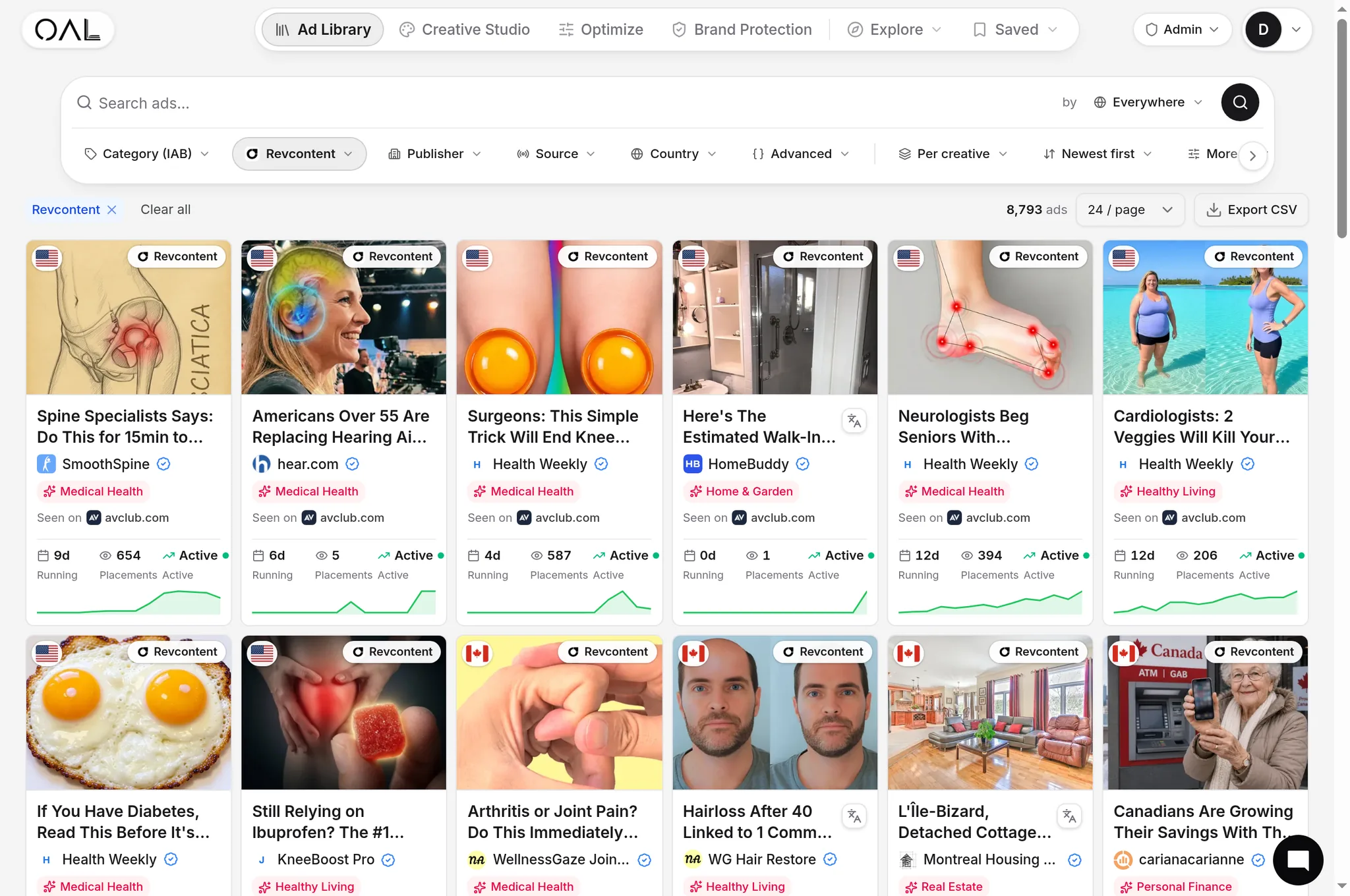
The Revcontent ad library holds the current index of live Revcontent creatives with observed run length attached, letting you see the actual approved creative style in health, finance or whatever vertical you're working in, rather than relying on general policy language alone. Pairing that with our native ad creative best practices guide gives you both the compliance boundary and the performance angle at the same time.
Vertical-specific rejection patterns worth knowing#
A few patterns come up disproportionately in specific categories. Health and beauty creative gets flagged most often for imagery, as covered above, but also frequently for implied medical claims in headlines ("doctors hate this," "cures," "reverses") even when the body copy is more measured; the headline alone can trigger review even before anyone reads the landing page. Finance and insurance creative more often trips claim-specific restrictions, particularly anything implying guaranteed approval, guaranteed rates, or government affiliation the advertiser doesn't actually have. Sweepstakes and giveaway offers get scrutinized for whether the terms, odds and sponsor disclosure are adequately represented in the funnel, not just the ad itself. Knowing which category your rejection falls into before you resubmit saves at least one wasted review cycle.
The relationship between approval and ad quality#
There is a useful side effect to strict approval standards: the creative that survives review, and keeps running, tends to be creative that also converts reasonably well, because networks that let obviously deceptive ads through lose publisher trust and advertiser trust over time. This is part of why ad longevity is such a reliable public signal of profitability across native networks generally. An ad running for three or four weeks has cleared the compliance bar repeatedly, not just once at launch.
If you are running the same creative concept across Revcontent and other mid-tier networks, our MGID and Revcontent ad spy guide is useful for comparing how the same offer gets adapted for each network's specific tolerance level.
How OpenAdLibrary helps#
Before submitting creative into review, checking the Revcontent spy tool for your vertical shows you what is currently live and running, which is a faster and more concrete calibration than reading policy documentation alone. If a competitor's advertorial creative in your exact category has been running for weeks, that's a strong signal of what tone and claim level the network is currently approving and sustaining in that space.
The bottom line#
Most Revcontent ad rejections trace to a handful of recurring, fixable issues: exaggerated imagery, missing disclosure, landing page mismatch, or a prohibited claim category. Fix the specific element the rejection cites rather than rebuilding the whole ad, verify your landing page still matches your claim before resubmitting, and use what's actually surviving review in your vertical as your calibration point rather than guessing at the policy boundary from scratch.