Español
 Português (Brasil)
 Français
 Deutsch
 Italiano
 Nederlands
 Polski
 Svenska
 Türkçe
 Русский
 日本語
日本語 한국어
한국어 简体中文
简体中文 Tiếng Việt
 Bahasa Indonesia
 繁體中文
繁體中文 Čeština
 Dansk
Dansk Norsk (bokmål)
 Suomi
Suomi Ελληνικά
 Română
 Magyar
 Українська
 ไทย
ไทย हिन्दी
 العربية
 עברית
עבריתOutbrain Section Blocking: Cut Wasted Spend Placement by Placement
Section blocking stops future spend on Outbrain publishers that never convert. Here's how to find the data, build a block list without guessing, and know when whitelisting is worth the reach you'll lose.


Section blocking on Outbrain means excluding specific publisher sections, or entire publishers, from serving your widgets, so your budget stops paying for placements that never convert. You do it inside Outbrain's campaign settings under site or section-level targeting, and the data you need to do it well (which sections actually drove traffic, not just which sections got spend) usually has to come from your own tracking, because Outbrain's dashboard reporting on this is thinner than most advertisers expect.
If you've run an Outbrain campaign for more than a couple of weeks, you already know the symptom: total spend looks fine, aggregate CTR looks fine, but conversions cluster on a handful of publishers while a long tail of sites just burns budget. Section blocking is the fix. For the broader mechanics of how the network allocates that inventory in the first place, see how Outbrain works. Here's how to actually do it, not just the theory.
What section blocking does (and doesn't do)#
Outbrain serves your widget across a marketplace of publisher sites and, within many of those sites, specific sections (homepage, sports, entertainment, and so on). Every impression and click carries a site ID, and on some inventory a section ID underneath that. Blocking works at whichever of those two levels the network exposes for your account and inventory type.
What it does: stops future spend on the sites or sections you exclude. It's forward-looking only. Nothing retroactive happens to money already spent.
What it doesn't do: fix a bad campaign. If your creative is weak or your landing page doesn't convert regardless of placement, blocking publishers just moves the problem around instead of solving it. Treat section blocking as a pruning tool for an otherwise sound campaign, not a rescue plan for a broken one.
It also doesn't guarantee reach stays flat. Every publisher you block is inventory you can no longer win. Block aggressively on a small budget and you can choke delivery entirely. That tradeoff is the whole game.
Where to find the data you need#
Outbrain's own reporting UI lets you break performance out by site, and on some account tiers by section, under the "Sites" or "Publishers" report view. That's your starting point, and for most advertisers it's also the ceiling of what the platform will show you without a manual pull from your account manager.
The bigger problem is usually attribution lag. A site can look fine on impressions and clicks and still be quietly terrible on conversion, because the report you're staring at hasn't caught up with your conversion pixel yet, or your pixel isn't segmenting by placement at all. Before you block anything, confirm your tracking actually passes site or section ID through to your analytics or affiliate network. If it doesn't, you're blocking based on vibes.
A second, underused signal: how long has an advertiser's creative been running on Outbrain generally, and where. If you're new to a vertical, looking at which publishers carry the ads that have survived longest (a strong signal that a placement is converting for someone) can shortcut months of your own trial and error. That's the kind of cross-account view an ad intelligence tool gives you that your own account dashboard never will, since your dashboard only shows your own campaigns.
Building your block list, step by step#
Pull at least two weeks of site-level data. One week is noise, especially on a lower-budget campaign. Two to four weeks smooths out day-of-week and weekend effects.
Segment by spend tier, not just conversion count. A site with 2 conversions off $40 spend and a site with 2 conversions off $400 spend are not the same problem. Rank by cost per conversion, and only then look at raw volume.
Set a hard threshold before you look at the data. Something like: any site with 3x your target CPA and at least $50 spend gets blocked, no exceptions, no "let's give it one more week." Deciding the rule after you've seen the results is how bias creeps in.
Block in batches, not one site at a time. Blocking a single underperformer barely moves total campaign economics. Block the bottom 15-20% of sites by cost efficiency in one pass, then reassess after another data cycle.
Re-run the exercise every 2-4 weeks. Outbrain's marketplace shifts. Publishers rotate inventory, seasonal content changes what runs where, and a section that was garbage in March can be fine in June. Section blocking isn't a one-time setup, it's a maintenance habit.
Watch your delivery volume after each blocking pass. If impressions or spend pacing drops sharply, you've blocked too much relative to your budget and bid. Loosen the list slightly and let the algorithm re-find volume.
Whitelisting vs blacklisting: which one actually wins#
Blacklisting (excluding known-bad sites) is the default approach because it's low-risk: you keep almost all your reach and just trim the worst performers. See whitelist vs blacklist targeting for the underlying mechanics. It works well once you have enough historical data to know who the worst performers are.
Whitelisting (restricting delivery to a curated list of known-good sites) is more aggressive. It caps your reach hard, often by 70-90%, in exchange for concentrating spend on placements you've already proven convert. It's the right call when you have a small, well-optimized offer and enough profit margin per conversion that reach matters less than efficiency. It's the wrong call when you're still in the discovery phase of a new campaign and need broad exposure to find your winners in the first place.
Most media buyers run blacklist-only for the first month of a new campaign, then graduate to a hybrid: a core whitelist of proven sites getting the bulk of budget, plus a smaller "exploration" budget left unrestricted so new winners can surface.
| Approach | Reach impact | Best used when |
|---|---|---|
| Blacklist only | Minimal reduction | New campaign, still discovering winners |
| Hybrid (whitelist + exploration budget) | Moderate reduction | Campaign has 4+ weeks of data |
| Whitelist only | Large reduction | Mature campaign, tight margins, proven site list |
Common mistakes that waste the effort#
Blocking based on a single bad day. Publisher performance is noisy at low volume; one weird Tuesday shouldn't decide a site's fate.
Ignoring device and geo splits. A site can be strong on desktop and terrible on mobile, or vice versa. Blocking the whole site throws out the good half.
Forgetting to unblock. Block lists calcify. Advertisers build a list in month one and never revisit it, even as the marketplace and their own creative change. Stale blocks quietly shrink your reach for no ongoing benefit.
Treating blocking as a substitute for creative testing. If CTR is fine but conversion rate is universally weak across every publisher, the problem is your landing page or offer, not your placements. No amount of section blocking fixes that.
When to loop in your account manager#
Outbrain account managers can sometimes surface section-level detail your self-serve dashboard doesn't show, especially on larger accounts. If you suspect a publisher category (not just an individual site) is dragging performance, ask directly rather than trying to reverse-engineer it from the UI. It's also worth asking about brand safety categories specifically. Outbrain, like other native ad networks, maintains publisher-side content and brand safety controls that sit alongside your own blocking, and understanding what's already filtered out by default changes how aggressively you need to build your own list. If you're comparing publisher quality across networks generally, our Outbrain ad spy guide covers how to research what's actually running before you commit budget.
How OpenAdLibrary helps you decide what to block#
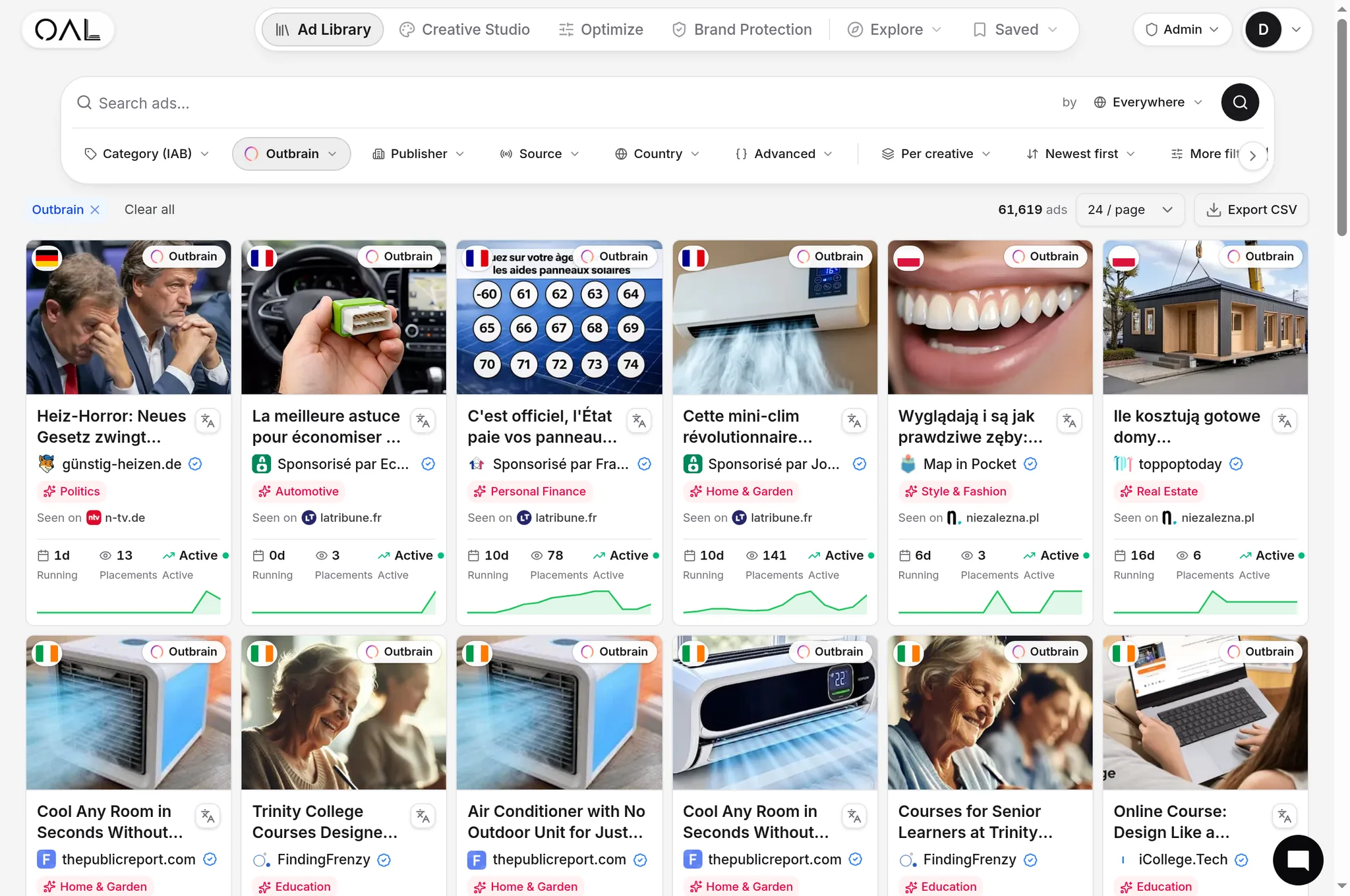
Section blocking works best when you're not guessing which publishers are worth keeping in the first place. OpenAdLibrary's /spy/outbrain tool lets you see which advertisers are running long-duration campaigns on Outbrain right now, by vertical and geo, which is a reasonable proxy for "this placement mix converts for someone." If a competitor in your vertical has had the same creative running for weeks, that's a signal about where the marketplace is working, not just where it's cheap.
Before you block anything, get your tracking right. Confirm your conversion pixel actually fires per placement, understand how CPA varies by site tier before you set a threshold, and revisit the list on a schedule instead of once. Section blocking is maintenance, not a launch task, and treating it that way is what separates accounts that stay efficient from ones that slowly bleed budget on autopilot.