Español
 Français
 Deutsch
 Italiano
 Nederlands
 Polski
 Svenska
 Türkçe
 Русский
 日本語
日本語 한국어
한국어 简体中文
简体中文 Tiếng Việt
 Bahasa Indonesia
 繁體中文
繁體中文 Čeština
 Dansk
Dansk Suomi
Suomi Ελληνικά
 Română
 Magyar
 Українська
 ไทย
ไทย हिन्दी
 العربية
 עברית
עבריתOutbrain for B2B: Lead Quality, Costs & Realistic Expectations
Outbrain can work for B2B, but as a top-of-funnel awareness channel, not a direct lead engine. Here's what content angles convert, realistic cost expectations, and where it fits alongside other B2B channels.

Outbrain can work for B2B marketing, but expect a top-of-funnel content and awareness role rather than a direct lead-generation engine, and expect lead volume and quality to vary a lot depending on how narrow your target buyer actually is. B2B advertisers who succeed on Outbrain typically use it to drive traffic to gated content or educational pieces, not straight to a demo-request form, and they measure success over weeks, not days.
Why B2B is a harder fit for native than consumer verticals#
Outbrain's widget sits below articles on consumer-heavy publisher sites: news, entertainment, lifestyle, sports. This is standard native advertising mechanics, and the person reading isn't in a B2B buying mindset; they're reading about something unrelated and your ad has to interrupt that with enough relevance to earn a click. That's a fundamentally different starting point than a channel where someone actively searched for "project management software" or clicked a LinkedIn ad while scrolling a professional feed. For the underlying delivery mechanics, see how Outbrain works.
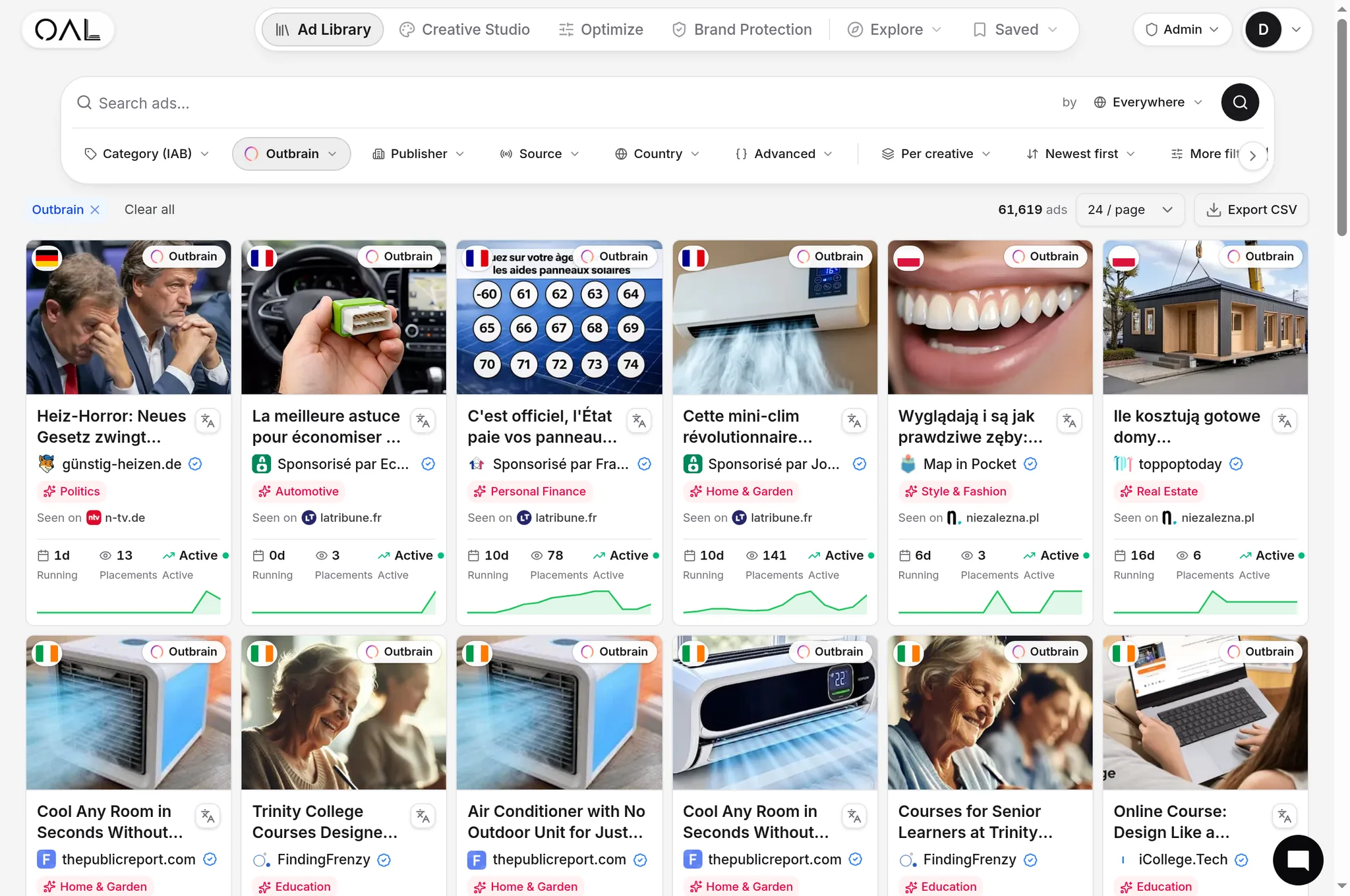
This shows up clearly in the marketplace data. Across OpenAdLibrary's live Outbrain index, software holds 1,932 classified creatives, a real presence but well behind Outbrain's largest verticals: insurance (4,345), finance (3,990), and health (3,102). B2B software and services advertisers exist on the network in meaningful numbers, but they're not what the marketplace is built around, and most of what does run leans toward broader business or productivity angles rather than narrow enterprise software categories.
None of that means B2B doesn't work, it means the targeting job is harder and the content needs to do more work bridging a consumer-context click to a business-context decision.
What actually converts for B2B on Outbrain#
Educational and thought-leadership content, not product pitches, are the most common successful entry point. A headline built around a business problem or trend, leading to an article, guide, or report, gives the click somewhere relevant to land, then nurtures from there rather than asking for a demo immediately.
Gated content offers (a whitepaper, template, or benchmark report in exchange for an email) tend to outperform direct "book a demo" creative, because the ask is smaller and matches where a cold native click actually is in the consideration process. This also gives you a lead to nurture through email or retargeting rather than losing the visitor entirely if they weren't ready to buy.
Broad job-function or industry framing works better than narrow product-feature messaging in the initial ad, since the native audience hasn't self-selected the way a search or LinkedIn audience has. Save the specific product pitch for the landing page or a follow-up touch, once you've earned enough attention to make that case.
Which B2B sub-segments do better than others#
Broad small-business and productivity tools, HR and workplace software, and financial or accounting services for businesses tend to have an easier time on Outbrain than narrow enterprise or highly technical categories, simply because the messaging translates more naturally to a general publisher audience. A tool aimed at "small business owners" or "freelancers" describes a recognizable, broad reader segment; a tool aimed at "DevOps engineers at Series C SaaS companies" describes an audience that's a much smaller fraction of any given publisher's readership, which makes reaching it efficiently through content-adjacent placement harder than through a channel built around firmographic or job-title targeting.
That doesn't rule out narrower B2B categories entirely, it just means the volume available to you will be smaller and the cost to find enough of the right audience within that broader inventory pool will typically run higher. Factor that into your expectations before you set a budget: a narrow enterprise offer testing on Outbrain needs a longer runway and more patience per qualified lead than a broad small-business tool would.
Targeting realities#
Outbrain's targeting options for reaching B2B audiences specifically are more limited than what you'd get on LinkedIn or an intent-data platform; check the network's current documentation for exactly what contextual, interest, and site-category targeting is available to your account, since this changes over time and by market. In practice, most B2B advertisers on native networks lean on contextual placement (running near business or finance content) and broad interest targeting rather than firmographic precision, which means some of your reach will always be outside your actual target account list. Budget and expectations should account for that inefficiency rather than assuming native targeting matches what dedicated B2B ad platforms offer.
Realistic expectations on cost and lead quality#
Media buyers commonly report Tier-1 desktop CPCs in a similar broad range to other verticals on Outbrain, roughly a few tens of cents up to around a dollar, though B2B campaigns competing for business-audience attention can push toward the higher end depending on your specific targeting; see native ads CPC benchmarks for how that compares across networks. Cost per lead (your CPL) will typically run higher than search-based lead gen for the same offer, since native traffic starts colder; the tradeoff is reach into an audience that isn't actively searching and therefore isn't being bid up by competitors doing the same search-based targeting you are. For general budgeting across formats, how much do native ads cost is a useful starting reference.
Lead quality tends to correlate strongly with how well the ad-to-content bridge is built. A vague "boost your business" headline pulling in unqualified clicks produces exactly the low-quality leads you'd expect. A specific, narrow angle (a named problem, a named audience, a specific outcome) filters harder before the click even happens, which costs you some volume but improves what comes through.
Where Outbrain fits alongside other B2B channels#
Treat Outbrain as a complement to, not a replacement for, channels built for buying-intent capture like search or LinkedIn. Its strength is reaching people who aren't yet actively looking for a solution but who fit your audience profile, which is genuinely hard to do on intent-based channels by definition. Use it to build awareness and fill a content or retargeting funnel, then let higher-intent channels close.
If you're weighing Outbrain against other native options for a B2B push, it's worth comparing against the broader field; our best native ad networks roundup covers how the major players differ, and media buying for native ads is a solid primer if native is new to your team generally.
Building the nurture sequence that makes B2B native pay off#
Since Outbrain rarely closes a B2B deal on the first click, the campaign's real return depends on what happens after someone downloads your gated content. A generic autoresponder that immediately pitches a demo tends to undo the trust the content just built. A short nurture sequence that continues the educational angle the ad opened with, before making a commercial ask, generally holds attention longer and converts a higher share of that colder native traffic into a genuine sales conversation.
This also changes how you should measure success. Judging an Outbrain B2B campaign purely on first-touch, same-session conversions will make it look far worse than it's actually performing, since the real value shows up over a multi-touch nurture window measured in weeks. If your reporting setup only credits last-click, same-session conversions, you're structurally unable to see the channel's actual contribution; align your attribution model with how the buying process really unfolds before deciding the channel isn't working.
Sizing the budget realistically#
Start with a budget large enough to reach statistical significance on your gated-content offer within a few weeks, rather than spreading a small test budget across several audience segments or creative angles at once. B2B audiences are inherently a smaller slice of any native network's overall traffic than mass-market consumer verticals, so testing thin, split too many ways, will take longer to produce a readable signal than the equivalent test would on a bigger consumer vertical.
Plan for a longer runway to judge the channel than you would with search or LinkedIn, where intent signals are more immediate. Give a new B2B native creative angle at least a few weeks of consistent spend before deciding whether it's worth scaling or cutting, and resist the temptation to judge it against day-one search-style benchmarks it was never going to hit.
How OpenAdLibrary helps#
Before committing B2B budget to Outbrain, it's worth checking what's already running in adjacent business and software categories on the network. OpenAdLibrary's /spy/outbrain tool lets you browse live creatives by vertical, so you can see the actual angles and content offers competitors or comparable companies are using right now, rather than guessing at what a "B2B native ad" is supposed to look like. If a software or services advertiser has a creative running for weeks, that longevity is a reasonable signal the approach is working, and worth studying before you build your own campaign from scratch.