Español
 Português (Brasil)
 Français
 Deutsch
 Italiano
 Nederlands
 Polski
 Svenska
 Türkçe
 Русский
 日本語
日本語 한국어
한국어 简体中文
简体中文 Tiếng Việt
 Bahasa Indonesia
 繁體中文
繁體中文 Čeština
 Dansk
Dansk Norsk (bokmål)
 Suomi
Suomi Ελληνικά
 Română
 Magyar
 Українська
 ไทย
ไทย हिन्दी
 العربية
 עברית
עבריתAre 'As Seen On' Claims Legal? Logo and Media Rules
A real media mention is fair game to advertise. A fabricated logo or an out-of-context screenshot isn't. Here's exactly where 'as seen on' claims cross from legal to deceptive.


"As seen on" claims are legal when the placement actually happened, the brand or product mentioned matches what ran in the ad, and the way it's presented doesn't imply an endorsement the outlet never gave. They become illegal deceptive advertising, and often trademark infringement on top, the moment any of those three conditions breaks: a fabricated logo, a real mention taken out of context, or a media brand used to imply endorsement of a product the outlet never reviewed.
The legal test, in plain terms#
Regulators don't ban the phrase "as seen on." News mentions of products and brands happen constantly, and advertisers are allowed to reference them. What's regulated is truthfulness and the overall impression the claim creates. The FTC's framework for this is the same one it applies to any advertising claim: does the ad create a misleading impression to a reasonable consumer, taken as a whole, including the visual presentation and not just the literal words.
A logo slap next to "As Seen On" implies three things to a consumer: that the placement genuinely happened, that it happened recently enough to be relevant, and that it reflects some level of editorial credibility rather than a paid placement. If any of those three implications is false, and the advertiser knew or should have known it was false, that's the deception.
When it's legal#
A few patterns are clearly on the right side of the line:
- A genuine, verifiable media mention. The product or founder was actually featured, interviewed, or reviewed by the outlet named, and you can point to the actual segment or article.
- Accurate context. The mention is presented in a way that doesn't overstate what happened. A brief mention in a roundup article is not the same as "featured on" a flagship investigative segment, and the ad copy should reflect the difference.
- Licensed use of the outlet's logo or trademark, or use that falls within a narrow fair-use lane for accurately referencing the outlet by name.
- Paid placements disclosed as such. If the "feature" was actually a paid sponsorship or contributed article rather than independent editorial coverage, disclosing that (rather than presenting it as unbiased press) keeps the claim honest even though it changes what the claim is worth.
When it becomes deceptive advertising#
The deceptive version of this pattern shows up constantly in native and social advertising, almost always in one of these forms:
| Pattern | Why it's deceptive |
|---|---|
| Fabricated network logos (a major broadcaster's mark on a page that outlet never touched) | False claim of endorsement/placement that never happened |
| Real logo, fake or unrelated article screenshot | Implies specific coverage that doesn't exist |
| A placement that happened once, years ago, presented as current or ongoing | Misleads on recency and relevance |
| Using a news brand's visual identity on a fake "article" advertorial page that isn't actually from that outlet | Combines false endorsement with brand impersonation |
| Quoting a generic "news report" without naming a real outlet, alongside stock network logos | Vague sourcing designed to imply legitimacy without a checkable claim |
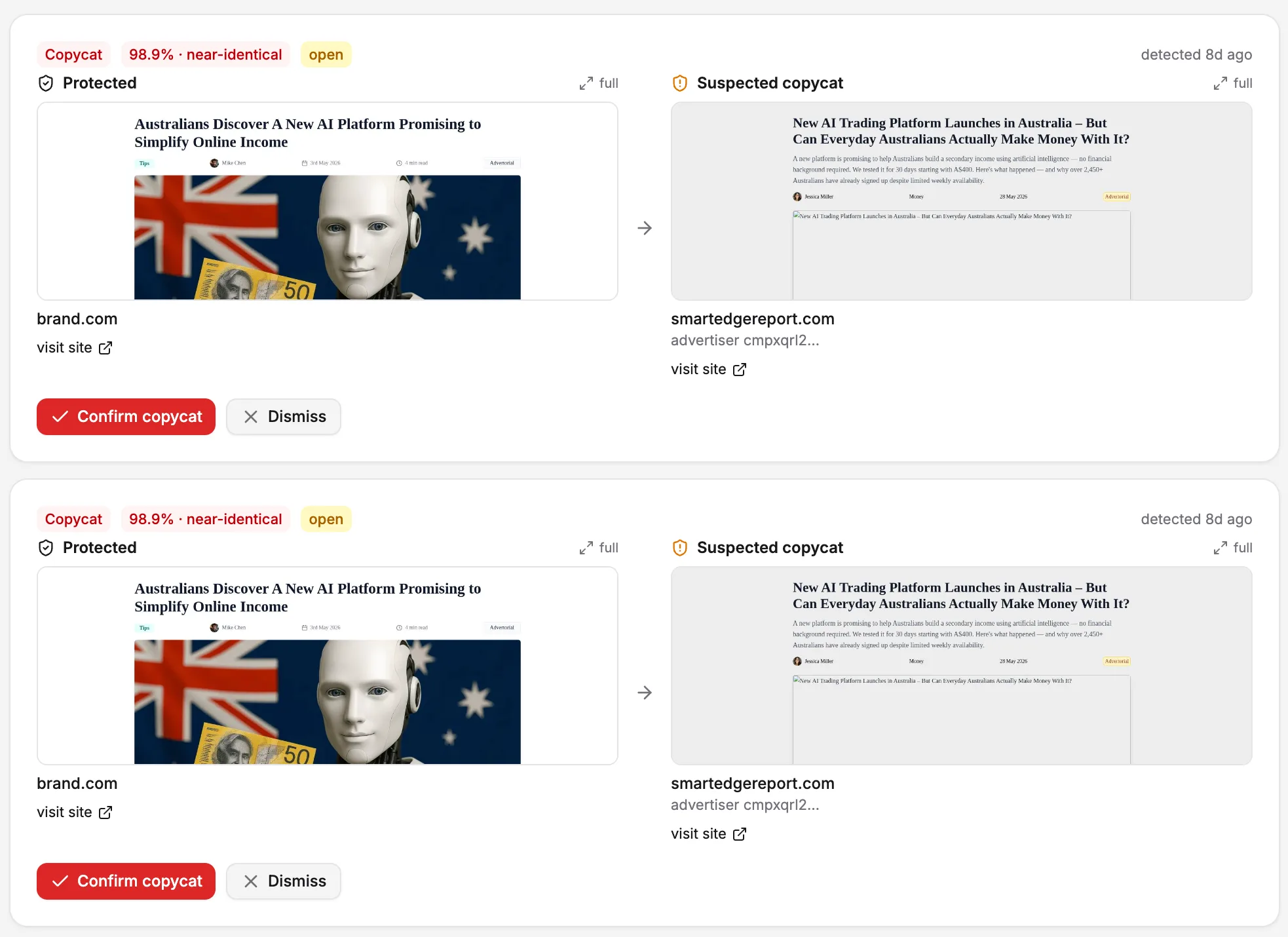
This last pattern overlaps heavily with what shows up in copycat landing pages: a lander built to visually resemble a real news site, using a similar layout, fonts and color scheme to a recognizable outlet, without ever claiming to be that outlet outright. Regulators and courts look past the literal absence of a false statement to the overall impression the design creates.
The trademark layer sits on top of the ad-law layer#
A fabricated "as seen on" claim using a real network's logo isn't just a deceptive-advertising problem, it's very often trademark infringement as well, because that logo is a registered mark the outlet controls. Using it without authorization, in a context that implies sponsorship or endorsement, is exactly the kind of use trademark law exists to stop, independent of whether the underlying weight-loss or supplement claim in the ad is even true. Media companies and their brand-protection teams actively monitor for this, which is one reason fake "as seen on" pages tend to get taken down fast once discovered.
Where this shows up in native ad creative#
Native placements are a common home for this pattern because the ad unit itself is designed to look like content, not a banner. A few specific things to watch for as you review or build creative:
- Thumbnail images that mimic a news broadcast frame (a studio backdrop, a lower-third graphic) without any actual segment behind them
- Headlines referencing "this morning's segment" or a specific show name without a real, current placement to back it up
- Landing pages using a network's color palette and typography closely enough to create confusion, even without using the logo directly
- Testimonial-style copy attributed to "a leading morning show" rather than a real, named outlet, which is vague enough to dodge a direct fact-check but still creates a false impression
Why this specific pattern draws enforcement so fast#
Compared to other misleading-ad categories, fake "as seen on" claims are unusually easy for regulators and brand owners to act on. There's rarely an ambiguous evidence question the way there is with a health claim (was the study good enough, is the effect size real). Either the segment or article exists or it doesn't, and that's checkable in minutes. That makes it a common first thread investigators pull on when a broader review of an advertiser's claims starts, and it's also why platforms move quickly to suspend advertisers once a fabricated placement is reported.
Consumers and competitors alike can report a scam ad that uses a fabricated media mention, and because the underlying facts are so easy to verify, these reports tend to get acted on faster than complaints about subjective claims. Media outlets themselves also run active brand-protection programs specifically to catch unauthorized use of their name and logo in advertising, for the same reason any company runs brand protection in native advertising: a fake "featured on" claim damages the outlet's own credibility, not just the advertiser's.
Auditing your own funnel for this risk#
If you're running or reviewing a funnel that uses media mentions, a short audit catches most of the risk:
- Trace every logo back to a real, dated placement. If nobody on the team can produce the actual segment, article link or screenshot with a URL, treat the claim as unverified and pull it.
- Check whether the placement is being described accurately. A single sentence in a roundup is not "featured," and a segment from three years ago is not "as seen on" in the present tense without a date attached.
- Confirm logo usage rights. Most major outlets publish brand-usage guidelines; if you can't find or meet them, don't use the mark.
- Look at the whole page, not just the logo. A layout, color scheme or typography that echoes a specific outlet closely enough to confuse a visitor is a problem even if no logo appears at all, and it's the same test that applies to is it legal to spy on competitor ads when researching how a competitor structures their own claims.
- Keep the receipts. If a claim is challenged, being able to produce the original placement immediately is the difference between a quick resolution and an extended investigation.
How to use real media placements safely#
If you actually landed a legitimate press mention, the safe way to use it is straightforward: link to or clearly describe the real placement, use the outlet's name and logo only under its actual usage guidelines (most major outlets publish these), keep the claim's recency and scope accurate, and don't let the visual design imply a broader endorsement than a single mention supports. When in doubt, a written permission or license from the outlet, even a simple one, removes almost all of the risk in one step.
Reviewing what's currently running under "as seen on" and similar claims across a market is a useful way to spot both the compliant patterns worth modeling and the fabricated ones worth avoiding. That's part of what a broad ad intelligence view is good for: seeing how the claim gets used at scale rather than in a handful of one-off examples.