Español
 Português (Brasil)
 Français
 Deutsch
 Italiano
 Nederlands
 Polski
 Svenska
 Türkçe
 Русский
 日本語
日本語 한국어
한국어 简体中文
简体中文 Tiếng Việt
 Bahasa Indonesia
 繁體中文
繁體中文 Čeština
 Dansk
Dansk Suomi
Suomi Ελληνικά
 Română
 Magyar
 Українська
 ไทย
ไทย हिन्दी
 العربية
 עברית
עבריתCopycat Landing Pages: How Scammers Clone Brands in Native Ads
Copycat landing pages borrow a trusted brand's logo and tone to launder a scam through native-ad networks, and here is the practitioner's method for catching them with evidence anyone can verify.


A copycat landing page is the payload, not the bait. The ad creative gets the click. The page does the real work: turning a stranger's trust in a brand they recognize into money for someone who has no relationship with that brand.
In native advertising (the recommendation widgets stitched into the bottom of news and content sites) this pattern is industrialized. An operator borrows three things at once: a publisher's context, a brand's visual identity, and a network's cheap, lightly reviewed inventory. Then they test creative variants until one converts. We have captured 589,036 creatives across 42 networks (OpenAdLibrary index, June 2026), and once you have looked at a few thousand of them, the impersonation playbook stops looking sophisticated. It looks like a logo and a redirect.
This is a methodology piece, not a body-count piece. I am not going to hand you a "37% of native ads are scams" stat, because any such number swings wildly by geo, vertical, and the week you measured, and quoting it as a constant would be dishonest. What does hold up is the method: the signals that separate a copycat from a legitimate campaign, how to read each one, and how to assemble evidence a network or regulator can verify without taking your word for it. The example creatives below are real ads we captured. They are clickbaity, lightly deceptive native ads, and that is exactly the point. This is what the genre looks like.
What actually makes a page a copycat#
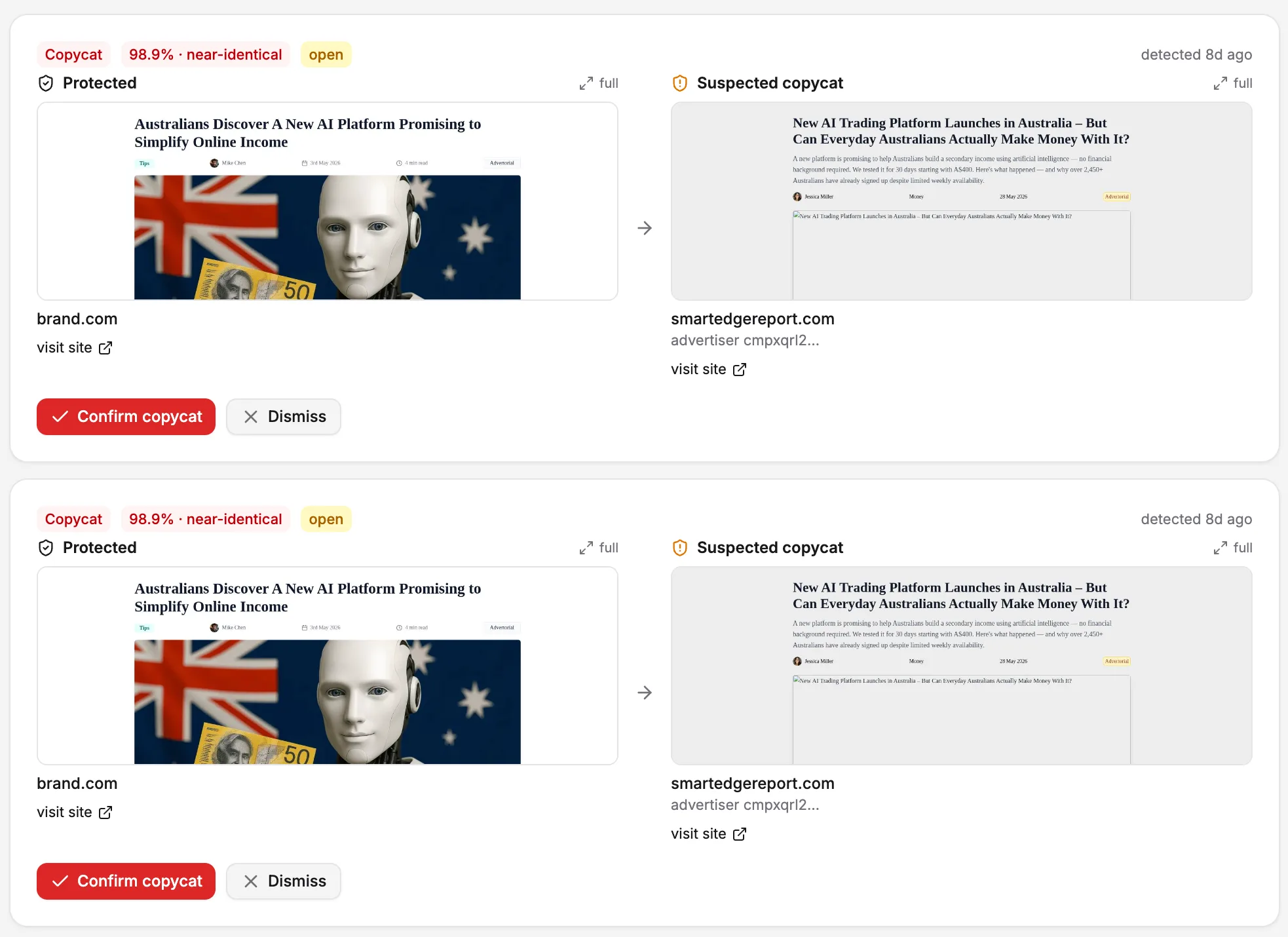
A copycat landing page imitates a trusted brand's identity (logo, palette, type, layout, voice) so a scam, knockoff, or thin offer inherits credibility it never earned. The impersonation lives on the page, but the setup starts in the ad. The ad copy and creative borrow the same brand cues, so the reader's expectation is fixed before they ever land. The page just confirms what the ad already promised.
It helps to keep three things separate, because people conflate them constantly:
- The creative. The image and headline inside the native ad widget. This is what a reader sees in the recommendation strip.
- The click chain. The sequence of redirects between the click and the final destination. A clean affiliate flow has one or two hops. An evasive one strings together several, usually passing through trackers and a bridge page.
- The landing page. The final rendered destination. A copycat landing page is one whose identity is borrowed, not owned.
Not every borrowed visual is fraud. An affiliate promoting a brand inside the terms of an affiliate program can use that brand's assets legitimately. The line that matters is misrepresentation of source: does the page lead a reasonable person to believe they are dealing with the brand itself, when they are not? That is the standard regulators apply too. The U.S. FTC's Government and Business Impersonation Rule, live since April 2024, targets spoofed business logos, addresses, and false claims of affiliation. That is the copycat toolkit, item for item. The FTC put the 2024 cost of impersonation scams to U.S. consumers at roughly $2.95 billion.
Look at the kind of headline that does this work in practice:

That ad runs an official-sounding "IRS forgives millions" angle with a hard deadline. The brand on the creative is "Fresh Start Information," which is not the IRS. Finance is the single largest native vertical in our index at 17,232 creatives (OpenAdLibrary, June 2026), and the official-program framing is its most reused trick. The page does not have to be a flawless clone of a government site. It only has to look official enough for the three seconds between curiosity and a form fill.
The cheapest thing to fake is a logo. The hardest thing to fake is a four-week campaign history across three geos with the same supply-chain intermediaries behind every placement. Detection works by ignoring the easy fake and pricing the expensive one.
Why native ads are the natural habitat#
Three structural features of native advertising make it hospitable to impersonation. Knowing them tells you where to look.
First, borrowed context. A native widget renders inside a mainstream publisher's article. Readers extend a slice of the publisher's credibility to the ads sitting beside the copy. That halo is exactly what a copycat operator is paying for.
Second, lighter friction. Native inventory is cheaper and less manually scrutinized than premium search or social, and creatives spin up and rotate fast. An operator can throw twenty headlines at one landing page and keep only the winner. You can see the survival-of-the-fittest logic in our data: health is the most-captured vertical on Taboola alone at 6,048 creatives, with finance right behind at 5,558 (OpenAdLibrary, June 2026). High volume, fast iteration, thin review.

Third, distance from the brand. The impersonated brand usually never sees the ad. It runs in geos the brand does not monitor, on publishers the brand does not buy, through networks the brand has no relationship with. By the time a customer complains, the campaign may have been live for weeks.
That last point is the opening for detection. Distance from the brand is also distance from scrutiny. It is not distance from the public ad record. The ad still ran in public. It can still be captured.
The detection signals#
No single signal proves impersonation. The method is to stack independent signals until the pattern is unambiguous and the evidence is defensible. Here are the ones that carry weight, and what each is actually telling you.
| Signal | What it measures | Why it exposes a copycat |
|---|---|---|
| Click-chain depth | Redirect hops from ad to final page | Evasive flows insert hops to fingerprint, cloak, or shed accountability |
| Identity vs. registered owner | Does the brand on the page match the domain/checkout owner? | A mismatch is the core tell of impersonation |
| Campaign longevity | How long the same creative or offer has run | Long-running pages are scaled operations worth documenting |
| Geo spread | Which countries the placement targets | Brand-absent geos are where impersonation hides |
| Supply-chain consistency | Recurring ad-tech intermediaries across placements | Repeated intermediaries link scattered ads to one operator |
| Creative cloning | Reuse of brand logo, palette, fonts in the creative | Establishes intent before the page even loads |
Click-chain depth. Follow the click. A legitimate affiliate flow is usually short and stable. A copycat flow adds hops to fingerprint the visitor, serve different content to bots versus humans, or just put legal distance between the ad and the page. Capturing the full chain, every URL from click to destination, is the single most useful artifact you can produce, because anyone who repeats the trace gets the same result. This overlaps heavily with how cloaking is detected. For the mechanics of divergent click paths, see Ad Cloaking: How It Works and How Auditable Evidence Exposes It.
Identity versus ownership. The page says "Acme." Who owns the domain, the checkout processor, the support inbox? When the brand on the page and the entity behind the transaction diverge, you have the substance of an impersonation claim. Not a vibe. A fact.
Longevity and spread. A copycat running the same offer for weeks across multiple geos is not a one-off. It is a business. Here is where I want to be careful with our own data versus industry lore. You will hear people talk about "90-day winners" in native. That is general affiliate folklore, not something we are asserting. What we can show you is what continuous observation actually captures: in our index, the longest-running creatives we are currently tracking sit at 28 days of unbroken observation. One of them is a finance ad styled as friendly advice:

A creative that survives 28 days of observation is one the network has not pulled. That cuts both ways. It is a scaled operation worth documenting, and it is proof that a documented report has somewhere to land. Whack-a-mole loses to operations that persist. Systematic capture does not.
Supply-chain consistency. This is the signal most analysts skip and the one that ties everything together. Native ads pass through a chain of intermediaries: SSPs, trackers, redirectors. When you classify that chain and watch the same intermediaries recur across ads that look completely unrelated, you have linked one operator's scattered campaigns into a single pattern. That is how a handful of suspicious pages becomes a documented network.
A real pattern, read signal by signal#
Here is how the stack works on the kind of ad you will actually find. Health and the "ditch your old device for this new one" angle is one of the most reused structures in native, and we have a live example:

Take it one signal at a time. The creative leans on an implied medical authority ("Americans are ditching"). The brand label, "Nebroo," is not a name a shopper would recognize, which is the point: the trust is meant to come from the format, not the seller. It has been observed for 26 days, so it is not a test, it is a running operation. Now you trace the click. If it passes through a tracker, then a bridge page that keeps the device-review styling, then redirects to an unbranded checkout on a domain registered weeks ago, you have your chain. Check identity against ownership. Pull the geos. See whether that same tracker sits behind other "different" offers. Each fact is individually plausible. Stacked, they describe an operation, and every link is a timestamped, reproducible artifact rather than an assertion.
The same shape shows up in home services, where "government subsidy" framing does the trust-borrowing:

How to run this analysis yourself#
You do not need a forensics team. You need to capture the public ad record and follow it without distorting it. Here is the workflow, written so it applies whether you use OpenAdLibrary or assemble the pieces by hand.
- Search your brand's terms across native networks. Hunt creatives using your name, logo, or product language, including misspellings and look-alikes. A native ad spy tool that captures live placements across Taboola, Outbrain, MGID, Revcontent, and similar networks turns this from manual hunting into a query. For scale, our index spans 926,259 landing captures and 25,933 advertisers (OpenAdLibrary, June 2026), so the look-alike is usually already in there.
- Capture the creative at full quality. You want the real image, not a thumbnail. Logo fidelity and palette are part of the evidence.
- Trace the click to the landing page. Record every hop. Do this in a way that does not programmatically click live ads in a manner that bills the advertiser or pollutes auction data. The goal is to observe the real destination, not to interact with the auction. OpenAdLibrary follows these destinations and captures the page without clicking the live ad.
- Check identity against ownership. Compare the brand on the page to the domain owner, the processor, and the contact details.
- Pull longevity and geo spread. How long has it run, and where? This converts a snapshot into a pattern.
- Classify the supply chain. Identify the intermediaries and check whether they recur across other suspicious placements.
- Export a timestamped evidence pack. Creative, ad text, placement, redirect chain, rendered page, date range, and supply chain: the artifacts a network or regulator can verify independently.
This is the auditable-evidence principle that runs through all of OpenAdLibrary's brand-protection work. A claim a third party can reproduce is worth more than one they have to trust. The EU's Digital Services Act pushes the same way. Its Article 39 advertising-repository requirements oblige very large platforms to disclose who is behind each ad and to publish ad records, formalizing the idea that the ad ecosystem should be inspectable rather than opaque.
From evidence to action#
Detection is half the job. Once you have a documented copycat, the evidence pack decides how fast it comes down. Networks act on reproducible reports. Registrars and processors respond to ownership-mismatch evidence. Regulators want timestamps and chains. For the full takedown and reporting workflow, see How to Report a Scam Ad (And Document the Evidence). If the issue is misuse of your marks rather than outright fraud, the framing shifts toward trademark infringement detection, where the same captured evidence supports a different legal path.
This article is one node in a larger map. The strategic context, building an ongoing monitoring program instead of reacting to individual incidents, lives in the pillar guide, Brand Protection in Native Advertising: A Practical Guide. Copycat landing pages are the symptom most worth catching early, because they are where a borrowed logo turns into a real loss.
The takeaway#
Copycat landing pages work because trust is transferable and logos are cheap. They are catchable because scaled operations leave durable traces (long campaign histories, consistent supply chains, ownership mismatches, evasive click chains) that a single snapshot never reveals but systematic capture does. The discipline is not finding the fake. It is documenting it in a form someone else can verify.
If you want to run this against your own brand, capture live native creatives, trace clicks to the landing page, and export auditable evidence, start free and browse 200 ads without a card.