 Español
 Português (Brasil)
 Français
 Deutsch
 Italiano
 Nederlands
 Polski
 Svenska
 Türkçe
 Русский
 日本語
日本語 한국어
한국어 简体中文
简体中文 Tiếng Việt
 Bahasa Indonesia
 繁體中文
繁體中文 Čeština
 Dansk
Dansk Norsk (bokmål)
 Suomi
Suomi Ελληνικά
 Română
 Magyar
 Українська
 ไทย
ไทย हिन्दी
 العربية
 עברית
עבריתHow to Verify a Celebrity Endorsement Before You Trust an Ad
A recognizable face in an ad isn't proof of anything. Here's how to actually verify whether a celebrity endorsement is real, from checking their own channels to spotting reused photos and templated claims.

Verify a celebrity endorsement by checking the celebrity's own verified channels and official representatives directly, not the ad or its landing page. Fabricated endorsements are one of the most common patterns in native advertising scams, because a recognizable face borrows trust the advertiser has not earned, and the fastest tell is that the "proof" almost never traces back to a source the celebrity actually controls.
Why celebrity endorsement ads are a recurring native ad pattern#
Nutra, crypto and weight-loss offers lean on fabricated celebrity quotes constantly because the format is cheap to produce and effective at stopping a scroll: a headline claiming a well-known name "invested in" or "swears by" a product, paired with a real photo pulled from an unrelated interview or press event. The celebrity has almost always never heard of the product. The ad and its landing page are built to look like news coverage rather than advertising, which is itself a disclosure problem before you even get to whether the claim is true.
This pattern shows up across every major native network because the economics favor it: a fabricated endorsement converts better than an honest ad, and by the time a network's policy team catches one version, a dozen slightly reworded copies are already live under different advertiser names.
The verification checklist#
Work through these in order; most fake endorsements fail on the first or second check.
- Go to the celebrity's own verified account or official representative, not the ad. Search their verified social profiles or official press contact directly. A real endorsement deal is something a celebrity or their team will confirm or deny if asked; a fabricated one will have no trace anywhere the celebrity actually controls.
- Reverse image search the photo. Fabricated endorsement ads almost always reuse a photo from an unrelated event, interview or red carpet appearance. Finding the original, unrelated context is close to definitive proof the ad is fake.
- Check whether the "coverage" only exists on look-alike news sites. Fabricated endorsements are usually hosted on an advertorial page styled to resemble a real outlet, sometimes with a real network's logo bar borrowed without permission. If the story does not appear on the actual outlet's own site, it is not real coverage.
- Check the landing page's actual advertiser against the disclosed brand. The company you would actually be buying from at checkout is often a completely different name than the one implied by the ad's framing, which is itself a strong signal something is being obscured.
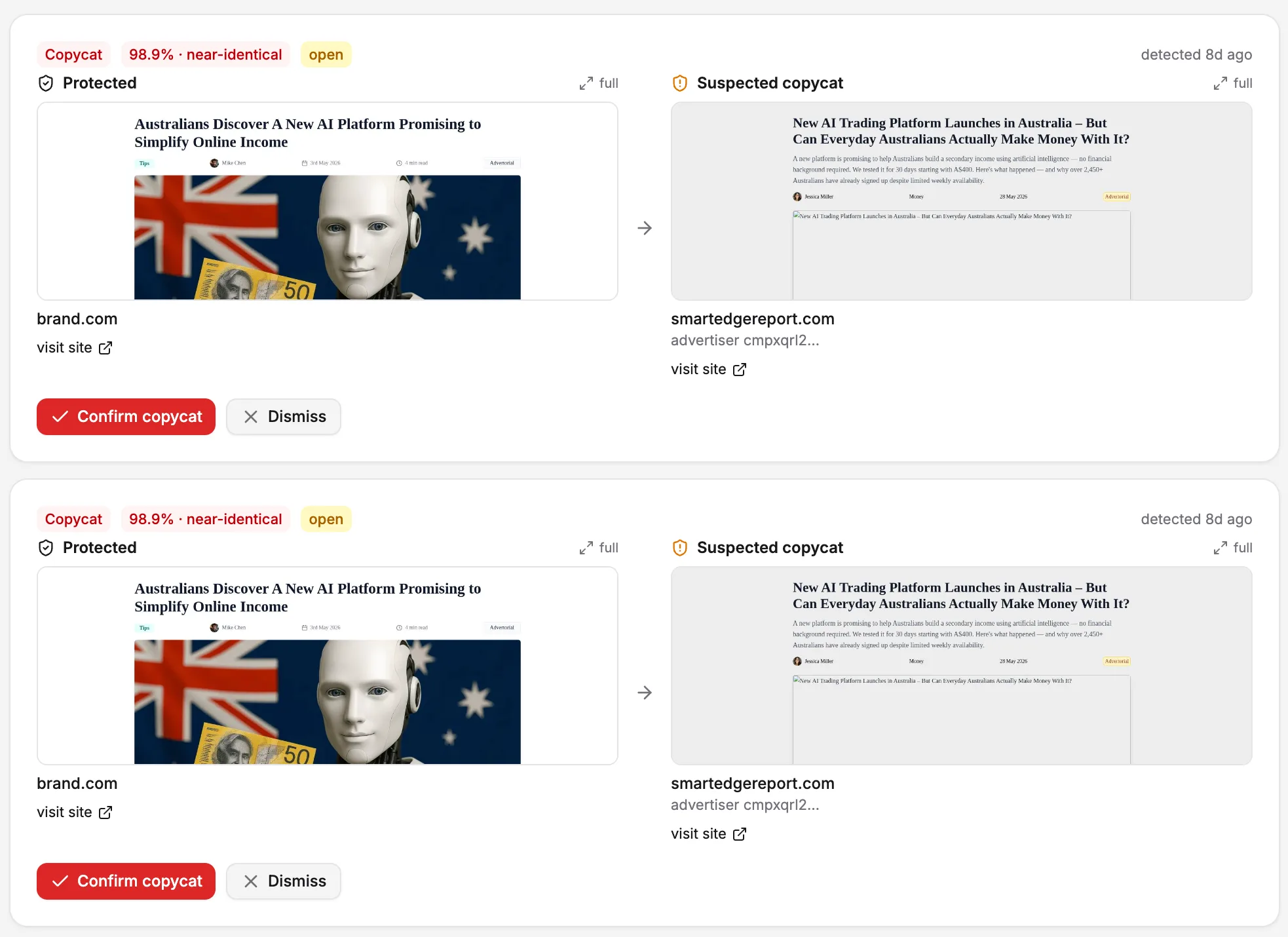
- Look at how widely the same creative is reused. If an identical claim ("doctors are shocked," "invested $X million in") appears attached to multiple unrelated products or celebrities across different ads, it's a template, not a real story about a specific person and product.
Why the photo and the claim rarely match reality#
A genuine celebrity endorsement deal involves contracts, usage rights and, in most jurisdictions, a disclosure requirement when the relationship is material to the audience. The FTC's endorsement guidance requires a clear and conspicuous disclosure when there is a material connection between an advertiser and an endorser; see the FTC's own guidance for the current standard. A fabricated endorsement skips all of that by design, which is exactly why it is worth checking for a disclosure statement as one of your verification steps: its absence is not proof of fraud on its own, but a genuine endorsement almost always carries one, and a fabricated one almost never does.
What a real endorsement usually looks like, for comparison#
| Signal | Real endorsement | Fabricated endorsement |
|---|---|---|
| Source of the claim | Celebrity's own channel, official press release, or clearly licensed use | Only appears inside the ad's own landing page |
| Disclosure | Present ("paid partnership," "sponsored," or similar) | Usually absent |
| Photo origin | Matches a shoot or context tied to the actual deal | Reused from an unrelated interview or event |
| Reuse pattern | Tied to one brand consistently | Same claim template reused across unrelated products |
| Outlet | Genuine coverage traceable to the real publication | Look-alike site styled as news, not actually affiliated |
The role of the landing page in the deception#
The ad creative is only the hook. The real deception usually happens on the landing page, which is why verification should not stop at the image and headline. Fabricated endorsement funnels often route through a bridge page built to look like an independent news article ("we investigated this product ourselves"), complete with fake comment sections, embedded video that is never a real interview, and a byline attributed to a journalist who does not exist at the outlet being impersonated. This structure exists specifically to launder the credibility of a real news brand onto a product that brand has no relationship with.
Checking the actual domain against the outlet it is impersonating is one of the fastest tells. A page styled like a national news site but hosted on an unrelated domain, often with a string of random characters or a slightly misspelled brand name, is not a technical glitch; it's the entire scheme.
Patterns specific to different verticals#
The fabricated-endorsement pattern shows up with slightly different framing depending on the vertical, though the underlying mechanics stay the same:
- Nutra and supplements lean on claims that a celebrity used a product to lose weight or reverse a health condition, often paired with a fake "doctors are furious" framing designed to imply suppressed information.
- Crypto and trading offers lean on claims that a celebrity or business figure "invested" in or personally endorses a platform, often alongside a fabricated news-style headline about an unrelated market event.
- Sweepstakes and giveaway offers sometimes borrow a celebrity's name to imply they are personally distributing a prize or reward, which is a separate but related misuse of likeness.
Recognizing which template you're looking at speeds up verification, because the checklist above applies almost identically across all three; only the specific claim changes.
What to do if you find a fabricated endorsement#
If you're a brand owner or affiliate checking whether a competitor or an impersonator is running a fake endorsement featuring you, a public figure you represent, or your own brand identity, document the ad (screenshot, URL, advertiser name, network it ran on, and date observed) before it gets pulled or swapped, since these creatives rotate constantly. From there, reporting a scam ad through the network's policy channel and, where relevant, a regulator, is the standard path. Trademark and likeness misuse is a related but distinct problem worth understanding separately; see our guide to trademark infringement in ads for how that claim differs from a straightforward fabricated-endorsement complaint.
How OpenAdLibrary helps with verification#
Part of verifying a suspicious endorsement ad is seeing its full pattern: how many advertisers are running the same or a near-identical creative, across which networks, and for how long. OpenAdLibrary's ad intelligence index makes that reuse pattern visible directly, rather than relying on a single ad you happened to see, which is often the fastest way to confirm a claim is templated rather than a genuine, one-off endorsement deal.
The pattern to remember#
A real endorsement traces cleanly back to the celebrity's own controlled channels and typically carries a disclosure. A fabricated one exists only inside the ad's own ecosystem, reuses a photo pulled from somewhere unrelated, and often gets recycled across multiple unrelated products. Check the source before the claim, and treat "coverage" you cannot find anywhere else as evidence against the ad, not for it.
None of this requires special tools beyond a search engine, a reverse image search and a few minutes of patience. The people running these funnels are betting that most viewers won't take those few minutes. Taking them is the entire verification process, and it works on the overwhelming majority of fabricated endorsement ads you'll come across.