Español
 Português (Brasil)
 Français
 Deutsch
 Italiano
 Nederlands
 Polski
 Svenska
 Türkçe
 Русский
 日本語
日本語 한국어
한국어 简体中文
简体中文 Tiếng Việt
 Bahasa Indonesia
 繁體中文
繁體中文 Čeština
 Dansk
Dansk Norsk (bokmål)
 Suomi
Suomi Ελληνικά
 Română
 Magyar
 Українська
 ไทย
ไทย हिन्दी
 العربية
 עברית
עבריתFake News Ad Pages: How 'Fauxmat' Landers Impersonate Media Sites
A fauxmat landing page is built to make you forget you clicked an ad: a fake masthead, a fake byline, a fake comment section, all borrowing credibility from a real news outlet. Here's how to recognize the pattern.


Fake news landing pages, sometimes called "fauxmat" or "advertorial" landers, are pages built to imitate the look of a real news outlet, complete with a masthead-style logo bar, a byline, a fake comment section and a "breaking" headline, in order to sell an unrelated product or offer using borrowed credibility the page has no actual claim to. They're one of the most common landing page patterns behind native ad clicks in health, finance and crypto verticals.
Why the format works#
A native ad click drops a user into what looks like an article they were "recommended," not an advertisement they clicked. If that article then looks and reads like a real news site, the borrowed authority does most of the persuasion work before the actual pitch even appears. This is the exact mechanism a genuine advertorial is supposed to disclose and a fake news lander deliberately obscures: the page is styled to erase the line between reporting and selling.
The pattern predates native advertising, but native's feed-based placement (an ad presented as a recommended story, next to real recommended stories) makes the deception more effective than it would be in an obvious banner slot, because the user has already been primed to expect editorial content in that spot.
The recognizable anatomy of a fake news lander#
Most fauxmat pages share a recurring structure, regardless of vertical:
- A masthead or logo bar resembling a real, well-known outlet, sometimes using an actual (unauthorized) logo, sometimes a close visual approximation designed to read as "a real news site" without naming one specifically.
- A fabricated byline, often attributed to a generic-sounding staff writer who does not exist at the outlet being impersonated.
- A "breaking" or urgency-framed headline, frequently paired with a countdown timer or a claim that the story or offer is about to be pulled.
- A fake comment section, populated with generic first-person testimonials rather than real reader comments, meant to simulate social proof.
- An embedded video presented as a news segment or interview, which is not a real broadcast clip.
- A pivot, partway through the "article," into direct product framing and a purchase link, the actual point of the page.
Recognizing this structure on sight is often faster than fact-checking any individual claim on the page, because the structure itself is the tell.
How this connects to fabricated celebrity endorsements#
Fake news landers and fabricated celebrity endorsements are frequently the same funnel: a celebrity photo pulled from an unrelated context, framed inside a fake news article claiming the celebrity "revealed" or "invested in" something, hosted on a page styled to look like real coverage. Verifying one usually means checking the other, since the fabricated quote and the fake outlet reinforce each other's fake credibility.
The disclosure problem underneath the design problem#
Beyond being deceptive in tone, these pages typically fail basic advertising disclosure standards. The FTC's guidance on native advertising and advertorial disclosure calls for a clear and conspicuous label distinguishing paid content from editorial content; see FTC disclosure rules for advertorials for the current standard native advertisers are expected to meet. A page deliberately designed to look like independent journalism, with no sponsor label anywhere, is the direct opposite of that standard, which is exactly why regulators and ad networks alike treat this pattern as a policy violation rather than an aggressive-but-legitimate marketing style.
How networks try to police this, and why some slip through#
Every major native network prohibits cloaking and deceptive landing pages in its published policies, and reviewers do catch a meaningful share of fauxmat pages before or shortly after launch. But the economics favor the deceptive advertiser: a page can be swapped, rehosted on a new domain and relaunched faster than a manual review cycle can keep pace with, particularly when the operator is deliberately cycling through domains to stay ahead of enforcement. Ad cloaking detection covers the technical side of how these pages sometimes show reviewers a clean version while showing real users the deceptive one, which is a related but distinct evasion technique from the fauxmat pattern itself.
How to identify one quickly, as a reader or a researcher#
- Check the actual domain in the address bar against the outlet the page is styled to resemble. A real major news domain will not host this kind of page.
- Look for a sponsor or "paid content" disclosure. Its absence on a page built entirely around a product pitch is itself a signal.
- Try to find the byline or reporter elsewhere. A fabricated name attached to a real outlet's supposed article will not appear in that outlet's actual archive.
- Notice the structural pivot from "story" to "buy now." Genuine journalism does not end in a checkout link.
Comparing a genuine advertorial to a fauxmat page#
Not every article-style landing page is deceptive. A properly disclosed advertorial is a legitimate and common native ad format; the difference is entirely in whether it tells you what it is.
| Element | Genuine, disclosed advertorial | Fauxmat / fake news lander |
|---|---|---|
| Sponsor label | Clear "sponsored" or "paid partnership" label, usually near the top | Absent, or buried where it won't be noticed |
| Outlet identity | Either a real publication's own sponsored content, or makes no claim to be a specific outlet | Styled to resemble a specific, real, well-known outlet without authorization |
| Byline | Real or clearly marked as a brand voice | Fabricated name presented as an independent staff reporter |
| Comment section | Either genuine or absent | Fake, generic testimonials presented as reader comments |
| Structural honesty | Reads as marketing content throughout | Pretends to be news until the pivot to a sales pitch |
The format itself (article-style content presented alongside a product) is not the problem. The absence of disclosure and the deliberate impersonation of a specific outlet are.
Why researchers and journalists track this pattern#
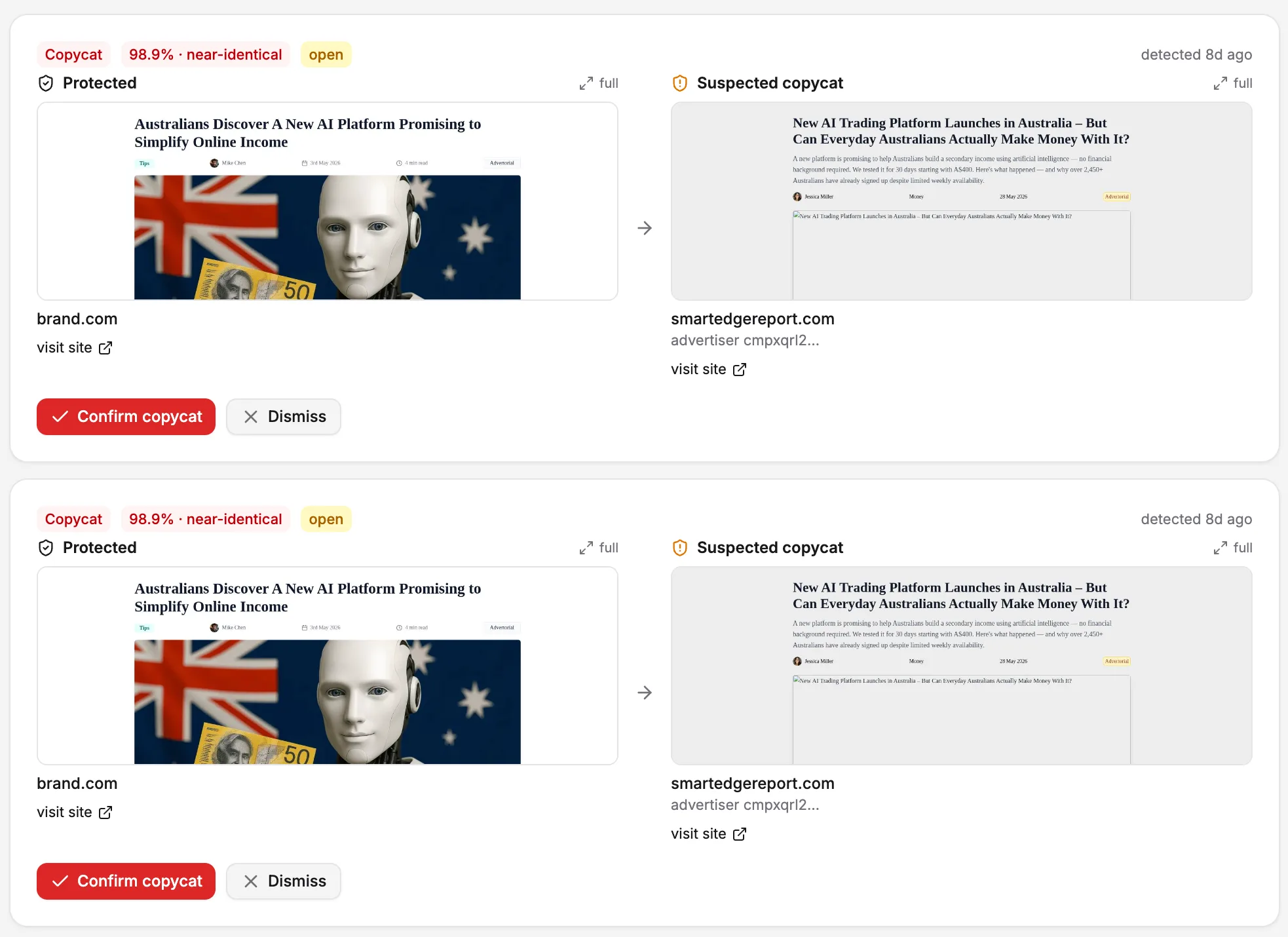
Fauxmat pages are also a recurring subject for consumer-protection journalism and platform policy research, precisely because they're hard to catch in the moment: a reporter or brand-protection analyst who sees one instance rarely has a way to show how widespread the pattern was, since the page is gone by the time anyone follows up. Treating this as a monitoring problem, not a one-off spot-check, is the only way to build a real picture of how a given template is being reused across advertisers and networks over time.
Why this matters for brands, not just consumers#
Brands get pulled into this pattern two ways: as the impersonated "outlet" whose visual identity gets borrowed without permission, or as the actual advertiser whose affiliate or agency partner is running fauxmat creative that exposes the brand to regulatory and reputational risk. Both are worth monitoring proactively rather than discovering after the fact; see our guide to brand protection in native advertising for a fuller framework on watching for both patterns.
How OpenAdLibrary helps#
Fauxmat landing pages are built to be seen once and disappear, which makes them hard to research after the fact using a browser alone. OpenAdLibrary's ad intelligence index traces the full path from a native ad creative to its actual landing page across the networks it covers, giving researchers, brand-protection teams and journalists a durable, timestamped record of pages that were deliberately built to be temporary.
The takeaway#
A fake news landing page is not a borderline aggressive marketing tactic; it's a page engineered to make you forget you clicked an ad. The masthead, the byline, the comment section and the urgency framing are all doing the same job: erasing the distinction between reporting and selling that real advertorial disclosure exists to preserve. Once you recognize the anatomy, spotting the next one takes seconds, not minutes.