

Ad-Tech Glossary
What Are Made-for-Advertising (MFA) Sites?
MFA sites are built to generate ad revenue rather than serve readers, typically thin on content and heavy on ad units and cheap paid traffic.
MFA sites are built to generate ad revenue rather than serve readers, typically thin on content and heavy on ad units and cheap paid traffic.

Bot traffic doesn't spread evenly across a native campaign — it concentrates in a handful of placements. Here are the placement-level red flags, a weekly detection workflow, and the campaign structure that keeps invalid clicks from mattering.

The headline ad-fraud numbers measure bots, not native's real problems: dead landings, cloaking and brand impersonation. Here is what placement-quality capture actually shows, and how to audit the inventory you buy.

Evidence first, traffic second, takedowns third. The exact order of operations when scammers clone your site, with the levers that actually move fast.

Ad review is a snapshot; scam campaigns are moving targets. The four techniques scammers use to pass review — and the tells that expose them after approval.

You don't need a fraud vendor to catch most bot clicks — you need your tracker, your analytics and a placement-level report read the right way. Here is the full detection stack, from cheap signals to hard proof.

There is no single honest number for bot traffic in native advertising — it ranges from negligible to campaign-killing depending on where in the supply chain you buy. Here is how the risk actually distributes, and how to measure yours.

There is no single 'deepfake ad law' — but a deepfake ad that fakes an endorsement almost always breaks several existing ones. Here is the actual legal landscape, jurisdiction by jurisdiction, and why enforcement still lags.

That ad claiming a TV host was arrested for revealing a money secret is not an accident of moderation — it is an industrialized fraud funnel. Here is who runs fake celebrity ads, how they beat review, and why they keep finding you.

Cloaking sits in a legal grey zone — but the deception it conceals usually doesn't. What the law actually says, why every ad network bans it, how it gets detected, and what the ban-cycle economics really look like.

MGID traffic is mostly real humans — but placement quality varies wildly. The signals that expose junk widgets and the 7-step framework profitable buyers use to build whitelists.

MGID is a real, 18-year-old ad network — not a scam. But the reviews aren't wrong about variance. What the complaints actually describe, and the checklist that keeps your budget safe.

Taboola sends real human clicks from mainstream publisher sites — cold ones, with huge variance between placements. What quality actually means on the network, and how the buyers who stay profitable handle it.

Reporting a scam ad rarely fails on intent, it fails on evidence, so here is the workflow that actually moves networks and regulators: what to capture, where to send it, and how to preserve the ad and its landing page before they disappear.

Copycat landing pages borrow a trusted brand's logo and tone to launder a scam through native-ad networks, and here is the practitioner's method for catching them with evidence anyone can verify.

Native ad fraud hides in the gap between the widget you see and the advertiser you don't, so here are the fraud types that matter and the supply-chain and landing-page signals that surface them.
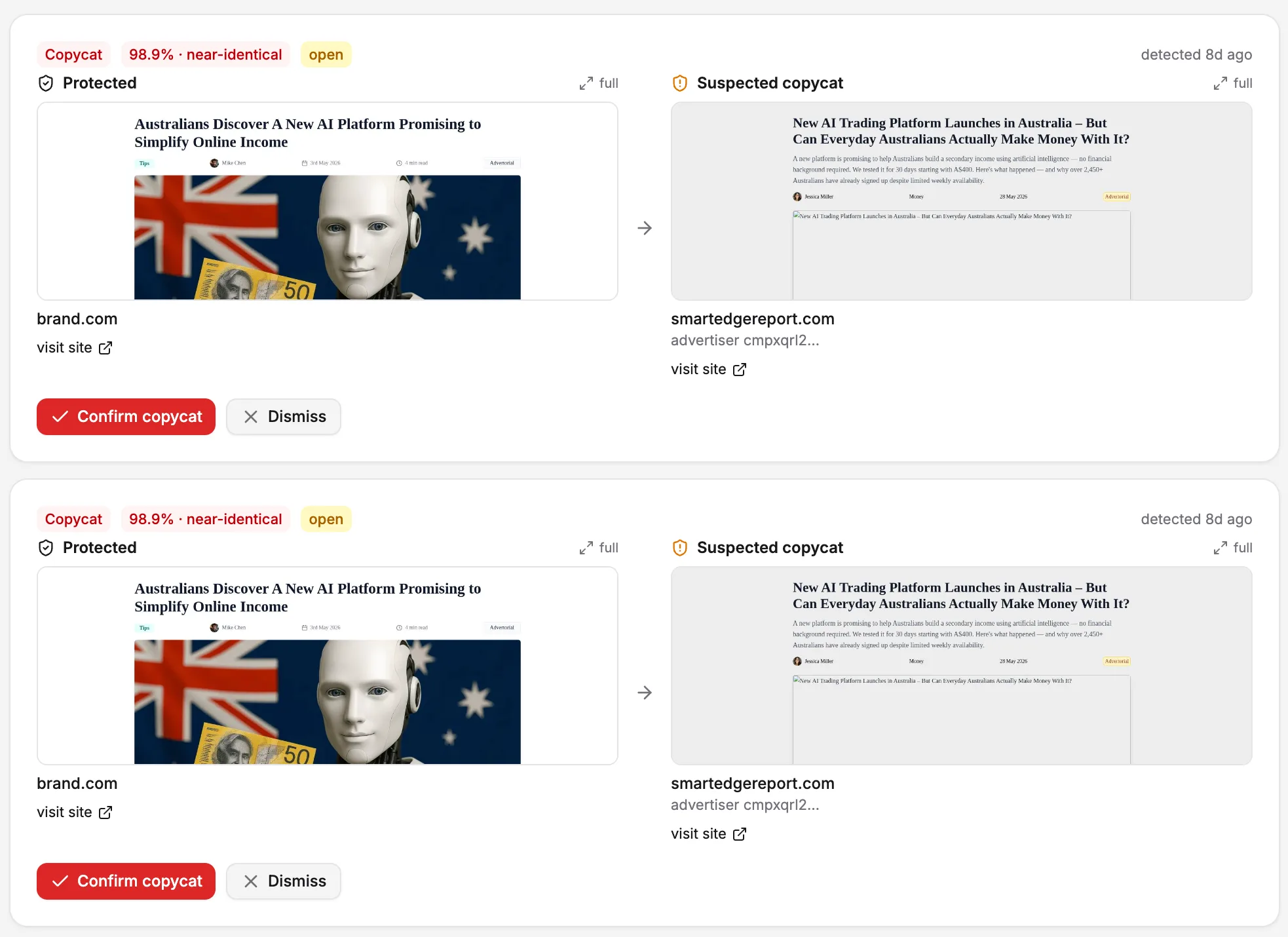
Native ad networks are where brand impersonation, copycat landing pages, and cloaked offers thrive, because the creative blends into the article and the real advertiser hides behind redirect chains; here is how to monitor, detect, document, and escalate brand abuse with evidence that holds up.

Ad cloaking is a deceptive technique that shows ad reviewers a compliant page while serving real users a different, often non-compliant destination.
Brand protection in advertising is the practice of defending a brand against impersonation, trademark misuse, cloaked ads, and copycat campaigns.

sellers.json is a public file that exchanges and SSPs publish to reveal the sellers and intermediaries authorized to sell inventory through them.
ads.txt is a public file publishers host to declare exactly which companies are authorized to sell their ad inventory.

Click fraud is the deliberate generation of fake or invalid ad clicks, by bots or humans, to drain budgets or earn illegitimate payouts.