

Ad Creative & Funnels
Are Countdown Timers on Landing Pages Legal?
The timer itself isn't the legal issue. What draws enforcement is a countdown that resets or doesn't match a real deadline, a pattern regulators treat as deceptive design.
The timer itself isn't the legal issue. What draws enforcement is a countdown that resets or doesn't match a real deadline, a pattern regulators treat as deceptive design.

A translated page still reads as foreign if the currency, payment methods, imagery and trust signals don't match the market. Here's what real localization covers, geo by geo.

A missing privacy policy or a buried disclosure is one of the cheapest ways to get an ad account suspended. Here's the minimum legal footprint a landing page needs, and where geo rules diverge.

Pageviews and bounce rate are the wrong numbers to watch on a pre-lander. Here's what actually predicts whether one is converting, and how to set up tracking that separates the pre-lander event from the offer event.

Fabricated comment sections on pre-landers fail the FTC's endorsement test and get rejected by native network compliance independently of the law. Here is why the pattern isn't worth the risk.

Native traffic is a phone-first audience, so a pre-lander adapted down from desktop will underperform one built mobile-first. Here are the design rules that actually move conversion.

Long-form advertorials and short bridge pages both win, just for different offers. Here is how offer complexity and traffic temperature decide which format fits.

Native traffic is cold and budgets are limited, so testing the wrong variables first wastes both. Here is the order experienced buyers actually test pre-landers in.

The domain hosting your pre-lander is a risk container. Here is how a dedicated root domain, a subdomain and a tracker redirect domain differ in blast radius, reputation and compliance risk.

A visitor who clicked a native ad has zero patience for a slow page, and a bounce before your pixel fires means the lost visitor never even shows up in your data.

Most prelander builds fail on tracking wiring and compliance, not copy. Here's a practical hour-by-hour workflow to get a first version tested in a single day.

Quiz funnels trade volume for qualification. Here's when the extra interactive step actually helps on native traffic and when it just adds friction.

A competitor's landing page usually changes more often than the ad pointing to it. Here's a practical way to capture, diff, and get alerted to those changes without manually revisiting URLs.

A native ad and an advertorial aren't competing formats, they're two links in the same chain: one earns the click, the other converts it. Here's how media buyers actually use both.

The ad headline sells the click; the advertorial headline sells the read. Six formulas drawn from live traced funnels, plus the compliance boundaries that end runs early.

Direct linking is faster; a landing page converts cold native traffic. When each one wins, what traced funnels show by vertical, and the math a pre-lander has to beat.

Five advertorial templates dominate live native ad funnels. Here is each one broken down — structure, live examples, and the seven-step writing process practitioners actually use.

Native networks reject landers off a short, stable list of triggers: claims language, missing trust pages, disruptive behavior, ad mismatch. The full checklist, the fix for each, and why month-old live landers are your best compliance spec.

The numbered pre-lander is native advertising's most durable format because inside a content widget it reads as content. The three listicle types, item-by-item anatomy, and what month-long live runs reveal about what converts.

Native clicks arrive with near-zero intent — quiz funnels convert that curiosity into micro-commitments and segmentation. Question sequencing, the analytics that matter at every step, and how to find live quiz landers worth modeling.

Downloading a competitor's landing page takes two minutes. What separates professionals from cloners is what happens next: an honest look at ripping tools, the legal line, and the rip-to-learn workflow that actually produces winners.

Outbrain reviews the ad and the landing page as one unit. What each review layer checks, the rejection causes behind most failures, and how to fix and resubmit without damaging your account standing.

Advertorial-ready templates, sub-second loads and tracker tokens beat drag-and-drop polish. How eight landing page builders stack up for native and affiliate funnels.

Nearly every profitable native pre-lander is built on one of six structures. Here is the block-by-block skeleton for each — hook, mechanism, proof, CTA — plus decision criteria for matching template to offer.

Rejection notices are vague; the reasons behind them are not. The ten things reviewers actually reject landing pages for, the fix for each, and how to resubmit without hurting your account.

Networks review the whole click path, not just the creative. Here are the landing page rules every major native network enforces, how the review actually works, and where each network sets the bar.

One warms cold traffic, one closes it. When your native funnel needs an advertorial, when it should go straight to the landing page, and how to test the choice honestly.

Direct linking is a validation tool; landing pages are a scaling tool. Here is the math that separates them, what live native funnels actually do, and a five-question test to pick the right setup for your campaign.

Conversion rates are private, but sustained ad spend isn't. How 1.3 million landing captures reveal the best-converting page anatomy in health, finance, lead-gen and ecommerce.
Copycat landing pages borrow a trusted brand's logo and tone to launder a scam through native-ad networks, and here is the practitioner's method for catching them with evidence anyone can verify.

Studying a competitor's ads one at a time tells you almost nothing; cluster them by the landing page each one points at and the whole offer strategy, the winners they keep alive and the tests they quietly kill, reads straight off the page.

The hard part of competitor research isn't seeing the ad, it's finding where the click lands, so here's how to trace a native ad to the real landing page, capture the evidence, and read the funnel.

The six pre-lander formats that actually convert cold native clicks, mapped to traffic temperature and offer complexity, with real captured ads showing each one in the wild.

Advertorials convert when the page resolves the exact tension the ad created, so here's the seven-section anatomy with teardowns pulled from live native captures, not stale swipe files.

A native ad is just the doorway; here is how to walk the full chain behind it, from creative to SSP to click tracker to pre-lander to offer page, and read what each link reveals about a competitor's strategy.
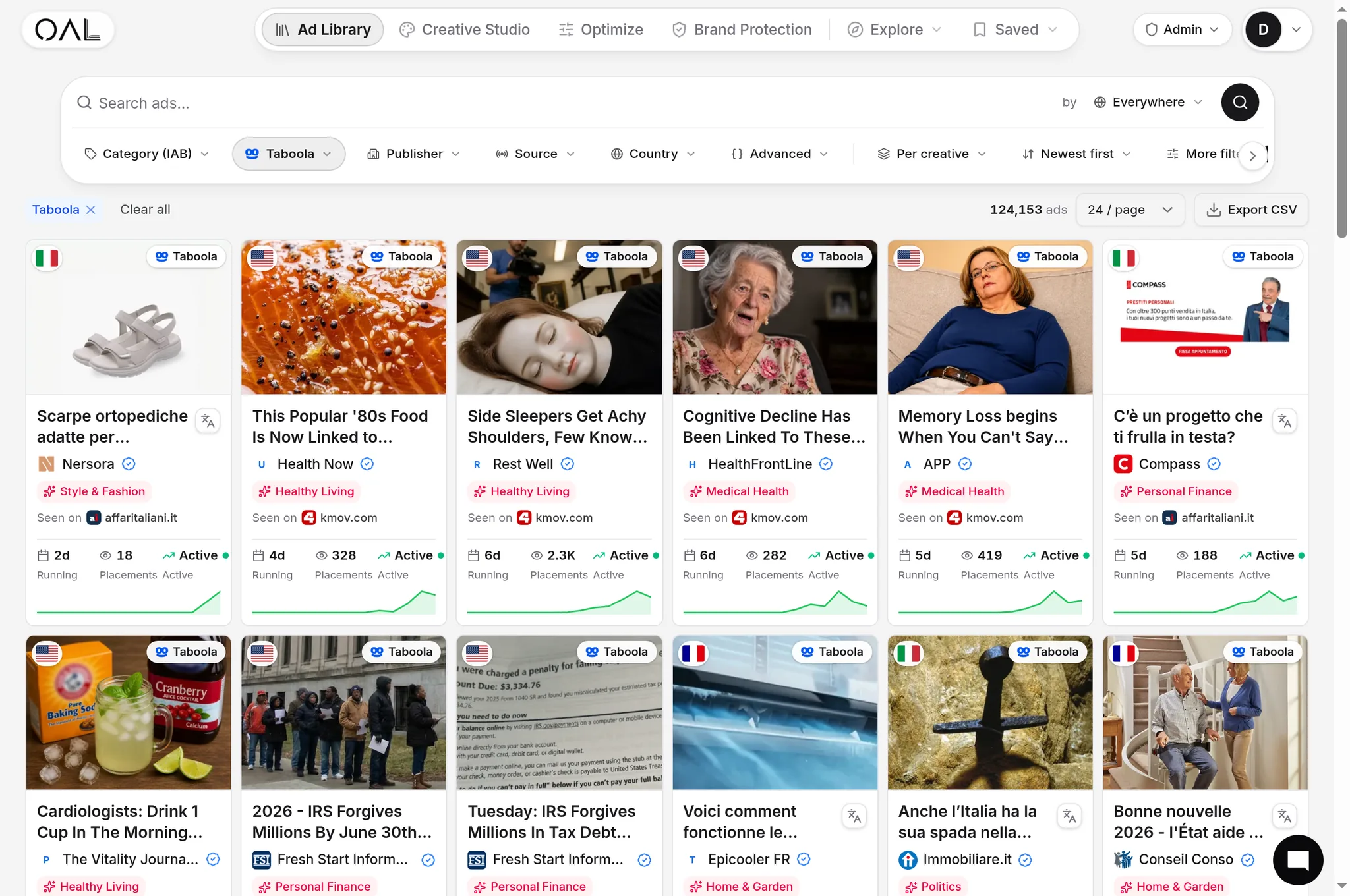
Native ads hide in plain sight at the bottom of every article, and here is how to find who is really buying them, read the creative and supply chain behind each placement, and trace the click to the landing page without ever firing a live ad.

A working media buyer's ranking of the best native ad spy tools for affiliate marketers in 2026, scored on landing-page access, network filters, geo, and price, with the real captured creatives to prove the point.

A landing page is the standalone destination a visitor lands on after clicking an ad, built around one conversion goal such as a purchase or sign-up.
A bridge page is an intermediate page that connects a traffic source to an offer, pre-selling the visitor before handing them to the final landing page.
A pre-lander is an intermediate page between the ad click and the offer that warms up and qualifies the visitor before the final landing page.
An advertorial is a paid page written in editorial style that pre-sells a product or offer before sending the reader to the sales page.