Español
 Português (Brasil)
 Français
 Deutsch
 Italiano
 Nederlands
 Polski
 Svenska
 Türkçe
 Русский
 日本語
日本語 한국어
한국어 简体中文
简体中文 Tiếng Việt
 Bahasa Indonesia
 繁體中文
繁體中文 Čeština
 Dansk
Dansk Norsk (bokmål)
 Suomi
Suomi Ελληνικά
 Română
 Magyar
 Українська
 ไทย
ไทย हिन्दी
 العربية
 עברית
עבריתHow to Scale Outbrain Campaigns: Budgets, Sections & Rotation
Scaling an Outbrain campaign by just raising the daily budget is the fastest way to blow up your CPA. Here is the sequence that holds performance while spend goes up.


Scaling an Outbrain campaign means growing spend in a sequence, budget first in small steps, then sections and geos, then creative rotation, while watching CPA and CTR at every step rather than after the fact. Jump straight from a $50 to a $500 daily budget and you will usually watch CPA climb within 48 hours, because Outbrain's auction re-learns your campaign every time the budget moves and a big jump throws it back into a rough exploration phase at exactly the moment you need it stable.
This is the same trap that catches new advertisers on Taboola and every other auction-based native network, but Outbrain has its own wrinkles. Its inventory leans premium publisher, its sections behave more like sub-audiences than Taboola's widget slots, and its merger with Teads has shifted some inventory dynamics over the past year. Here is the scaling sequence that holds up in practice.
Why Outbrain scaling breaks differently than Taboola#
Outbrain runs on a modified auction across a smaller, more curated publisher footprint than Taboola. OpenAdLibrary's index currently holds 108,573 live Outbrain creatives (June 2026) against 206,145 for Taboola, roughly half the volume. That narrower inventory pool means a sudden budget increase competes for a smaller set of impressions, so the auction has less room to find you cheap ones before it starts bidding up. You feel this as CPA creeping upward within a day or two of a big budget jump, well before creative fatigue or audience saturation would normally explain it.
The practical implication: Outbrain punishes big jumps harder than Taboola does, and rewards patience more. If you have a campaign that has been converting at a stable CPA for five to seven days, that stability is the asset you are protecting. Every scaling move should be sized to not threaten it.
Step 1: Scale budget in increments, not jumps#
Media buyers commonly report raising Outbrain budgets in 15 to 25 percent steps every two to three days, holding each step until CPA settles back to baseline before moving again. This is a heuristic, not an official Outbrain guideline, but it is the pattern that shows up across accounts that scale successfully rather than burning through a winning campaign in a week.
A few things to check before every step up:
- CPA trend over the last 48 hours, not the lifetime average. A campaign with a rising 48-hour CPA is not ready for more budget regardless of what the all-time number says.
- Frequency and impression share. If you are already capturing most of the available impressions in your targeted sections, more budget just bids up the same inventory rather than reaching new users.
- Landing page load and conversion consistency. Scaling budget scales traffic to your landing page too; if your funnel has any capacity or tracking issues, they get worse, not better, at volume.
Step 2: Expand sections and geos before you expand budget further#
Once a single section and geo combination is performing and budget increases start showing diminishing returns, the next lever is breadth, not depth. Outbrain groups publisher inventory into sections, and duplicating a winning ad set into an adjacent section or a new geo tier often scales spend with less CPA pressure than pushing more dollars into the same section.
This is horizontal scaling rather than vertical scaling, and the tradeoffs between the two approaches are worth understanding in more depth. Our guide on horizontal vs vertical scaling in native media buying covers when each makes sense; the short version for Outbrain is that its narrower inventory base makes horizontal moves relatively more valuable than they are on Taboola, because you run out of room to scale vertically sooner.
If you are also considering moving into new markets, scaling to new geos is the companion piece: Tier 2 and Tier 3 markets on Outbrain tend to have thinner competition and lower CPCs, which is a different scaling lever than budget or sections entirely.
Step 3: Build a creative rotation schedule, not a single winning ad#
Every scaled campaign eventually runs into creative fatigue: CTR declines as the same audience sees the same ad repeatedly, and Outbrain's algorithm starts deprioritizing it in the auction. The fix is not waiting for fatigue to show up in the numbers and reacting; it's having replacement creative ready before you need it.
A workable rotation cadence for a scaling campaign:
| Scaling phase | Active creative count | Rotation trigger |
|---|---|---|
| Testing (pre-scale) | 3 to 5 variants | Kill anything below threshold CTR after meaningful volume |
| Early scale | 5 to 8 variants | Add 2 to 3 fresh variants weekly |
| Full scale | 8 to 12+ variants | Add fresh variants every 3 to 5 days; retire anything with declining CTR trend |
The reason to keep more variants live at full scale isn't variety for its own sake. It's that a bigger budget serves more impressions per day, so each individual creative burns through its useful life faster. The ad longevity signal is useful here in reverse: on the open market, a creative that keeps running for weeks is a signal it is still converting; inside your own account, a creative whose CTR is sliding while spend holds steady is telling you the opposite.
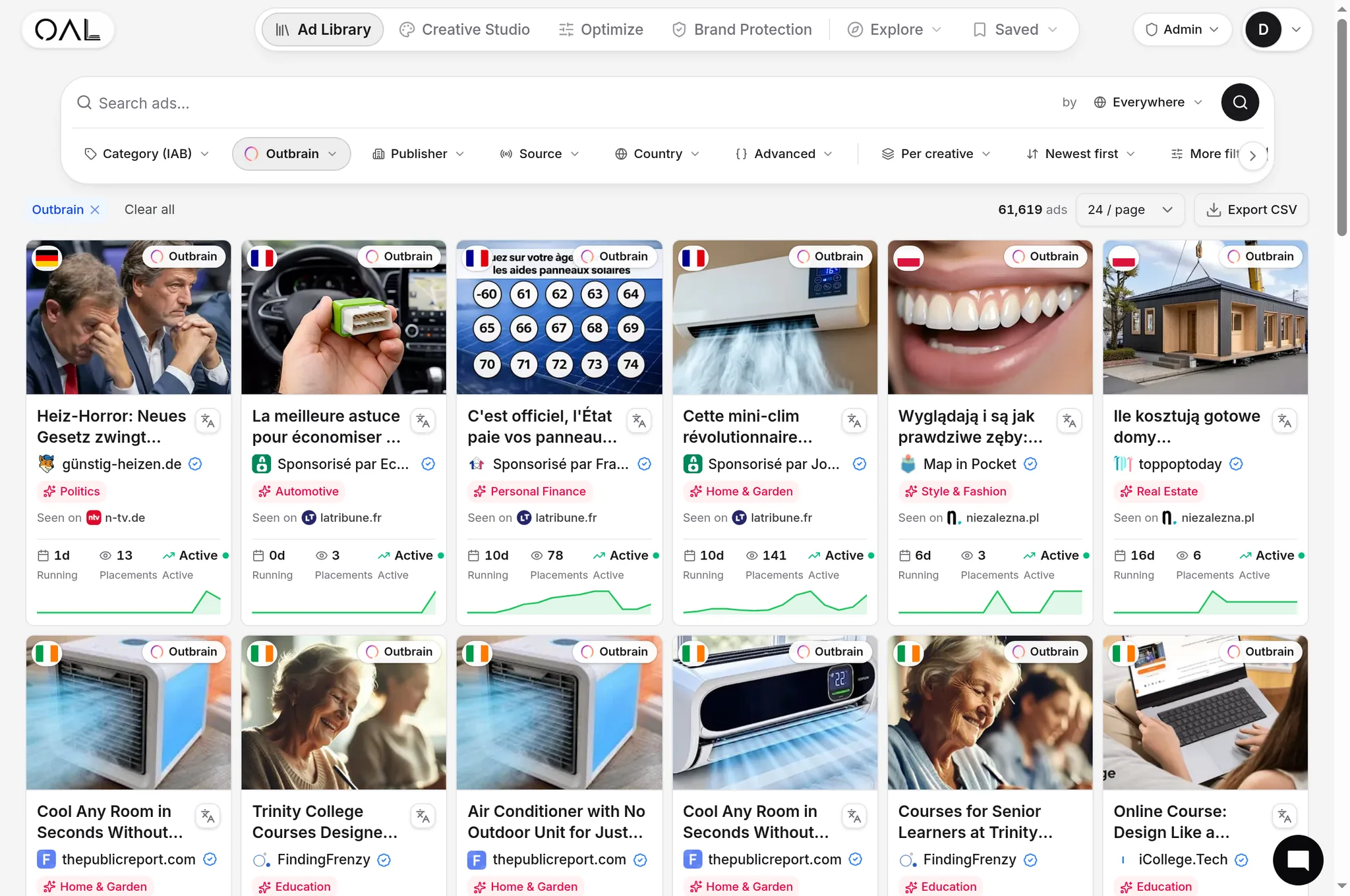
Studying what's actually surviving at scale elsewhere on the network is a fast way to build your rotation list before you need it. The Outbrain ad spy guide covers the workflow, and the Outbrain ad library is where you pull the raw creative data: as of June 2026 it holds the full 108,573-creative index with observed run length on every entry, so you can see which formats and hooks are persisting in your vertical before you commit budget to your own version.
Step 4: Watch the metrics that actually predict a scaling failure#
CPA is a lagging indicator. By the time it moves, the underlying problem has usually been building for a day or two. Two earlier signals catch it sooner:
- CTR decline on your top creative. A 15 to 20 percent CTR drop over 3 to 4 days on your best-performing ad, with spend held constant, usually precedes a CPA spike by 24 to 48 hours.
- Bid pressure without volume growth. If your effective CPC is rising but daily conversions are flat, the auction is telling you that you have hit the ceiling of available impressions at your current targeting and budget level is no longer the constraint.
Either signal is a cue to pull back the scaling pace, not necessarily to stop scaling altogether. Dropping back to the previous budget step for a few days while refreshing creative is usually enough to reset.
Common scaling mistakes#
- Raising budget and refreshing creative on the same day. You lose the ability to tell which change moved your numbers. Space them out by at least 48 hours.
- Scaling a campaign that has only run 3 to 4 days. Outbrain's own optimization needs a stable data baseline; scaling before that baseline exists just adds noise to noise.
- Ignoring section-level performance. A campaign's blended average can hide one section quietly losing money while another carries it. Check section-level breakdowns before every scaling decision.
- Treating all geos as equal. Contextual targeting and publisher mix vary a lot by country on Outbrain; a scaling pace that works in the US often needs to be slower in a market where your available section inventory is thinner.
How OpenAdLibrary helps you scale with more confidence#
Most of the risk in scaling comes from not knowing what "normal" looks like for your vertical on Outbrain, which makes every CPA wobble feel like an emergency. Pulling up your vertical and geo inside the Outbrain ad spy tool shows you what advertisers already scaling successfully in your space are running right now, how long their creative sets have survived, and roughly how many variants they keep in rotation. That context turns "is this CPA bump normal" from a guess into a comparison against real, currently-running campaigns.
The bottom line#
Scaling Outbrain successfully is a sequencing problem more than a budget problem. Move in small, spaced-out budget steps, expand sections and geos once a single combination plateaus, keep a deeper creative bench than you think you need, and watch CTR and bid pressure rather than waiting for CPA to confirm a problem that has already been building for days.