Español
 Português (Brasil)
 Français
 Deutsch
 Italiano
 Nederlands
 Polski
 Svenska
 Türkçe
 Русский
 日本語
日本語 한국어
한국어 简体中文
简体中文 Tiếng Việt
 Bahasa Indonesia
 繁體中文
繁體中文 Čeština
 Dansk
Dansk Suomi
Suomi Ελληνικά
 Română
 Magyar
 Українська
 ไทย
ไทย हिन्दी
 العربية
 עברית
עבריתOutbrain Bid Strategies Explained: Semi-Auto, Max Conversions & CPC Caps
Outbrain's bidding runs on manual CPC, Conversion Bid Strategy (three modes), and Engagement Bid Strategy. Here is how each works and which one fits your account's data volume.


Outbrain's bidding runs on three layers: manual cost-per-click, where you set a hard ceiling yourself; Conversion Bid Strategy (CBS), which bids per publisher section and audience toward a conversion goal; and Engagement Bid Strategy (EBS), which optimizes toward on-site behavior instead of a hard conversion event. Most accounts with real conversion volume end up on CBS, but understanding all three, and when each one actually fits, is what separates accounts that scale from accounts that stay stuck on manual all the way to shutdown.
This sits under Outbrain's self-serve Amplify dashboard, and the mechanics described here carry over whether your account still says Outbrain or has been rebranded under Teads following the 2025 merger. For the full picture of how the auction itself ranks ads before bid strategy even enters the picture, see our guide to how Outbrain works.
Manual CPC: the starting point for new accounts#
Manual CPC bidding means you set a maximum cost per click and Outbrain's auction decides whether your ad wins a slot based on that bid combined with predicted engagement. It is the least sophisticated option and the right one for exactly one scenario: a brand new account or campaign with no conversion history yet.
The reason manual makes sense here is not that it performs better, it almost never does once you have data, but that Outbrain's automated bidding needs conversion volume to train against. Launching straight into an automated strategy with zero historical conversions gives the algorithm nothing to learn from, and it will often spend inefficiently while it gropes for a pattern. Manual CPC over the first one to two weeks of a new campaign, watched closely and adjusted by section, builds the conversion history that automated bidding then optimizes against.
A practical manual CPC workflow:
- Set an initial bid in the middle of what you have seen reported for your vertical and geo tier, not the floor and not the ceiling.
- Let the campaign run long enough to generate statistically meaningful clicks per publisher section, not just overall.
- Review section-level performance and cut or lower bids on sections with poor conversion signal, even if overall CPC looks acceptable.
- Once you have enough conversions (the exact threshold varies by account and vertical; check the network's current documentation for guidance), migrate to Conversion Bid Strategy.
Conversion Bid Strategy (CBS): the default for scaling accounts#
CBS ingests your first-party conversion data through the pixel and adjusts bids automatically per publisher section and audience segment to hit a stated goal. It runs in three modes:
| Mode | What it does | When to use it |
|---|---|---|
| Target CPA | Defends a specific cost-per-acquisition number you set | You know your breakeven CPA and want the algorithm to hold the line |
| Fully-Automatic | Maximizes conversion volume within your budget, without a hard CPA ceiling | You have budget headroom and want maximum volume, willing to accept some CPA drift |
| Semi-Automatic | Pushes budget toward the top-converting sections and audiences while you retain manual override control | You want automation's efficiency but are not ready to hand over full control |
Semi-Automatic is the mode most media buyers reach for first when moving off manual, because it keeps a human hand on the wheel while letting the algorithm do the heavy lifting of section-level reallocation, work that is tedious and slow to do by hand across dozens of publisher sections. Target CPA suits accounts with a firm, known breakeven number where holding the CPA line matters more than maximizing raw volume. Fully-Automatic suits accounts chasing scale where some CPA variance is an acceptable tradeoff for hitting a higher total conversion count.
The honest limitation across all three CBS modes: they are hungry for data. An account with thin, sporadic conversion volume will see CBS underperform manual bidding, because the algorithm keeps re-learning from noise instead of a stable signal. If your daily conversion count is in the single digits, expect a longer, rockier learning period before CBS earns its keep.
Engagement Bid Strategy (EBS): the cookieless fallback#
EBS optimizes toward on-site engagement signals, time on page, scroll depth, pages per session, pulled from your analytics, rather than a hard conversion event like a purchase or lead form submission. This exists for a specific gap: accounts that do not have enough conversion volume to train CBS, or that operate in a funnel where the actual conversion happens off-site or with a long delay (a lead that gets called and closed days later, for instance).
EBS is not a replacement for CBS when you have real conversion data; treat it as a bridge strategy for early-stage campaigns or thin-conversion accounts, with a plan to migrate to CBS once your pixel accumulates enough purchase or lead events to make that switch worthwhile.
Bid caps and section-level manual overrides#
Even inside an automated bidding mode, most accounts retain some manual control worth using actively:
- Section-level bid caps. If a specific publisher section is burning budget without converting, cap or exclude it manually rather than waiting for the algorithm to deprioritize it on its own, which can take longer than you want to wait.
- Device-level adjustments. Desktop and mobile often convert at meaningfully different rates for the same offer; watch this split even under automated bidding.
- Dayparting where supported. Some accounts see conversion rate vary by time of day in ways worth capping bids around, particularly for offers with a call-center or live-chat close.
These manual levers are how experienced buyers keep automated bidding honest. CBS optimizes toward the goal you gave it, but it is optimizing within whatever targeting and section pool you have set up; a bad section pool produces a worse outcome no matter how good the bidding algorithm is underneath it.
How bid strategy choice affects your effective CPC#
The bidding mode you choose interacts directly with what you actually pay per click. Manual CPC gives you a hard ceiling but no intelligence about which sections or audiences are worth paying more for. CBS in any mode will often push effective CPC higher on specific high-converting sections (because it has learned those clicks are worth more) while pulling it down elsewhere, which can make your blended average CPC look similar to manual even though the underlying allocation is far smarter. This is one reason a blended CPC benchmark, the kind covered in our native ad CPC benchmarks study, tells you less than section-level data does about whether your bidding strategy is actually working.
Researching bid behavior through live creative data#
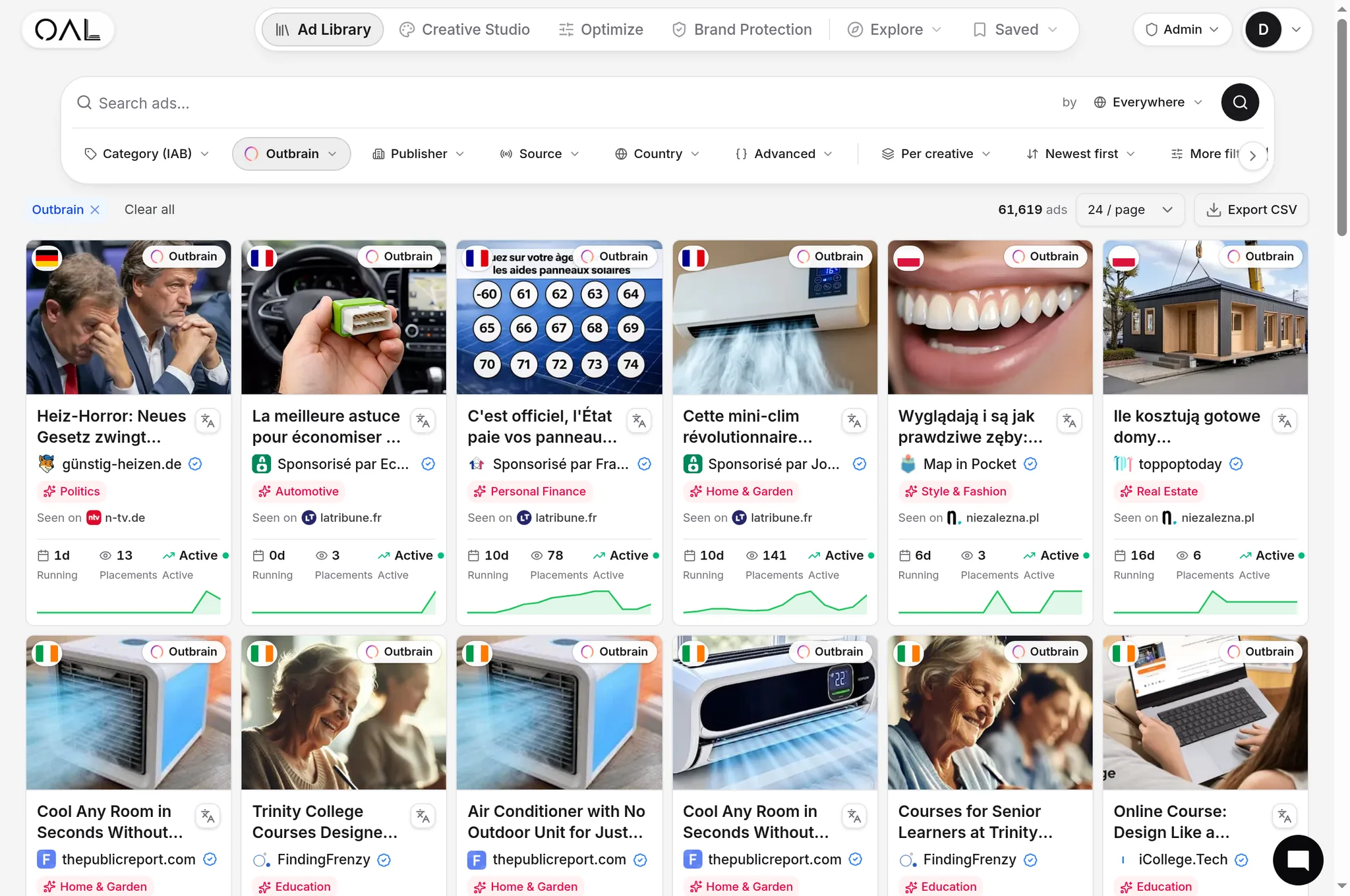
Bid strategy decisions get easier when you can see what is actually surviving in the market. A creative that has held a paid Outbrain slot for weeks is strong evidence that whatever bid strategy is behind it, manual or CBS, is working well enough to keep spending. OpenAdLibrary's index holds 108,573 live Outbrain creatives as of June 2026, each tagged with observed run length, so you can gut-check a new campaign's target CPA against what proven, long-running creatives in your vertical are managing to sustain. The /spy/outbrain tool lets you filter by vertical to build that picture before you commit to a bid strategy and a number.
Common bid-strategy mistakes#
- Switching to CBS too early, before enough conversion volume exists to train it, then blaming the algorithm when it underperforms manual.
- Setting a Target CPA below your actual breakeven out of caution, which starves the algorithm of winnable auctions and suppresses volume rather than protecting margin.
- Ignoring section-level data because the blended number looks fine. A healthy overall CPA can hide a few sections quietly losing money while others carry the account.
- Never revisiting bid strategy after initial setup. An account that launched on manual eighteen months ago and never migrated to CBS is very likely leaving efficiency on the table, especially if conversion volume has grown enough in the meantime to train the algorithm properly.