Español
 Português (Brasil)
 Français
 Deutsch
 Italiano
 Nederlands
 Polski
 Svenska
 Türkçe
 Русский
 日本語
日本語 한국어
한국어 简体中文
简体中文 Tiếng Việt
 Bahasa Indonesia
 繁體中文
繁體中文 Čeština
 Dansk
Dansk Norsk (bokmål)
 Suomi
Suomi Ελληνικά
 Română
 Magyar
 Українська
 ไทย
ไทย हिन्दी
 العربية
 עברית
עבריתHow to Lower Outbrain CPC: Section Bids, Creatives & Timing
Outbrain ranks ads on predicted value, not bid alone, so creative and section-level cuts move your CPC more than the bid field does. Here is the order of operations that works.


Lowering your Outbrain CPC comes down to three levers that actually move the number: cutting or capping weak publisher sections, improving creative click-through rate so the auction ranks you higher at the same bid, and adjusting when and where your budget spends. Outbrain's auction ranks ads on predicted value, bid multiplied by predicted engagement and conversion likelihood, not on bid alone, which means a better creative routinely beats a higher bid. That single fact is why creative work, not the bid field, is where most sustainable CPC reduction actually happens.
This guide walks through each lever in the order most media buyers should actually work through them, cheapest and fastest first.
Start with section-level bid caps and exclusions#
Every Outbrain campaign spends across dozens, sometimes hundreds, of individual publisher sections, and performance across them is never even. A handful of sections typically drive most of your conversions while a long tail drags down your blended CPC and CPA without contributing much.
The fastest, lowest-effort CPC reduction most accounts can make: pull section-level performance data after your campaign has run long enough to generate meaningful volume per section, then cap bids or exclude outright the sections converting worst. This does not lower the CPC on your good sections directly, but it stops you paying for expensive, unproductive clicks on weak ones, which pulls your blended average down and frees budget to spend where it actually converts.
Do this review on a schedule, weekly for active campaigns, rather than once at launch and never again. Publisher section performance drifts as content mix and reader behavior on those pages change over time.
Improve creative click-through rate#
Because Outbrain ranks on predicted value rather than raw bid, a creative with a materially higher click-through rate can win auction slots at a lower effective cost per click than a weaker creative bidding higher. This is the single biggest lever available to advertisers, bigger than any manual bid adjustment, and it is the one most accounts underinvest in relative to time spent fiddling with the bid strategy dashboard.
Practical creative levers that move CTR, and therefore effective CPC, most reliably:
- Test more headline variants per image, not just more images. The headline usually carries more of the click decision than the image does, since it holds the specific curiosity gap or claim.
- Match the creative's visual style to the surrounding publisher content. A native thumbnail that reads as editorial photography rather than a display ad blends into the feed and earns more organic-feeling attention.
- Refresh creative before it visibly fatigues, not after. CTR decay on a stale creative is usually gradual, and by the time it shows up clearly in a weekly CPA report, you have already been overpaying for days or weeks.
- Study what is already surviving in your vertical. A creative that has held a live Outbrain slot for weeks has proven it converts well enough to keep funding, which makes it useful reference material for your own headline and image direction. Our guide to analyzing winning native ad creatives covers how to read those signals systematically.
Our deeper guide on native ad creative best practices covers the image and headline mechanics in more depth if you want a full framework rather than a quick checklist.
Move off manual CPC once you have conversion data#
If you are still running manual CPC bidding after a few weeks of live conversion volume, you are very likely leaving efficiency on the table. Outbrain's Conversion Bid Strategy adjusts bids automatically per publisher section and audience to hit a stated cost or volume goal, work that is slow and imprecise to replicate manually across dozens of sections. Understanding how each mode works, and which one fits your account's conversion volume, is worth doing before you flip that switch rather than after.
The honest caveat: automated bidding needs real conversion data to work well. If your daily conversion count is thin and sporadic, expect a rocky learning period. That is a reason to build toward automated bidding deliberately, not a reason to avoid it indefinitely.
Adjust targeting to cut wasted spend#
A few targeting adjustments reliably lower blended CPC by removing low-value impressions from the mix rather than by winning cheaper auctions directly:
- Device-level bid adjustments, since desktop and mobile often convert at meaningfully different rates for the same offer, and an even bid across both wastes budget on the weaker device.
- Geo tier discipline. Tier-1 markets clear at a real premium over Tier-2 and Tier-3 inventory. If your offer converts acceptably in lower-tier geos, shifting some budget there lowers your blended CPC without touching bid strategy at all.
- Audience and retargeting layers, where available, tend to convert at a lower effective cost than fresh cold traffic, since the reader already has some familiarity with your brand or offer.
Timing: when your budget spends matters more than most buyers assume#
Native inventory competition is not flat across the day or week. Publisher traffic volume shifts by time of day, and so does the competitive density of advertisers bidding into the same sections. A few timing-related adjustments worth testing:
- Dayparting around your actual conversion pattern, not just traffic volume. An offer with a call-center close, for instance, often converts far better during business hours regardless of when raw traffic peaks.
- Watching weekend versus weekday performance separately. Many verticals see meaningfully different CPC and CPA on weekends, when publisher traffic mix and reader intent both shift.
- Avoiding aggressive budget increases right after a launch. Ramping spend too fast before the algorithm, whether manual review or automated bidding, has stabilized on a section pool tends to produce worse blended CPC than a slower, more deliberate scale-up.
What a realistic CPC range looks like, and why it varies so much#
Media buyers commonly report Tier-1 desktop CPCs on Outbrain landing in a wide range depending heavily on vertical competition and creative quality; treat any specific number you see quoted elsewhere as a rough starting point, not an official rate, and expect finance, insurance, and health verticals to clear meaningfully above lighter content categories. Our native ad CPC benchmarks study breaks down how geo tier, device, and vertical competition each move the number independently, which matters more for planning purposes than any single blended average.
Benchmark against what is actually surviving in the market#
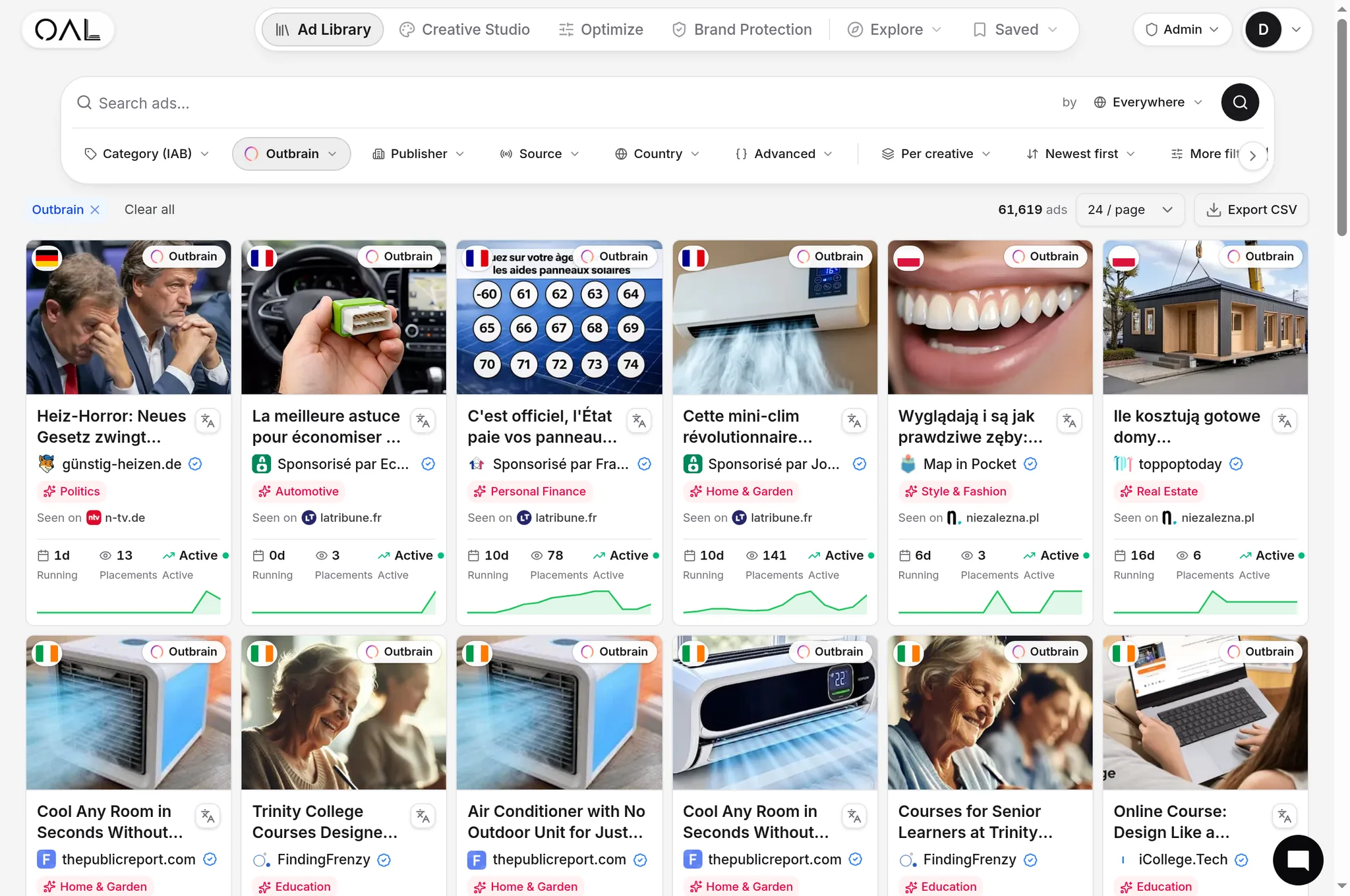
The most reliable signal that a CPC and creative combination is working is longevity: advertisers do not typically keep funding a losing campaign for weeks on end. OpenAdLibrary's index holds 108,573 live Outbrain creatives as of June 2026, each tagged with observed run length and vertical, which gives you a real-world reference point for what a sustainable creative and cost structure looks like in your category before you commit to a specific bid target. The /spy/outbrain tool filters that index by vertical and advertiser, and our pricing page covers the tiers if you want ongoing access to the full research workflow.
A simple order of operations#
For an account with rising or stubbornly high CPC, work through the levers roughly in this order: pull section-level data and cut the worst performers first, since it is the fastest fix; refresh creative if CTR has been flat or declining for more than a week or two; confirm you have moved to Conversion Bid Strategy once conversion volume supports it; then layer in device, geo, and dayparting adjustments as a final tuning pass. Chasing a lower CPC by adjusting the bid number alone, without touching sections or creative, is usually the slowest and least durable way to move it.
Keep a simple log of what you changed and when, section cuts, creative refreshes, bid strategy switches, dated against your CPC and CPA trend line. Without that log it becomes almost impossible to tell which lever actually produced a given week's improvement, and you end up repeating the slow, low-value adjustments while skipping the ones that worked. A few months of that log also becomes a useful internal benchmark of its own: what a realistic CPC floor looks like for your specific offer and geo mix, independent of any published industry range.