Español
 Português (Brasil)
 Français
 Deutsch
 Italiano
 Nederlands
 Polski
 Svenska
 Türkçe
 Русский
 日本語
日本語 한국어
한국어 简体中文
简体中文 Tiếng Việt
 Bahasa Indonesia
 繁體中文
繁體中文 Čeština
 Dansk
Dansk Norsk (bokmål)
 Suomi
Suomi Ελληνικά
 Română
 Magyar
 Українська
 ไทย
ไทย हिन्दी
 العربية
 עברית
עבריתBest Niches for MGID: Why Entertainment Dominates (13,987 Creatives)
Entertainment isn't just MGID's biggest vertical — at 13,987 classified live creatives it outweighs the next five combined, several times over. A data study of what actually runs on the network and what it means for buyers.


Measured by what is actually running, the best niches for MGID are entertainment first and everything else a distant second: entertainment accounts for 13,987 classified live creatives in OpenAdLibrary's index — more than five times the next five verticals combined — followed by health (1,220), insurance (663), real estate (309), ecommerce (265) and food & beverage (219). That distribution, drawn from 62,765 live MGID ads observed as of July 2026, is unlike any other major native network we index: on Taboola, health and finance lead; on Revcontent, health leads. The practical takeaway for media buyers is that MGID rewards offers that can be packaged as mass-market story content — and punishes anything that needs a premium context to convert.
Where this data comes from#
OpenAdLibrary continuously observes live native ad placements, resolves each creative's advertiser and landing page, and classifies creatives by vertical. As of July 2026 the index holds 725,000+ native ad creatives across 49 networks; the MGID slice analyzed here is 62,765 live creatives. Vertical labels cover the subset of creatives classified with confidence, so the counts below are floors rather than a census — the ranking between verticals is the reliable signal, more than any absolute number.
Each creative also carries first-seen and last-seen dates from continuous observation, a resolved advertiser where the landing trace allows it, and geo and device context — which matters for this study because raw creative counts alone can flatter high-churn verticals. Where longevity changes the reading, we say so. For the network's mechanics — formats, targeting, pricing model — see how MGID works; this study is about what the demand side is actually buying.
The numbers: MGID's vertical mix#
| Rank | Vertical | Live classified creatives | Share of all 62,765 MGID creatives |
|---|---|---|---|
| 1 | Entertainment | 13,987 | 22.3% |
| 2 | Health | 1,220 | 1.9% |
| 3 | Insurance | 663 | 1.1% |
| 4 | Real estate | 309 | 0.5% |
| 5 | Ecommerce | 265 | 0.4% |
| 6 | Food & beverage | 219 | 0.3% |
Verticals two through six sum to 2,676 creatives. Entertainment alone is 5.2 times that combined total, and 11.5 times health, the runner-up. Even allowing generously for classification coverage, no reweighting closes a gap that wide.
How MGID's mix compares with other native networks#
The same index classifies every major content-recommendation network the same way, which makes the contrast unambiguous:
| Network | #1 classified vertical | #2 | #3 | Live creatives indexed |
|---|---|---|---|---|
| MGID | Entertainment (13,987) | Health (1,220) | Insurance (663) | 62,765 |
| Taboola | Health (11,982) | Finance (8,200) | Insurance (7,422) | 206,145 |
| Outbrain (Teads) | Insurance (4,345) | Finance (3,990) | Health (3,102) | 108,573 |
| Revcontent | Health (2,566) | Finance (816) | Home & garden (789) | 15,789 |
Every other network is led by monetization-first offer verticals — health, finance, insurance — the categories where advertisers have deep funnels and deep pockets. MGID alone is led by a creative style as much as an industry, and by a margin no other network approaches.
Two practical implications fall out of that table:
- Health buyers face far fewer incumbent creatives on MGID than on Taboola — 1,220 versus 11,982 live classified health ads. Less contextual demand, yes, but also dramatically less direct competition for the same curiosity click. For an angle already proven on Taboola, MGID is a cheap, under-contested port.
- Finance is conspicuously absent from MGID's top six while ranking second on all three rivals. Buyers with compliant finance offers should read that as thin native demand competing for MGID's finance-curious readers — either an overlooked opening or a warning that the traffic quality does not convert for the vertical. A small structured test settles which, and it costs little on this network.
The full head-to-head for buyers is in MGID vs Taboola; the rest of this study digs into why MGID's mix looks like this and what to do with it.
Why entertainment dominates MGID#
Three structural forces produce the skew:
- The supply base. MGID's publisher network leans toward entertainment, news and viral-content sites, with a strong Tier-2/3 international footprint. Audiences on those pages are browsing for diversion, and the ad that wins the click is the one that looks like more diversion.
- Click economics. MGID's CPCs sit at the affordable end of native, which is exactly where story-content advertisers and traffic-arbitrage operations can make volume math work. Cheap curiosity clicks feed content loops that monetize on the other side; expensive premium clicks do not.
- Creative culture. The curiosity-gap teaser is the unit MGID's marketplace was built around. Buyers who arrive with polished product ads watch them lose auctions to story cards; the survivors adapt, which compounds the house style.
There is also a selection effect worth naming: networks attract the demand their moderation tolerates and their price point enables. MGID's affordable clicks and pragmatic review make it the venue of choice for high-tempo creative testing — buyers who iterate ten story angles a week rather than polishing one brand-safe concept a quarter. That testing culture generates enormous creative volume per advertiser, which further inflates the entertainment count relative to networks where each approved creative represents more spend.
None of this makes MGID a bad network — it makes it a specific one. The buyers who profit on it are the ones who work with the grain.
What "entertainment" actually contains — read the label carefully#
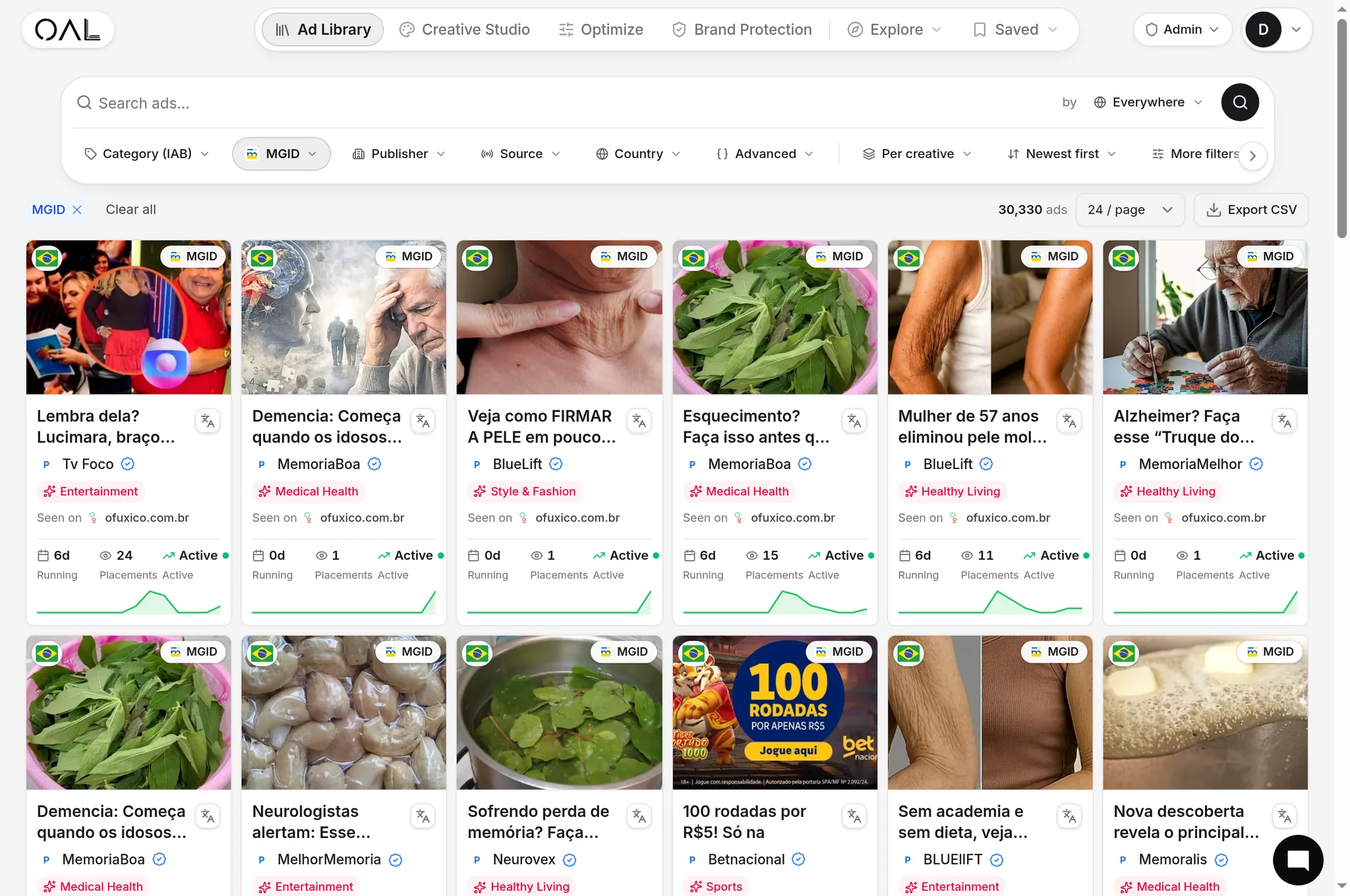
The vertical label describes the creative's packaging, and on MGID a meaningful share of "entertainment" creatives are performance offers wearing content clothing. Live examples from the index make the point: a red-light gum-regrowth device running under the headline "Dentists Said Gums Can't Grow Back. Red Light Proves Them Wrong" classifies alongside entertainment-style content, as does an over-the-counter pain product billed as "Doctors Call It 'Nature's Morphine'." Even a B2B marketing-audit service runs story-styled units on the network rather than anything resembling a LinkedIn ad.
The lesson is not that entertainment content is the only thing being sold. It is that the entertainment creative format is MGID's lingua franca: whatever the underlying offer, the ad that wins is the one a bored reader would tap like the next story. If your creative reads like an ad, you are fighting the network; if it reads like content, you are using it. The recurring hook patterns — and how to tell a durable angle from a burned one — are cataloged in our breakdown of the most common native ad angles.
Niche-by-niche: where the openings are#
Health and beauty — 1,220 creatives, the offer heartland#
Health is MGID's second-largest classified vertical and its most classic performance territory: advertorial funnels front-ended by a pre-lander that converts curiosity into problem-awareness before the offer page ever loads. Devices, topicals and supplements all appear in the live corpus, and the recurring pattern among the advertisers that persist is headline rotation on a stable funnel — the same offer testing many story framings while the pre-lander and checkout stay fixed. That is the shape to copy: creative volume up front, stability behind it. The format tolerance is high but so is the compliance exposure — aggressive disease claims are the fastest route to moderation trouble, and the network's cheap clicks tempt buyers into exactly that. The offer-side realities, angle patterns and compliance lines are covered in our nutra on native ads guide.
Insurance and finance lead-gen — 663 creatives#
Insurance is quietly the third vertical, mostly lead-generation: benefit-eligibility hooks, quote-comparison angles, senior-targeted offers. The economics differ from health — payouts come per qualified lead, so the funnel tolerates lower click volumes but demands geo precision, and lead buyers punish junk quickly, which forces discipline the curiosity-click world otherwise lacks. MGID's international inventory is an asset here for buyers running localized offers in markets premium networks barely serve: an eligibility hook translated and geo-targeted to an under-served market often faces no incumbent at all.
Real estate — 309 creatives#
A small but persistent slice: property-listing content, home-valuation hooks and investment-education angles. Real-estate creatives on MGID succeed the same way everything else does — as stories ("what this waterfront home sold for") rather than listings. The audience skews browsers, not buyers, so the funnels that work harvest emails and retarget rather than expecting a transaction from a curiosity click.
Ecommerce impulse offers — 265 creatives#
The live corpus shows the pattern clearly: urgency-framed impulse products — a coconut-oil hair-removal cream running a 50%-off countdown headline, commemorative-coin offers — rather than considered purchases. If the product is a sub-$100 impulse buy with a visual story, MGID traffic can work; if it needs brand trust or comparison shopping, it will not. Margin structure decides survival here: the traffic converts at rates that require either strong AOV or a backend. The broader product-selection method is in how to find winning products with native ad data.
Food and beverage — 219 creatives#
The smallest of the top six: recipe-adjacent content plays, kitchen gadgets and specialty-food offers. Thin, but thin also means uncontested — a workable corner for buyers who already have food-angle creative from other channels and want cheap incremental reach without bidding against a wall of incumbents.
A decision framework for picking your MGID niche#
Five questions, in order:
- Can the offer be told as a story? If you cannot write a headline a bored reader would tap out of curiosity, the niche is wrong for this network regardless of the data above.
- Does the margin survive volume math? MGID is a cheap-click, modest-CVR channel. Offers with thin unit economics need conversion rates the traffic rarely delivers.
- Is there a pre-lander in the funnel? Across the index, the dominant MGID funnel shape routes through an advertorial step. Direct-to-offer is the exception, not the plan.
- Can you tolerate Tier-2/3 geos? The network's inventory depth is international. Offers restricted to US-only payouts forfeit much of what makes MGID cheap.
- What does the live competition look like? Before committing budget, filter the MGID ad library to your vertical and geo, and check how long the incumbent creatives have been running — ad longevity is the closest thing to a public profitability signal. A niche where the same advertisers keep paying for the same angles for 30+ days is proven; a niche of week-old churn is a graveyard. The free MGID spy tool covers this without a credit card.
A worked pass through that framework takes an afternoon, not a sprint: pick the two verticals where your offer inventory overlaps the data above, pull the twenty longest-running creatives in each, and write down the angle each one is running. If you cannot produce a story-led variant of your offer that would sit naturally in that list, the niche is not yours on this network — no bid strategy fixes a creative that fights the feed.
What this means for publishers#
The same data reads differently from the supply side. A publisher weighing an MGID widget should expect the cards to look like the distribution above: predominantly entertainment-style teasers, with health advertorials and impulse-commerce offers in the mix. Niche content sites in health or finance will attract some contextual demand — advertisers do target relevant environments — but the network's center of gravity is mass-market curiosity, and no amount of category configuration turns MGID's feed into a brand showcase. Audit the live cards for your geo before signing, configure category blocks at onboarding, and price the trade honestly: accessible demand for mid-tier and international inventory, in exchange for a house style you do not control.
Method notes and caveats#
- Classified subset. Vertical counts cover confidently classified creatives; the remainder of the 62,765 corpus is unlabeled. Shares are floors, and the between-vertical ranking is the robust finding.
- Live snapshot. Figures reflect ads observed live as of July 2026. Demand mixes move with seasons and offer cycles; re-check before betting a quarter's budget.
- Packaging vs business. As shown above, the entertainment label captures creative style. Some entertainment-classified ads are monetizing health, ecommerce or B2B offers underneath.
- Geo weighting. Observation is geo-distributed but not perfectly proportional to MGID's full global footprint; niches strong in unobserved markets may be underrepresented.
- Creative count ≠ spend. A vertical with many cheap test creatives can out-count a vertical with fewer, bigger-budget ads. Longevity — how long a creative keeps being observed live — is the corrective lens, which is why the decision framework above leans on it.
The bottom line: MGID's data says one loud thing. Entertainment-style creative is not a niche on this network — it is the operating system, and the winning move in any vertical is to build for it. Buyers who internalize that ship story-led creative into an under-contested vertical and let longevity data confirm the winners; buyers who ignore it keep asking why their perfectly good product ads never scale on perfectly cheap traffic.