Español
 Português (Brasil)
 Français
 Deutsch
 Italiano
 Nederlands
 Polski
 Svenska
 Türkçe
 Русский
 日本語
日本語 한국어
한국어 简体中文
简体中文 Tiếng Việt
 Bahasa Indonesia
 繁體中文
繁體中文 Čeština
 Dansk
Dansk Norsk (bokmål)
 Suomi
Suomi Ελληνικά
 Română
 Magyar
 Українська
 ไทย
ไทย हिन्दी
 العربية
 עברית
עבריתOutbrain Ad Approval: Common Rejections and How to Pass
Outbrain reviews the ad and the landing page as one unit. What each review layer checks, the rejection causes behind most failures, and how to fix and resubmit without damaging your account standing.

Outbrain ad approval is a dual review: reviewers evaluate your creative and the landing page behind it as one unit, against the platform's content and advertiser guidelines. Most rejections trace back to four causes — overreaching claims, restricted or prohibited categories, landing page quality failures, and a mismatch between what the headline promises and what the page delivers. Fix those four and the large majority of legitimate offers pass, usually within a few business days of resubmission. Since Outbrain now operates under the Teads name following the merger — background in Did Outbrain become Teads? — its review standards apply across a supply footprint that includes premium editorial placements, which is precisely why the bar is higher than performance buyers expect.
How the review actually works#
Three review layers matter, and buyers regularly confuse them:
- Account onboarding. New advertiser accounts are reviewed before ads serve at all — business legitimacy, site quality, offer category. Weak or thin sites fail here before a single creative is judged.
- Creative review. Every headline-and-image combination is checked against content policies: claim language, image standards, brand-name accuracy. Each new variant goes through it again.
- Landing page review. The URL you submit is inspected — and the click path behind it matters. Reviewers evaluate whether the destination matches the ad, meets quality requirements, and stays the same page after approval.
Review timing varies with queue depth and category; a few business days is the common experience, and edits re-trigger review. Two structural facts explain most of the friction. First, how Outbrain works as a business: it sells advertiser access to name-brand publisher feeds, so every bad ad it approves spends down publisher trust — the review is protecting its supply, not hazing you. Second, review is category-aware: health, finance and dating offers get looked at harder because those verticals generate the most policy violations.
Before you submit anything: pass onboarding on purpose#
Because account review comes first, prepare the account the way you'd prepare a creative. Apply with your real business site — not a fresh landing page with no history — and make sure it has the trust basics reviewers look for everywhere: an about page, contact details, a privacy policy, and content consistent with the offers you plan to run. Declare your actual category rather than a softer-sounding adjacent one; category mismatches discovered later look like evasion and cost more than an honest restricted-category conversation up front. And if your model is affiliate, expect more scrutiny, not a refusal — plenty of affiliates run compliantly, but thin bridge pages with no disclosure are exactly what onboarding review exists to filter out.
The most common rejection reasons#
Across practitioner reports, the same causes recur:
- Overreaching claims. Cure language, guaranteed results, guaranteed earnings, "doctors hate this" framings. Health and finance are the strictest categories; if a claim can't be substantiated, soften it to a curiosity structure instead of a promise.
- Prohibited and restricted categories. Adult content, weapons, counterfeit goods and illegal products are prohibited outright; categories like supplements, crypto, gambling and dating are restricted — allowed in some geos and configurations, refused in others. Check the current guidelines for your category and target geo rather than assuming a blanket yes or no.
- Shock and before/after imagery. Skin conditions, dramatic body transformations, distressing images — standard fare on looser networks — routinely fail Outbrain review.
- Bait headlines. If the headline promises something the landing page doesn't deliver, expect rejection; headline-to-page coherence is an explicit review criterion, not just a conversion best practice.
- Undisclosed advertorials. Editorial-style pages that fail to disclose their commercial nature — the advertorial format done badly. Disclosure is both a platform requirement and a legal one; the FTC's disclosure rules for advertorials and native ads cover what compliant pages include, and the FTC publishes its own business guidance on endorsement and disclosure standards.
- Cloaking. Showing reviewers a different page than users see is the one violation with no recovery path — it's account-termination territory on every major network, not just this one. What it is and why detection is easier than cloakers assume: ad cloaking.
Landing page requirements that pass review#
The landing page kills more submissions than the creative. A page that passes review consistently has:
- A real, functioning site — working navigation, no dead links, no empty template pages one click deep
- Identity and contact information — a reachable business behind the offer, plus a privacy policy
- Disclosure where the format needs it — advertorials and pre-landers labeled as promotional content, affiliate relationships disclosed
- Claim parity with the ad — the page substantiates what the headline says, in the same offer and product
- No hostile mechanics — no forced redirects, no auto-downloads, no exit-traps, no popups that block content
- HTTPS and reasonable load times — quality signals reviewers check and users feel
- A stable destination — swapping the page's content after approval is treated as circumvention, and re-reviews catch it
If your funnel runs ad → pre-lander → offer, the pre-lander is your submitted landing page and takes the full weight of review. Compliant pre-landers exist in every vertical — even the strictest ones, as the compliance section of the nutra on native ads guide shows — but they carry disclosure, real contact info, and claims their offer page can back.
Rejected anyway? How to fix and resubmit#
- Read the stated reason literally. Rejections cite a policy area. Fix that area — don't shotgun random edits, and don't resubmit the identical creative hoping for a different reviewer. Repeated identical submissions damage account standing.
- Fix the pair, not just the ad. If the claim was the problem, it usually lives on the landing page too. Reviewers see both; so should you.
- Resubmit with the change made, and note it. Where there's a review-notes or support channel, one sentence describing what changed speeds the second pass.
- Escalate genuine edge cases. Restricted categories and unusual formats sometimes need a support conversation or account-manager review rather than another silent resubmission.
- Track your rejection rate. A rising rejection pattern is an account-health signal on ad platforms generally. Three clean fixes beat ten fast retries.
Study ads that already passed review#
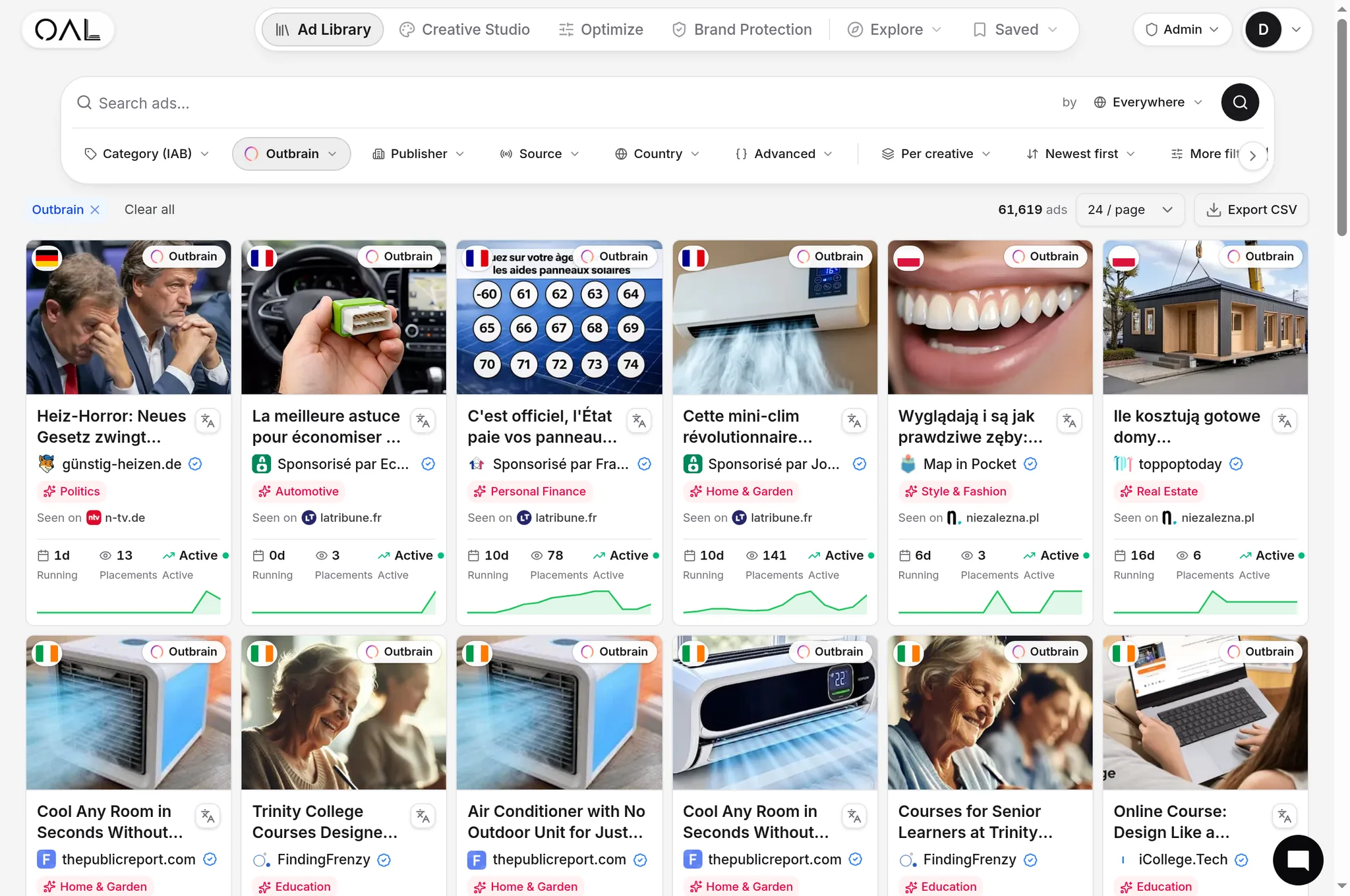
Here's the shortcut most buyers miss: every one of the 108,000+ live Outbrain creatives in OpenAdLibrary's index (July 2026) has, by definition, passed this review. Browse the Outbrain ad spy tool, filter to your vertical, and read how approved advertisers phrase claims that would seem impossible to run compliantly — how health advertisers imply outcomes without promising them, how finance offers hedge, what their disclosed pre-landers look like behind the click. The Outbrain ad library holds the corpus, and reading competitors' full funnels shows you compliant funnel architecture faster than any policy document, because it's policy as actually enforced.
Long-observed creatives are the most instructive: an ad that has served for weeks has survived initial review and ongoing re-review. Model your claim strength on those, not on the loudest ad you saw once.
How Outbrain's bar compares to other native networks#
Buyers running multiple networks should calibrate expectations per platform rather than reusing one creative standard everywhere. Outbrain's premium-publisher supply makes its review among the stricter in native: claims and imagery that clear review on mid-tier networks routinely fail here, and the same is broadly true of Taboola's review relative to looser networks — the two are compared buyer-to-buyer in Taboola vs Outbrain. The practical workflow implication: write your creative to the strictest network you plan to run, then loosen selectively for the others, rather than writing loose and fighting rejections upward. A compliant creative rarely loses much performance on the looser networks; a non-compliant one loses weeks everywhere.
Approval is a state, not an event#
Passing review once doesn't end the process. Creatives get re-reviewed, landing pages get re-crawled, policies get revised, and accounts accumulate a compliance history that determines how much benefit of the doubt future submissions get. The durable strategy is boring: run offers a mainstream network can live with, keep claims at the strength your landing page can substantiate, disclose what the format requires, and treat every rejection as calibration data. Buyers who fight the review lose weeks; buyers who reverse-engineer what passes ship compliant creative the first time.