Español
 Português (Brasil)
 Français
 Deutsch
 Italiano
 Nederlands
 Polski
 Svenska
 Türkçe
 Русский
 日本語
日本語 한국어
한국어 简体中文
简体中文 Tiếng Việt
 Bahasa Indonesia
 繁體中文
繁體中文 Čeština
 Dansk
Dansk Norsk (bokmål)
 Suomi
Suomi Ελληνικά
 Română
 Magyar
 Українська
 ไทย
ไทย हिन्दी
 العربية
 עברית
עבריתMGID vs Outbrain: Budget Network vs Premium Feed Compared
MGID and Outbrain get lumped together as native networks, but the inventory, the verticals and the cost structure behind each one are genuinely different. Here is what the data shows.


MGID and Outbrain are both native ad networks, but they sit at opposite ends of the inventory spectrum: MGID runs deeper into entertainment and content-discovery widgets at high volume and lower cost, while Outbrain concentrates on a smaller footprint of premium publishers and skews harder toward finance and insurance advertisers. Picking between them comes down to whether your offer needs volume and low CPCs or a more curated, brand-safe placement.
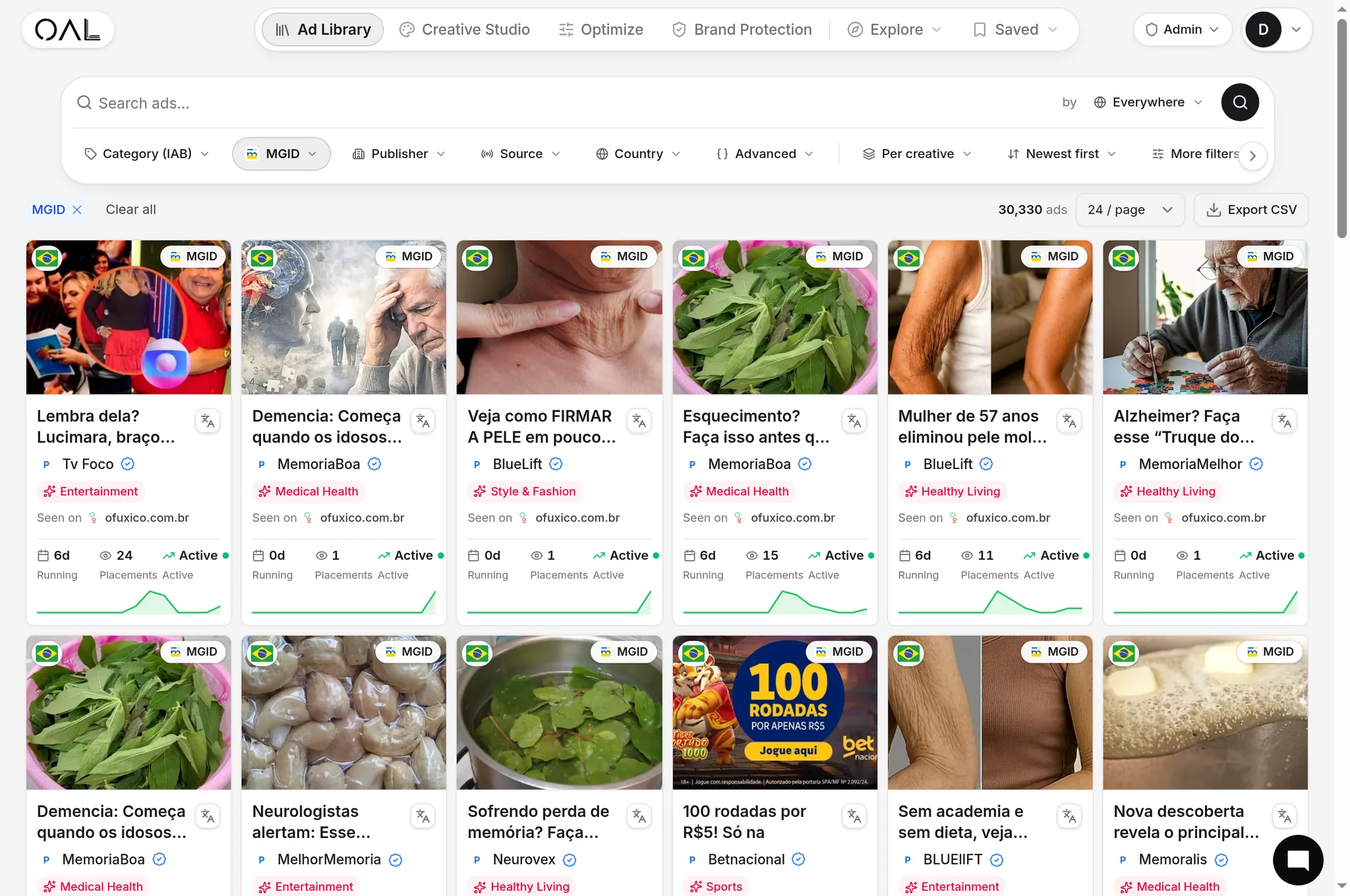
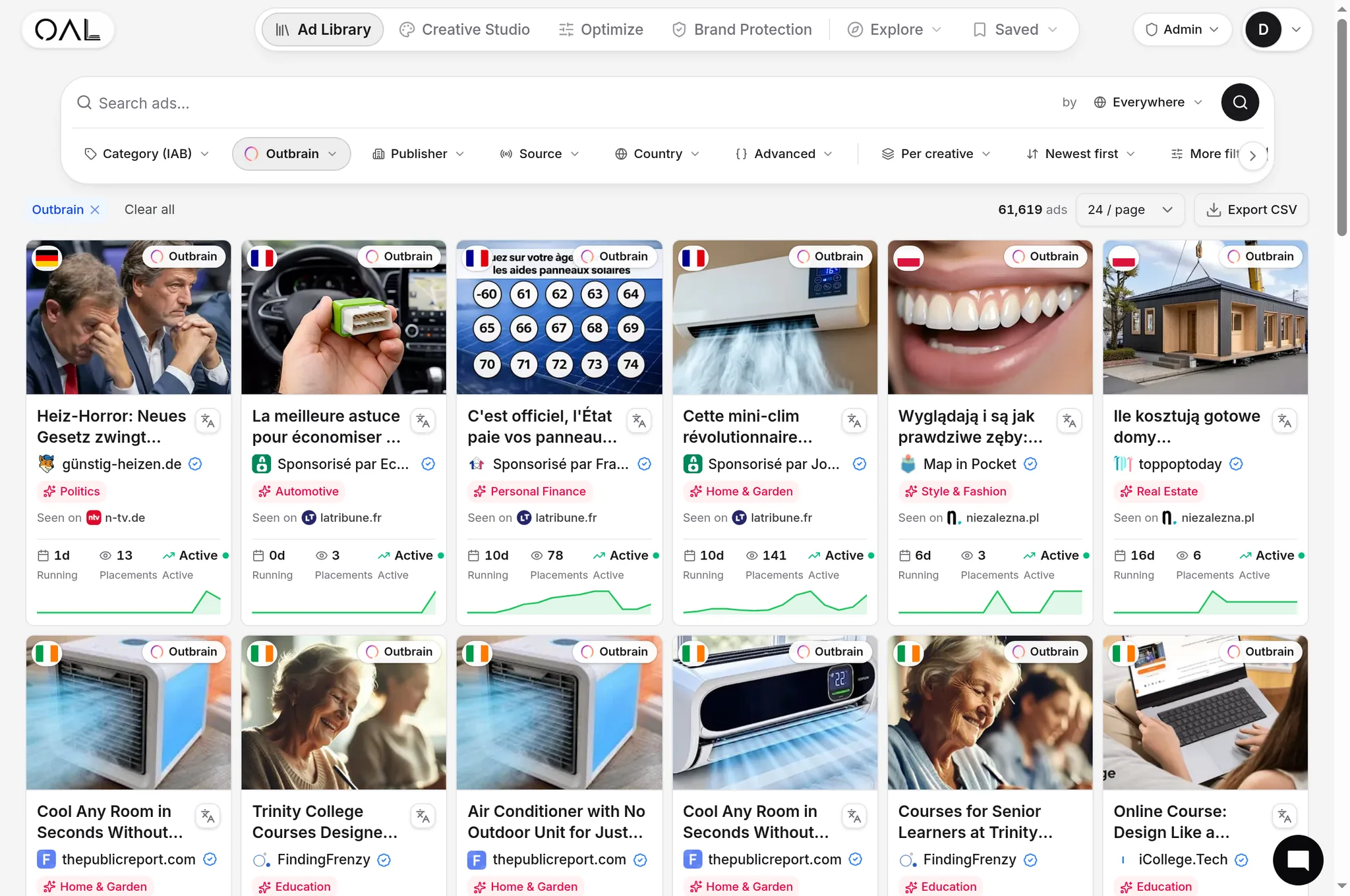
OpenAdLibrary's index currently holds 62,765 live MGID creatives against 108,573 for Outbrain (June 2026), so Outbrain actually carries more raw creative volume in our data despite its reputation as the smaller, more exclusive network. The difference that matters is not total volume, it's what each network's inventory is actually built for.
The core difference: publisher mix#
Outbrain built its reputation on premium publisher placements, the recommendation widgets you see at the bottom of news articles on well-known media sites. MGID's footprint runs wider and deeper into entertainment, content-discovery and international publisher networks, including a large volume of sites outside English-language markets.
That publisher difference shows up directly in the vertical mix each network carries.
| Vertical | MGID creatives (June 2026) | Outbrain creatives (June 2026) |
|---|---|---|
| Entertainment | 13,987 | not a top category |
| Health | 1,220 | 3,102 |
| Insurance | 663 | 4,345 |
| Finance | not a top category | 3,990 |
| Real estate | 309 | not a top category |
| Ecommerce | 265 | 2,277 |
The pattern is stark. MGID's single largest classified vertical, entertainment at 13,987 creatives, dwarfs its next category by more than 10x, reflecting a network still heavily built around content-discovery and curiosity-driven placements. Outbrain's top two verticals, insurance at 4,345 and finance at 3,990, are essentially tied and together outweigh its next four categories combined, reflecting the premium publisher demand that finance and insurance advertisers specifically pay for.
If your offer is a finance, insurance or other high-CPA vertical that benefits from being seen next to authoritative news content, that context favors Outbrain. If your offer is entertainment, curiosity-gap or broad-appeal content that performs regardless of publisher prestige, MGID's wider reach and typically lower CPCs are the better fit.
Cost and approval friction#
Neither network publishes official rate cards, but media buyers commonly report MGID CPCs running lower than Outbrain's, sometimes noticeably so, in exchange for less premium placement and a publisher mix that includes more low-authority and international sites. Outbrain's narrower, more curated inventory tends to command a CPC premium, which advertisers in finance and insurance are generally willing to pay because the placement context supports higher-value offers.
Approval friction differs too. MGID has historically run a wider tolerance for aggressive, curiosity-driven ad copy, which is part of why it dominates in entertainment and lifestyle content. Outbrain, tied more closely to premium publisher relationships (and now under Teads' corporate umbrella since the 2025 merger), tends to enforce stricter content and claims policies to protect those publisher relationships. Neither of these is a hard rule you should treat as guaranteed; check each network's current published policy before committing creative budget, since enforcement changes over time.
What the creative actually looks like on each network#
Numbers only tell part of the story, so it helps to look at real examples. A recent MGID entertainment creative in OpenAdLibrary's index, from a brand labeled "factripple.com," ran a Greek-language cosmetic-procedure headline aimed squarely at curiosity clicks, exactly the kind of content-discovery hook that fits MGID's international, entertainment-heavy inventory. Compare that to a recent Outbrain finance creative from SmartAsset, an "Ask a Pro" style headline about IRA withdrawal taxes, an authority-framed, advisory-toned hook that fits Outbrain's premium, finance-and-insurance-leaning publisher base. Neither creative would obviously work if you swapped networks; the tone each one uses is built for the specific audience its network's publisher mix delivers.
Longevity data reinforces the same split. Outbrain creatives regularly show up among the longest-running ads across OpenAdLibrary's entire index, including a home-and-garden advertorial from House and Garden and an insurance-adjacent piece from Goodnet, both observed for 38 straight days, the ceiling of our current observation window. That kind of multi-week persistence, on a premium publisher network, signals a genuinely durable, proven angle. MGID's inventory turns over faster in general, consistent with its content-discovery, high-volume model where testing new creative constantly matters more than nursing a single winner for a month.
Targeting and format differences worth knowing#
Beyond publisher mix, the two networks differ in a few mechanical ways that affect how you'd actually run a campaign on each:
- Minimum spend and account access. Outbrain has historically run a higher account minimum and more of a managed relationship for larger spenders, while MGID has been more accessible to smaller advertisers and self-serve setups. Check each network's current onboarding requirements, since these thresholds shift.
- Geo and language depth. MGID's self-serve platform generally exposes broader language and geo targeting granularity, reflecting its international publisher base. Outbrain's targeting is comparably capable but concentrated on the geos where its premium publishers actually operate, mostly English-language, Western European and a handful of other developed markets.
- Creative formats. Both networks support standard image-plus-headline native units; Outbrain has pushed further into video-native formats as part of the Teads integration, which is worth checking if video creative is part of your strategy.
Which one should you actually run?#
A simple decision framework:
- Run MGID first if: your vertical is entertainment, curiosity content, sweepstakes, or broad-appeal offers where volume and low CPC matter more than placement prestige, or you are testing a new offer cheaply before committing bigger budget.
- Run Outbrain first if: your vertical is finance, insurance, or another high-value category where premium publisher context supports a higher price point, or you have an established creative that performs and want to scale it into a more curated audience.
- Run both if: you have the operational bandwidth, because the two networks reach genuinely different audiences with genuinely different creative that works. The overlap in advertiser strategy between the two is smaller than most first-time native buyers assume.
For a full side-by-side workflow on researching what's actually running on each network before you commit budget, our MGID and Revcontent ad spy guide and the Outbrain ad spy guide both walk through the process using live creative data rather than guesswork.
How to research both networks before you commit budget#
The fastest way to settle the MGID-versus-Outbrain question for your specific vertical is to look at what is actually running on each network right now, rather than relying on general reputation. The MGID ad library and Outbrain ad library both let you search by advertiser, vertical and geo, and both show observed run length on every creative, which is the closest public signal to "this is currently profitable" that exists outside the networks themselves.
Pulling up your specific niche on each network's ad spy tool side by side (MGID's is at /spy/mgid, Outbrain's at /spy/outbrain) usually answers the question faster than any general comparison article, including this one, because it shows you your actual competitive set on each network rather than an aggregate.
A quick gut check before you commit budget#
If you're still unsure which network fits, ask yourself three questions. Does your creative rely on a curiosity gap or an authority frame? Curiosity leans MGID, authority leans Outbrain. Does your offer need a premium editorial adjacency to justify its price point, the way financial advisory or insurance offers often do? That's an Outbrain signal. Does your budget need to stretch across a wide test before you know what works? MGID's typically lower CPC gives you more shots on goal per dollar. None of these questions has a universally correct answer, they just point you toward which network to test first rather than splitting a small budget evenly across both from day one.
The bottom line#
MGID and Outbrain are not interchangeable substitutes for "a native network." MGID's strength is volume and reach into entertainment and content-discovery placements at a typically lower cost; Outbrain's strength is a curated, premium publisher footprint that finance and insurance advertisers pay for specifically. The right starting point depends on your vertical more than any general ranking of the two networks against each other, and checking the live creative data for your specific niche beats guessing every time.