Español
 Português (Brasil)
 Français
 Deutsch
 Italiano
 Nederlands
 Polski
 Svenska
 Türkçe
 Русский
 日本語
日本語 한국어
한국어 简体中文
简体中文 Tiếng Việt
 Bahasa Indonesia
 繁體中文
繁體中文 Čeština
 Dansk
Dansk Suomi
Suomi Ελληνικά
 Română
 Magyar
 Українська
 ไทย
ไทย हिन्दी
 العربية
 עברית
עבריתWhere Do MGID Ads Appear? Publisher Mix & Quality Tiers
MGID ads show up on entertainment sites, content-discovery publishers and international news sites far more than on the recognizable premium mastheads people expect from native advertising.


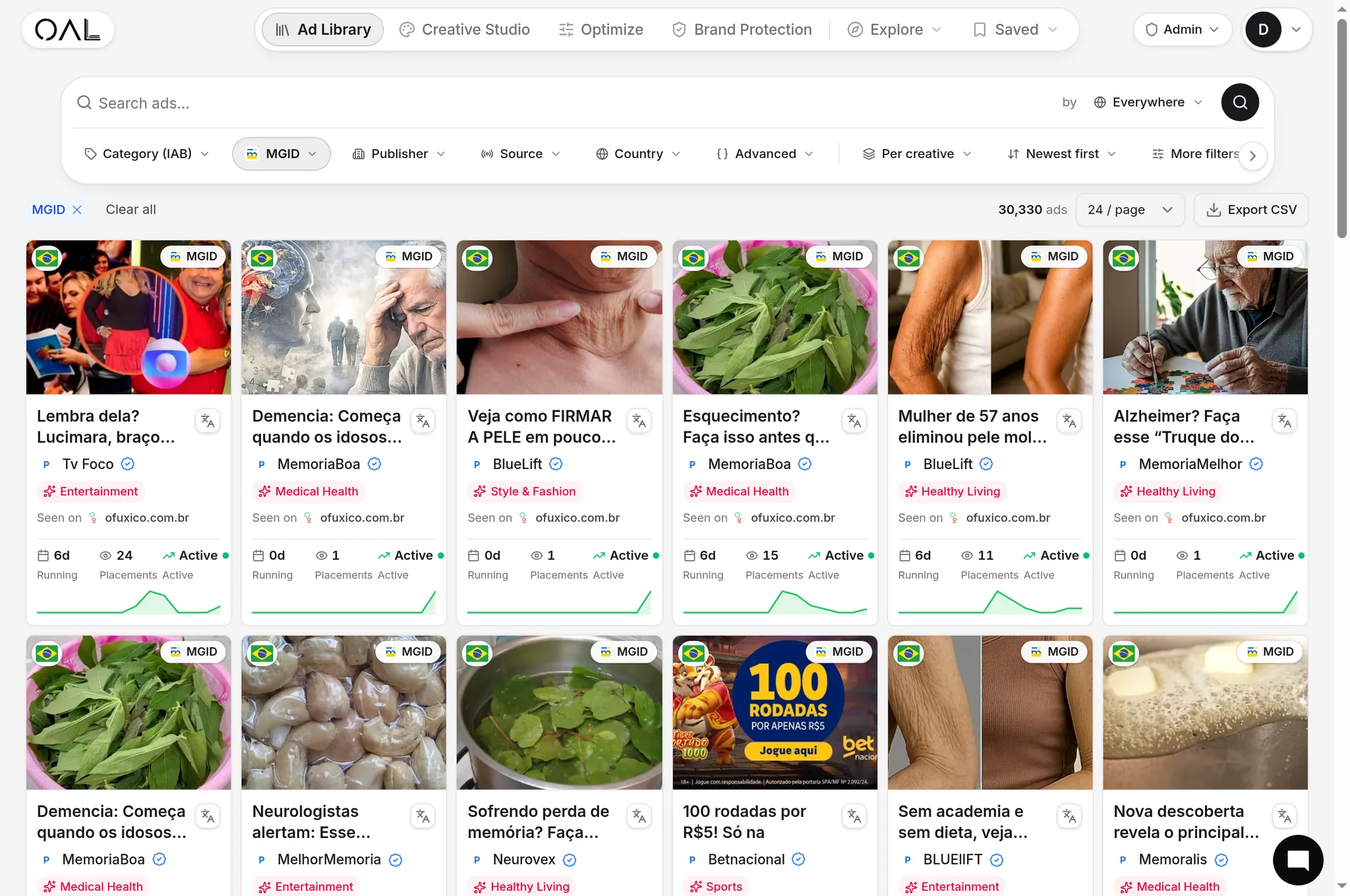
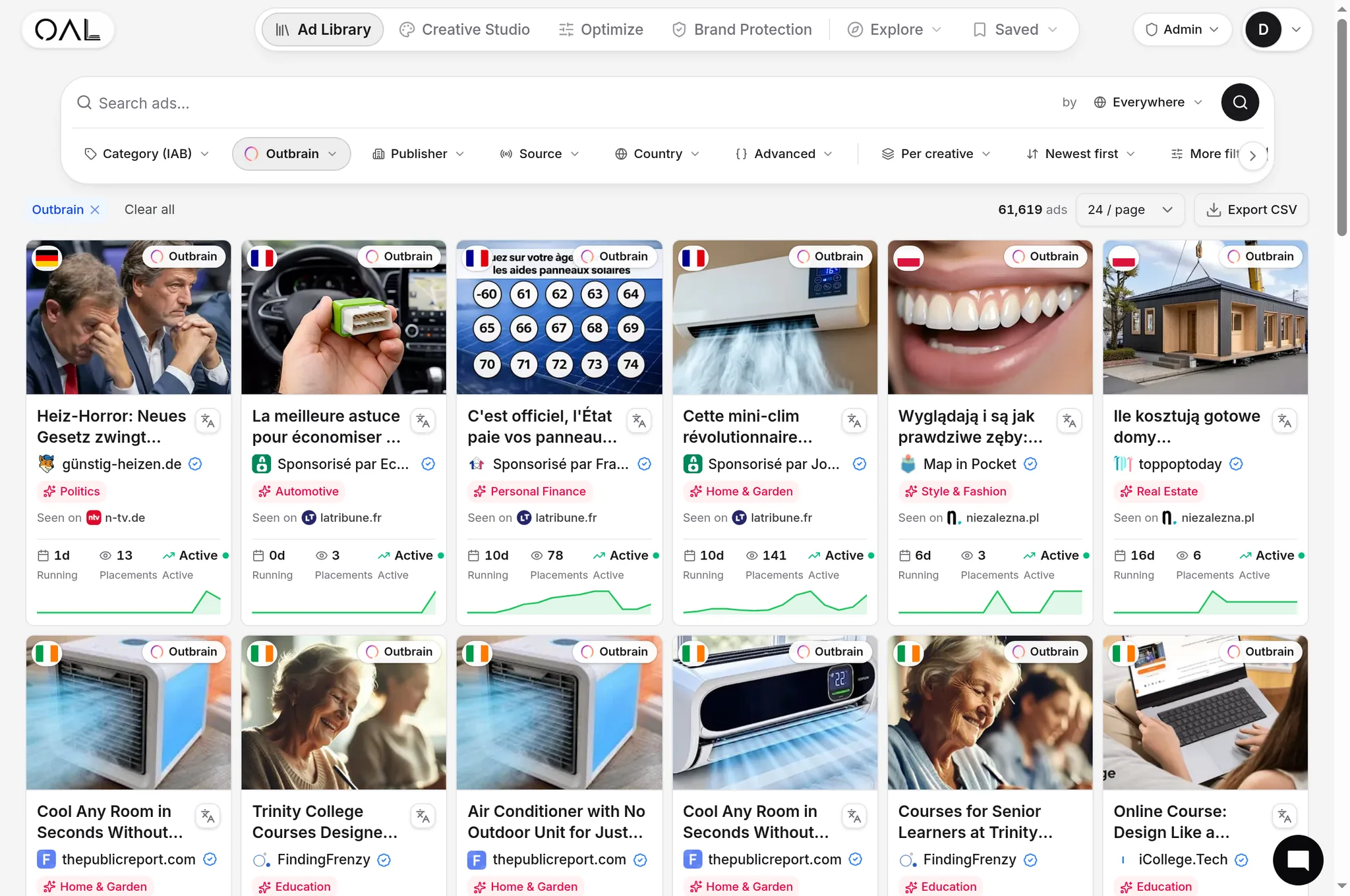
MGID ads appear mostly on entertainment, content-discovery and lifestyle publisher sites, plus a large volume of international and non-English-language sites, rather than on the recognizable premium news mastheads that networks like Outbrain are known for. The widgets show up as "you may also like" or "around the web" recommendation blocks under articles, exactly where you'd see any native content-discovery unit.
MGID does not publish a public list of its exact publisher roster, and that is true of every major native network, not a gap specific to MGID. What we can show instead is what the ads running on MGID actually look like at scale, which tells you a lot about the kind of sites carrying them even without a publisher directory.
The vertical mix tells the publisher story#
OpenAdLibrary's index holds 62,765 live MGID creatives as of June 2026, and the vertical breakdown is unusually lopsided compared to other networks:
| Vertical | Live MGID creatives (June 2026) |
|---|---|
| Entertainment | 13,987 |
| Health | 1,220 |
| Insurance | 663 |
| Real estate | 309 |
| Ecommerce | 265 |
| Food & beverage | 219 |
Entertainment creative outnumbers the next-largest category, health, by more than 11 to 1. That is not a coincidence of what advertisers happen to choose; it reflects the actual publisher inventory MGID has to sell. A network dominated by entertainment advertisers is a network whose widgets are mostly sitting on entertainment, celebrity, viral-content and content-discovery sites, because that is where entertainment creative performs and where MGID has depth of placement to sell against it.
Site quality: a wide spread, not a single tier#
MGID's publisher footprint is genuinely wide, which cuts both ways. On one end you get legitimate entertainment, news-adjacent and lifestyle publishers running the same recommendation-widget model as any other native network. On the other end, MGID's reach extends into lower-authority content mills and international sites that would not clear the bar for more curated networks like Outbrain, whose premium publisher base is a deliberate, narrower selection.
This is not automatically a quality problem for advertisers. A wider publisher pool at a lower cost per click is exactly the tradeoff some offers want, particularly entertainment, sweepstakes and broad-appeal products where volume beats precision. It does mean brand-conscious advertisers, particularly in regulated categories like finance and health, should expect more variance in where their ad actually lands than they would on a more curated network, and should check placement reports where MGID provides them.
The widget format itself is worth understanding too. If you are new to how a content-recommendation unit actually gets served on a publisher page, our native advertising guide covers the mechanics that apply across MGID, Outbrain and every other network running the same basic model.
What actual MGID creative looks like#
A concrete example is more useful than a description. A recent MGID creative from a brand labeled "factripple.com" ran entirely in Greek, a cosmetic-procedure cost headline aimed at a curiosity click rather than a direct offer pitch. Another, from a brand called Perpetual Ad Tech, ran a B2B-services angle ("A machine does it for a flat fee") framed almost like a native content recommendation rather than a traditional ad. Both examples point at the same underlying publisher reality: MGID's widgets sit on sites where the audience is browsing loosely, clicking on curiosity and cost-comparison hooks, not sites where someone arrived with high commercial intent already formed.
That matters for creative strategy. Ads that lean on strong headlines and a "you won't believe" or cost-reveal structure tend to fit MGID's actual audience behavior better than a straightforward product pitch, which is more suited to an audience already primed by a premium editorial context, the kind Outbrain's placements provide.
International reach is a defining feature, not a side effect#
A large share of MGID's inventory runs on non-English-language sites, spanning European, Latin American and other international publisher networks. This is one of the clearer structural differences from Taboola and Outbrain, both of which skew more heavily toward English-language, US and Western European placements in OpenAdLibrary's index. If your offer targets a market outside the usual US/UK/AU/CA rotation, MGID's international depth is frequently the reason it outperforms the bigger-name networks in that specific geo, even though its overall creative volume is smaller.
What this means for advertisers choosing MGID#
- Entertainment, lifestyle and curiosity-driven offers tend to find the deepest, most relevant inventory, because that is where MGID's publisher base concentrates.
- International and non-Tier-1 geo campaigns often perform better on MGID specifically because of its wider international publisher reach relative to Outbrain and Taboola.
- Regulated or brand-sensitive verticals (finance, health, insurance) should expect a wider quality spread in placement and budget for more active monitoring of where creative actually lands.
- Volume-first strategies benefit from MGID's breadth; precision-first strategies aimed at premium context should look at Outbrain instead.
For a wider view of how MGID stacks up against the rest of the field before you commit, our roundup of the best native ad networks in 2026, ranked by real ad volume, is a useful starting point.
How publisher tiering affects your budget planning#
Because MGID's publisher pool spans such a wide quality range, the same daily budget can land very differently depending on which tier of inventory your account actually reaches. A smaller test budget on a self-serve account often skews toward the wider, lower-authority end of the pool simply because that's where more available impressions sit; a larger, sustained budget with an account manager involved tends to unlock access to higher-traffic, more selectively curated placements over time. This is a meaningful difference from Outbrain, where the publisher pool is narrower and more consistent regardless of account size, so a small Outbrain test and a large one see a more similar publisher mix.
The practical takeaway is that a disappointing small-budget test on MGID doesn't necessarily predict what a larger, sustained budget would deliver, since the inventory itself can shift as your account scales. If your first test underperforms, it's worth checking whether a different budget tier or more direct account relationship changes the placement mix before concluding the network doesn't work for your vertical.
How to see the actual sites and advertisers running right now#
Rather than relying on a static publisher list, which no network keeps current or complete, the more reliable approach is to look at what MGID creative is actually live right now, in your vertical and geo, and reverse-engineer the placement pattern from there. The MGID ad library holds the full 62,765-creative index with resolved advertisers, observed run length and geo data on every entry, updated continuously rather than published once and left stale.
For a hands-on research workflow, our MGID and Revcontent ad spy guide walks through tracking specific advertisers across mid-tier native networks, and the /spy/mgid tool applies that same index to your own competitive research.
A quick self-check before you commit budget#
If you're deciding whether MGID's publisher mix fits your offer, three quick questions help. Is your creative built around curiosity or a broad "you may also like" hook rather than a direct product pitch? That style of creative tends to travel further on MGID's inventory than a polished brand pitch. Are you targeting a market outside the usual US/UK/AU/CA rotation? MGID's international depth is a real advantage there. Is your vertical entertainment, lifestyle or broadly appealing rather than a regulated category needing tight placement control? If two or three of those are true, MGID is worth testing before you assume you need a more premium, curated network instead.
The bottom line#
MGID's publisher footprint is genuinely wide and skews heavily toward entertainment, content-discovery and international sites rather than premium news mastheads. That is a feature for advertisers who need volume, low cost and international reach, and a consideration for advertisers in regulated verticals who need tighter control over placement context. Studying the live creative on the network, rather than hunting for a publisher list that does not exist, is the fastest way to understand where your specific ad is likely to land.