English
 Español
 Português (Brasil)
 Français
 Deutsch
 Italiano
 Nederlands
 Polski
 Svenska
 Türkçe
 Русский
 日本語
日本語 한국어
한국어 简体中文
简体中文 Tiếng Việt
 繁體中文
繁體中文 Čeština
 Dansk
Dansk Norsk (bokmål)
 Suomi
Suomi Ελληνικά
 Română
 Magyar
 Українська
 ไทย
ไทย हिन्दी
 العربية
 עברית
עבריתPelanggaran Merek Dagang dalam Iklan: Panduan Deteksi Perlindungan Merek
Penyalahgunaan merek dagang jarang bersembunyi di salinan iklan; ia bersembunyi di kreatif, pengiklan asli di balik nama penjual ulang, dan halaman arahan setelah klik. Berikut cara tim merek mengumpulkan bukti yang bertahan untuk proses penghapusan atau tinjauan hukum.

Sebagian besar penyalahgunaan merek dagang dalam periklanan terlewatkan karena tim merek mencari di tempat yang salah. Mereka mencari nama mereka di salinan iklan, tidak menemukan hal yang mengkhawatirkan, dan melanjutkan. Masalahnya adalah pelanggaran hampir tidak pernah ada di judul yang ditulis pembeli media untuk lolos tinjauan. Ia berada di gambar kreatif, identitas pengiklan yang tersembunyi di balik akun penjual ulang, dan halaman arahan yang dimuat setelah klik. Pada saat pelanggan mengeluh, kampanye telah berjalan selama berminggu-minggu dan buktinya sudah berganti.
Panduan ini untuk tim merek, hukum, dan kepatuhan afiliasi yang perlu membuktikan pelanggaran, bukan hanya menduganya. Deteksi dan dokumentasi adalah masalah yang sama. Anda tidak dapat mengajukan permintaan penghapusan yang kredibel atau surat perintah berhenti berdasarkan firasat. Anda membutuhkan rantai bukti yang dapat diaudit, ditangkap sebelum hilang.
Apa yang sebenarnya dianggap sebagai pelanggaran merek dagang dalam iklan#
Pelanggaran merek dagang dalam iklan adalah penggunaan tanda terdaftar yang dilindungi, atau tanda yang mirip hingga membingungkan, tanpa izin dalam periklanan yang kemungkinan membuat konsumen percaya bahwa merek Anda yang membuat, mendukung, mensponsori, atau berafiliasi dengan produk yang diiklankan. Di bawah hukum AS, ujiannya adalah kemungkinan kebingungan, bukan bukti bahwa ada yang benar-benar tertipu.
Kata kemungkinan itu adalah di mana praktisi salah memahami hukum di kedua arah. Dua putusan banding baru-baru ini menetapkan batasannya. Dalam keputusan Sirkuit Kesembilan Lerner & Rowe v. Brown Engelhardt dan Sirkuit Kedua 1-800 Contacts v. Warby Parker, pengadilan menemukan bahwa sekadar menawar merek dagang pesaing sebagai kata kunci, tanpa menampilkan merek tersebut dalam iklan, umumnya tidak menciptakan kemungkinan kebingungan. Dalam kasus Warby Parker, pengadilan menolak menemukan pelanggaran meskipun halaman arahan meminjam warna dan tata letak penggugat, karena salinan iklan itu sendiri tidak menunjukkan tanda bersama.
Pelajaran praktisnya justru sebaliknya untuk perlindungan merek. Penawaran kata kunci saja adalah kasus yang lemah. Namun saat merek Anda muncul di kreatif yang terlihat, nama tampilan, judul, atau sebagai klaim otorisasi di halaman arahan, analisisnya berubah dan bukti Anda harus menangkap persis permukaan-permukaan itu. Deteksi harus mengikuti klik. Tidak boleh berhenti di slot iklan.
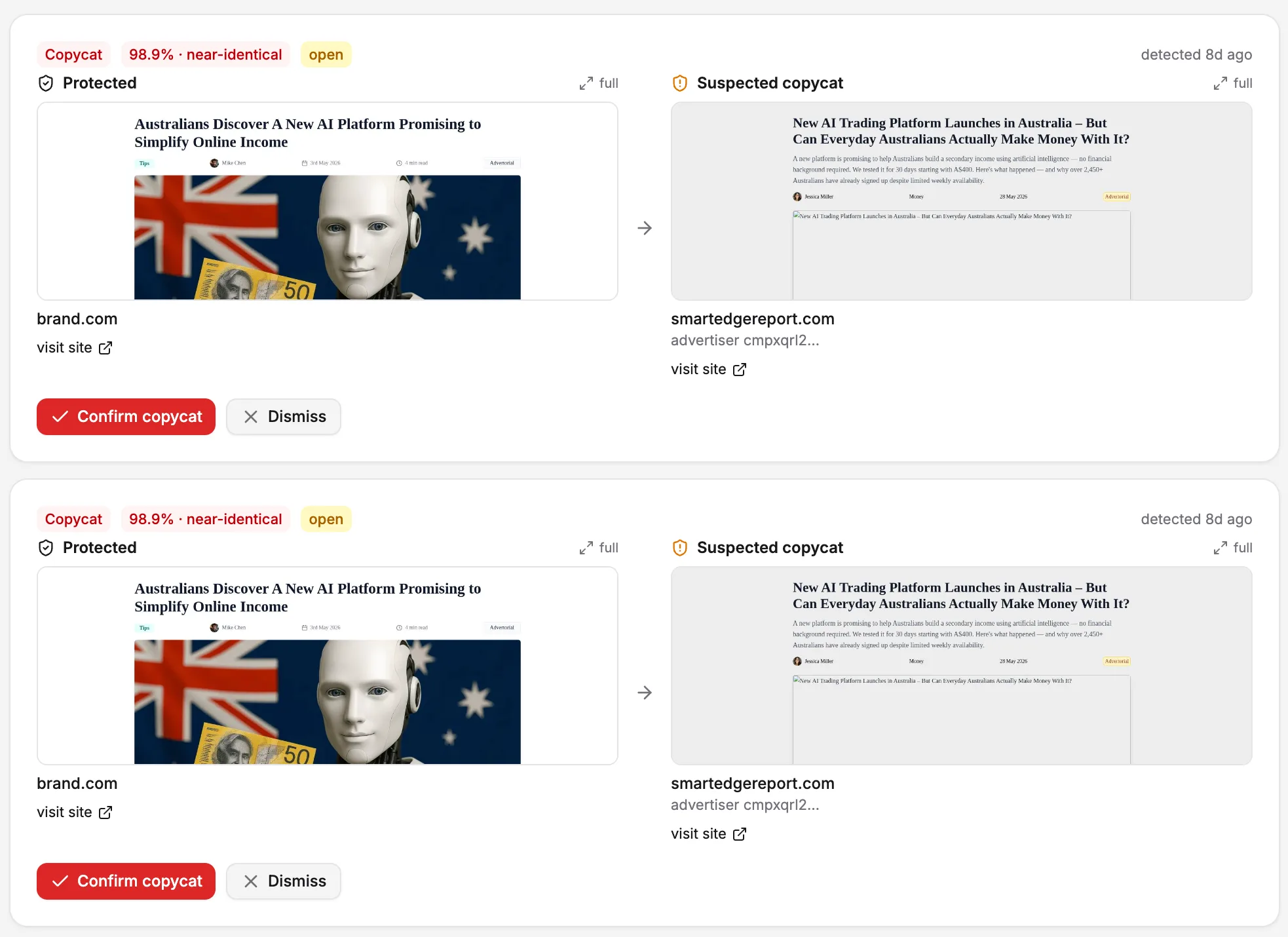
Berikut jenis iklan yang memperjelas poinnya. Kreatif keuangan langsung ini sangat mengandalkan kerangka otoritas palsu ("IRS Mengampuni Jutaan") di bawah nama penerbit generik. Ganti "IRS" dengan logo merek dan Anda memiliki peniruan identitas yang textbook, dan pemindaian teks saja tidak akan pernah membacanya.

Kasus pelanggaran terkuat tidak dibangun dari apa yang ditulis pengiklan dalam salinannya. Mereka dibangun dari kesenjangan antara merek yang dikira diklik konsumen dan pengiklan yang sebenarnya mereka temui.
Untuk program yang lebih luas yang menjadi bagiannya, lihat pilar kami tentang perlindungan merek dalam periklanan native, dan entri glosarium tentang perlindungan merek dalam periklanan untuk definisi dasarnya.
Empat permukaan tempat pelanggaran bersembunyi#
Iklan native memiliki permukaan serangan yang jauh lebih banyak daripada iklan teks pencarian. Kreatifnya adalah gambar, dan rantai pasokannya berlapis. Perlakukan setiap permukaan sebagai lapisan bukti terpisah.
| Permukaan | Seperti apa bentuk pelanggarannya | Mengapa tim melewatkannya |
|---|---|---|
| Gambar kreatif | Logo, kemasan, maskot, atau bidikan produk Anda digunakan tanpa lisensi; tanda yang hampir identik | Pemantauan teks saja tidak pernah membaca pikselnya |
| Nama pengiklan / tampilan | Akun penjual ulang atau arbitrase yang berpura-pura sebagai merek Anda atau saluran "resmi" | Nama yang ditampilkan seringkali bukan pembeli sebenarnya |
| Perantara ad-tech | DSP, SSP, atau jaringan yang menyajikan penempatan, yang memberi tahu Anda siapa yang harus diberi tahu | Tidak terlihat tanpa klasifikasi rantai pasokan |
| Halaman arahan / pre-lander | "Toko resmi," dukungan palsu, checkout palsu, atau klon tiruan | Menghilang atau terselubung jika Anda hanya mengambil tangkapan layar iklan |
Periklanan native dan native programmatic membuat baris kedua dan ketiga terutama licin. Iklan dapat melewati beberapa perantara, dan entitas yang dinamai dalam unit iklan seringkali adalah afiliasi atau akun arbitrase, bukan pedagang yang memenuhi pesanan. Dinamika yang sama muncul dalam periklanan programmatic dan periklanan display, di mana pembelian otomatis memisahkan merek yang terlihat dari pihak yang bertanggung jawab.
Iklan kesehatan dan suplemen adalah pelanggar terburuk untuk baris pertama. Mereka mengandalkan otoritas pinjaman ("Dokter Mengidentifikasi...") dan citra medis stok, dan tiruan yang menggunakan bidikan produk merek Anda atau dukungan dokter terlihat identik dengan yang sah sampai Anda melacaknya.

Halaman arahan adalah permukaan yang mengubah kasus lemah menjadi kuat. Pre-lander yang mengklaim "pengecer resmi," mereproduksi trade dress Anda, atau mengarahkan ke checkout palsu adalah bukti langsung kebingungan konsumen. Itu juga tepat di mana halaman arahan tiruan beroperasi, dan di mana penyelubungan iklan digunakan untuk menunjukkan halaman bersih kepada peninjau sambil mengirim pengguna nyata ke halaman yang melanggar.
Alur kerja deteksi yang menghasilkan bukti yang dapat digunakan#
Deteksi dan dokumentasi adalah satu saluran. Bangun sehingga setiap temuan sudah menjadi catatan yang siap diajukan.
- Tentukan daftar pantauan. Tanda Anda yang persis, salah eja dan homoglif umum, nama produk, frasa "resmi" dan "penjual resmi yang sah", dan nama distributor sah sehingga Anda dapat memisahkan penggunaan yang sah dari peniruan identitas.
- Pantau kreatifnya, bukan hanya teksnya. Cocokkan dengan gambar iklan yang ditangkap, karena penyalahgunaan logo dan trade dress tidak pernah muncul sebagai salinan yang dapat dicari. Di sinilah alat mata-mata iklan native yang menyimpan kreatif berkualitas penuh membuktikan nilainya.
- Identifikasi pengiklan sebenarnya. Identifikasi pembeli di balik nama tampilan dan perantara di jalurnya. Apakah Anda berurusan dengan afiliasi nakal, akun arbitrase, atau pemalsu menentukan siapa yang Anda beri tahu dan caranya.
- Ikuti klik tanpa mengklik. Tangkap tujuan halaman arahan dan pre-lander apa pun di jalurnya, tanpa memicu klik berbayar yang sebenarnya. Itu melindungi Anda dari halaman berbahaya yang terselubung dan menghindari pengeluaran anggaran pelanggar untuk kunjungan verifikasi.
- Tangkap durasi dan penyebaran. Catat tanggal pertama dan terakhir dilihat, setiap penempatan, dan setiap geo. Kreatif yang berjalan selama berminggu-minggu di banyak penerbit adalah pelanggaran yang disengaja dan menguntungkan, bukan kesalahan satu kali, dan pola itu memperkuat urgensi dan narasi kerugian.
- Bekukan catatan bertanda waktu. Kunci kreatif, pengiklan, jalur pasokan, URL tujuan, penempatan, dan tanggal menjadi satu artefak bertanggal sebelum kampanye berganti.
Alasan untuk mengotomatiskan langkah dua hingga enam adalah pembusukan. Kreatif native berganti cepat dan kampanye pelanggaran berganti lebih cepat, seringkali justru karena operator mengharapkan dilaporkan. Bukti yang ditangkap terlambat seminggu seringkali adalah bukti yang tidak lagi ada.
Seberapa cepat? Di antara 589.000+ kreatif yang kami tangkap (indeks OpenAdLibrary, Juni 2026), durasi berjalan terus menerus terpanjang yang kami amati pada satu kreatif mencapai sekitar 28 hari. Pemenang yang benar-benar tahan lama adalah yang polos dan patuh: penjelas pajak IRA SmartAsset di Outbrain, iklan game "Combat Siege", serangkaian kreatif kuis "My IQ" di Microsoft Audience Network, masing-masing bertahan selama jendela 28 hari penuh. Kampanye pelanggaran jarang berperilaku seperti itu. Mereka terbakar dan berganti, itulah sebabnya mengapa tangkapan layar yang terlambat tidak berharga dan tangkapan dalam minggu yang sama adalah emas. (Catatan: aturan "pemenang 90 hari" yang Anda dengar di kalangan afiliasi adalah cerita industri, bukan pengukuran kami. Indeks kami saat ini mencakup hingga sekitar empat minggu pengamatan berkelanjutan per kreatif.)
Apa yang terkandung dalam paket bukti siap diajukan#
Satu tangkapan layar adalah pengajuan yang paling lemah. Jaringan, registrar, dan platform melakukan triase berdasarkan kelengkapan, begitu pula pengadilan. Paket yang kredibel menjawab setiap "lalu apa" sebelum ditanyakan.
- Kreatif dengan resolusi penuh, menunjukkan tanda atau trade dress yang melanggar seperti yang dilihat konsumen.
- Identitas pengiklan seperti yang ditampilkan, ditambah pembeli yang teridentifikasi jika berbeda.
- Rantai pasokan: jaringan dan perantara mana yang menyajikan penempatan, sehingga pemberitahuan sampai ke pihak yang dapat bertindak.
- Tujuan: URL halaman arahan dan pre-lander apa pun, ditangkap di sepanjang jalur klik nyata.
- Jangkauan dan durasi: penempatan, geo, dan tanggal pertama/terakhir dilihat yang menetapkan skala dan niat.
- Stempel waktu pada setiap elemen, sehingga catatan dapat direproduksi daripada anekdotal.
Ini juga muatan yang membuat laporan platform efektif. Panduan pendamping kami tentang cara melaporkan iklan scam dan mendokumentasikan buktinya membahas di mana setiap item masuk dalam keluhan jaringan atau platform, dan entri glosarium keamanan merek menjelaskan mengapa ini penting di luar paparan hukum.
Ke mana Anda harus mengarahkan pemantauan pertama? Ikuti uangnya. Keuangan memimpin seluruh indeks kami dengan 17.232 kreatif, diikuti asuransi (15.629) dan kesehatan (14.895), dari sepuluh vertikal teratas (indeks OpenAdLibrary, Juni 2026). Di Taboola saja, jaringan terbesar kami dengan 157.727 kreatif, kesehatan dan keuangan berada di puncak tumpukan. Itulah kategori di mana peniruan identitas paling menguntungkan, sehingga di situlah daftar pantauan perlindungan merek mendapatkan daya tarik terbesar.

Bagaimana regulasi menggeser beban bukti#
Lingkungan pengungkapan bergerak mendukung pemilik merek, yang membuat penangkapan sistematis lebih berharga, bukan kurang.
Di UE, Undang-Undang Layanan Digital mengharuskan platform untuk membiarkan pengguna melihat, untuk setiap iklan, bahwa itu adalah iklan, siapa pengiklannya, dan siapa yang membayarnya. Pasal 39 mewajibkan Platform Online Sangat Besar untuk memelihara repositori iklan yang dapat dicari termasuk identitas pengiklan, parameter penargetan, dan durasi kampanye. DSA juga mengharuskan pasar online untuk memverifikasi informasi penjual sebelum mencantumkan, dan memungkinkan pemegang hak yang memenuhi syarat bertindak sebagai "penanda tepercaya" yang pemberitahuannya diprioritaskan. Tidak satu pun dari ini menghilangkan kebutuhan untuk menangkap bukti Anda sendiri, tetapi itu memberi pemberitahuan yang terdokumentasi dengan baik lebih banyak daya ungkit.
Di AS, sikap FTC terhadap periklanan yang menipu dan peniruan identitas, dikombinasikan dengan standar kebingungan Undang-Undang Lanham, berarti bahwa catatan terorganisir tentang di mana dan bagaimana merek Anda disalahgunakan adalah perbedaan antara pemberitahuan yang ditindaklanjuti dan yang duduk dalam antrean. Benang merah di kedua rezim adalah sama: pihak yang datang dengan bukti yang dapat diaudit dan direproduksi yang menetapkan kecepatan.
Di mana OpenAdLibrary berada#
Bagian sulit dari alur kerja ini adalah bagian yang membusuk. Menangkap kreatif berkualitas penuh sebelum berganti. Mengidentifikasi pengiklan sebenarnya di balik nama penjual ulang. Mengklasifikasikan rantai pasokan ad-tech. Mengikuti klik ke halaman arahan tanpa menghabiskan klik langsung atau memicu halaman terselubung.
OpenAdLibrary menangkap iklan native publik langsung di seluruh Taboola, Outbrain, MGID, Revcontent, Teads, Yahoo, dan MSN, menyimpan kreatif asli dengan kualitas penuh, melabeli rantai pasokan, dan melacak setiap klik ke tujuan halaman arahannya. Per Juni 2026, itu adalah 589.036 kreatif dari 25.933 pengiklan di 42 jaringan, dengan 926.259 tangkapan halaman arahan dan lebih dari 5,4 juta pengamatan iklan di balik sinyal durasi dan penyebaran yang memisahkan uji coba sesat dari kampanye pelanggaran industri. Ini terbuka dan terjangkau di mana Adbeat, Anstrex, dan AdSpy berharga $80 hingga $400 per bulan, dan akses API dan MCP memungkinkan tim merek menyambungkan pemantauan langsung ke saluran peringatan yang ada.
Mulai gratis dan jelajahi 200 iklan tanpa kartu untuk melihat seperti apa jejak merek Anda sebenarnya di seluruh ekosistem native.