English
 Português (Brasil)
 Français
 Deutsch
 Italiano
 Nederlands
 Polski
 Svenska
 Türkçe
 Русский
 日本語
日本語 한국어
한국어 简体中文
简体中文 Tiếng Việt
 Bahasa Indonesia
 繁體中文
繁體中文 Čeština
 Dansk
Dansk Norsk (bokmål)
 Suomi
Suomi Ελληνικά
 Română
 Magyar
 Українська
 ไทย
ไทย हिन्दी
 العربية
 עברית
עבריתInfracción de Marca en Anuncios: Guía de Detección para la Protección de Marca
El abuso de marca rara vez se esconde en el texto del anuncio; se esconde en el creativo, el anunciante real detrás del nombre de un revendedor y la landing page tras el clic. Aquí se explica cómo los equipos de marca capturan evidencia que sobrevive a una retirada o a una revisión legal.


La mayoría del abuso de marca en publicidad se pasa por alto porque los equipos de marca buscan en el lugar equivocado. Buscan su nombre en el texto del anuncio, no encuentran nada alarmante y siguen adelante. El problema es que la infracción casi nunca está en el titular que un comprador de medios escribió para pasar la revisión. Vive en la imagen del creativo, en la identidad del anunciante oculta detrás de una cuenta de revendedor y en la landing page que se carga después del clic. Para cuando un cliente se queja, la campaña lleva semanas activa y la evidencia ya ha rotado.
Esta guía es para equipos de marca, legales y de cumplimiento de afiliados que necesitan demostrar la infracción, no solo sospecharla. La detección y la documentación son el mismo problema. No puedes presentar una solicitud de retirada creíble o una carta de cese y desistimiento basándote en una corazonada. Necesitas una cadena de evidencia auditable, capturada antes de que desaparezca.
Qué cuenta realmente como infracción de marca en anuncios#
La infracción de marca en anuncios es el uso no autorizado de una marca protegida, o de una marca confusamente similar, en publicidad que probablemente haga creer a los consumidores que tu marca fabricó, respaldó, patrocinó o está afiliada al producto anunciado. Según la ley de EE.UU., la prueba es la probabilidad de confusión, no la prueba de que alguien haya sido realmente engañado.
Esa palabra probabilidad es donde los profesionales interpretan mal la ley en ambas direcciones. Dos decisiones recientes de tribunales de apelación establecieron el límite. En Lerner & Rowe v. Brown Engelhardt del Noveno Circuito y 1-800 Contacts v. Warby Parker del Segundo Circuito, los tribunales determinaron que simplemente pujar por la marca de un competidor como palabra clave, sin mostrar esa marca en el anuncio, generalmente no crea una probabilidad de confusión. En el caso Warby Parker, el tribunal se negó a encontrar infracción incluso cuando la landing page tomaba prestados el color y el diseño del demandante, porque el texto del anuncio en sí no mostraba marcas compartidas.
La lección práctica es contraria para la protección de marca. La puja por palabras clave por sí sola es un caso débil. Pero en el momento en que tu marca aparece en el creativo visible, el nombre mostrado, el titular o como una afirmación de autorización en la landing page, el análisis cambia y tu evidencia tiene que capturar exactamente esas superficies. La detección tiene que seguir el clic. No puede detenerse en el espacio publicitario.
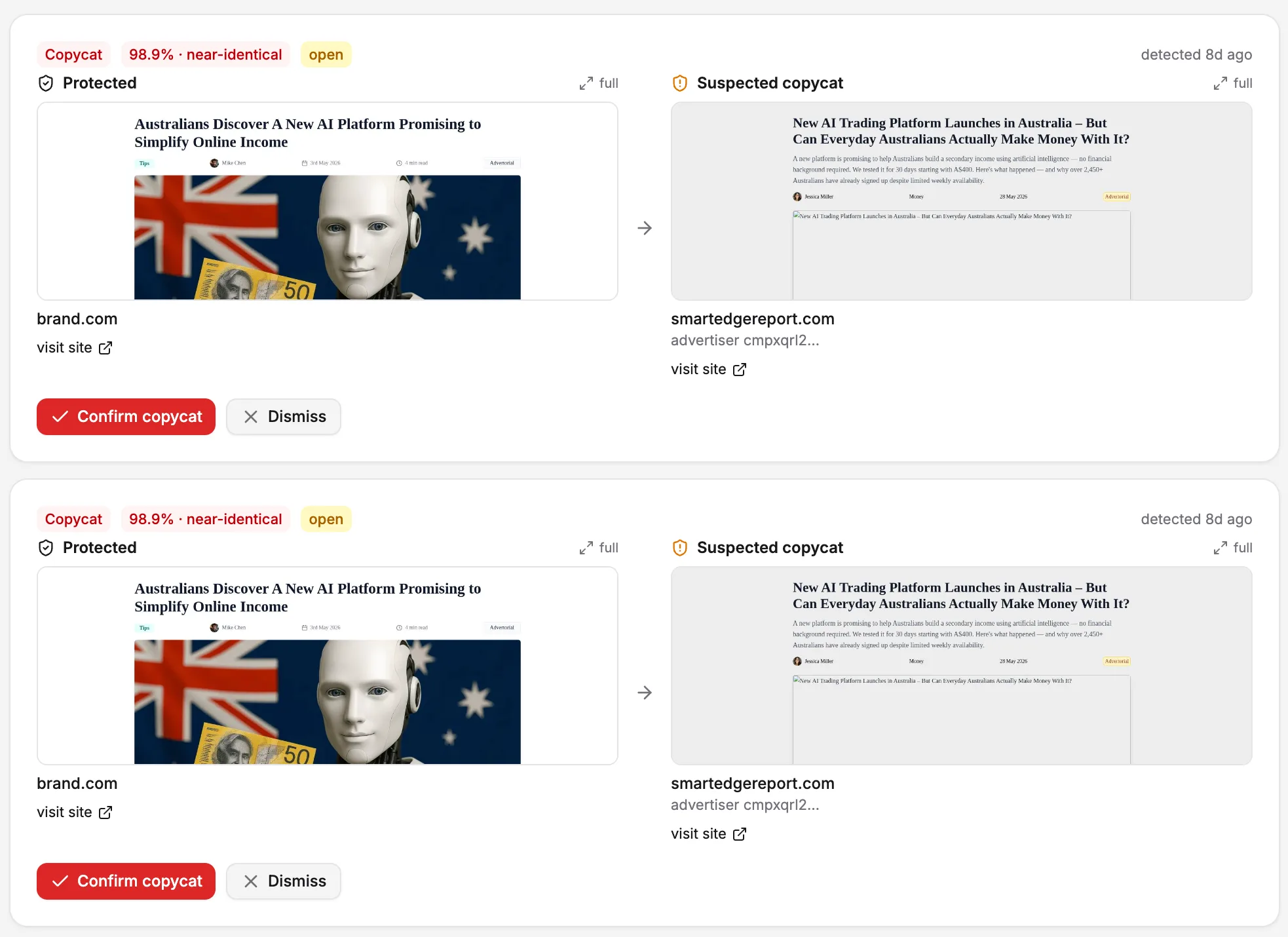
Aquí está el tipo de anuncio que ilustra el punto. Este creativo de finanzas en vivo se apoya mucho en un marco de autoridad falsa ("IRS Forgives Millions") bajo un nombre de editor genérico. Cambia "IRS" por el logotipo de una marca y tienes una suplantación de libro de texto, y un escaneo solo de texto nunca lo leería.

Los casos de infracción más sólidos no se construyen a partir de lo que un anunciante escribió en su texto. Se construyen a partir de la brecha entre la marca que un consumidor cree que está haciendo clic y el anunciante al que realmente llega.
Para el programa más amplio en el que encaja esto, consulta nuestro pilar sobre protección de marca en publicidad nativa y la entrada del glosario sobre protección de marca en publicidad para las definiciones fundamentales.
Las cuatro superficies donde se esconde la infracción#
Los anuncios nativos tienen mucha más superficie de ataque que los anuncios de texto de búsqueda. El creativo es una imagen y la cadena de suministro está estratificada. Trata cada superficie como una capa de evidencia separada.
| Superficie | Cómo se ve la infracción | Por qué los equipos la pasan por alto |
|---|---|---|
| Imagen del creativo | Tu logotipo, empaquetado, mascota o foto de producto usada sin licencia; una marca casi idéntica | El monitoreo solo de texto nunca lee los píxeles |
| Nombre del anunciante / nombre mostrado | Una cuenta de revendedor o arbitraje que se hace pasar por tu marca o un canal "oficial" | El nombre mostrado a menudo no es el comprador real |
| Intermediario de ad-tech | El DSP, SSP o red que sirve la ubicación, lo que te dice a quién notificar | Invisible sin clasificación de la cadena de suministro |
| Landing page / pre-lander | "Tienda oficial", respaldo falso, checkout de productos falsificados o un clon copia | Desaparece o se oculta si solo haces una captura de pantalla del anuncio |
La publicidad nativa y la publicidad nativa programática hacen que la segunda y tercera filas sean especialmente resbaladizas. Un anuncio puede pasar por varios intermediarios, y la entidad nombrada en la unidad de anuncio es frecuentemente un afiliado o una cuenta de arbitraje, no el comerciante que cumple el pedido. La misma dinámica aparece en la publicidad programática y la publicidad display, donde la compra automatizada separa la marca visible de la parte responsable.
Los anuncios de salud y suplementos son los peores infractores en la primera fila. Se apoyan en autoridad prestada ("MDs Identify...") e imágenes médicas de archivo, y una imitación que usa la foto de producto de tu marca o el respaldo de un médico se ve idéntica a una legítima hasta que la rastreas.

La landing page es la superficie que convierte un caso débil en uno fuerte. Una pre-lander que afirma ser "revendedor autorizado", reproduce la imagen comercial de tu marca o redirige a un checkout de productos falsificados es evidencia directa de confusión del consumidor. Eso es también exactamente donde operan las landing pages copia y donde se despliega el ocultamiento de anuncios para mostrar a los revisores una página limpia mientras envía a los usuarios reales a la infractora.
Un flujo de trabajo de detección que produce evidencia utilizable#
La detección y la documentación son una misma tubería. Construyela de modo que cada hallazgo sea ya un registro listo para presentar.
- Define la lista de vigilancia. Tus marcas exactas, errores ortográficos comunes y homóglifos, nombres de productos, frases como "oficial" y "revendedor autorizado", y los nombres de distribuidores legítimos para que puedas separar el uso autorizado de la suplantación.
- Monitorea el creativo, no solo el texto. Haz coincidencias con las imágenes de anuncios capturadas, porque el abuso de logotipo e imagen comercial nunca aparece como texto buscable. Aquí es donde una herramienta de espionaje de anuncios nativos que almacena el creativo en calidad completa gana su lugar.
- Resuelve el anunciante real. Identifica al comprador detrás del nombre mostrado y a los intermediarios en la ruta. Ya sea que estés tratando con un afiliado deshonesto, una cuenta de arbitraje o un falsificador, eso determina a quién notificar y cómo.
- Sigue el clic sin hacer clic. Captura el destino de la landing page y cualquier pre-lander en la ruta, sin generar un clic facturado real. Eso te protege de una página maliciosa oculta y evita gastar el presupuesto del infractor en una visita de verificación.
- Captura la longevidad y la propagación. Registra las fechas de primera y última vista, cada ubicación y cada geografía. Un creativo que se muestra durante semanas en muchos editores es una infracción deliberada y rentable, no un error puntual, y ese patrón fortalece tanto la urgencia como la narrativa de daños.
- Congela un registro con marca de tiempo. Bloquea el creativo, el anunciante, la ruta de suministro, la URL de destino, las ubicaciones y las fechas en un artefacto fechado antes de que la campaña rote.
La razón para automatizar los pasos del dos al seis es la descomposición. Los creativos nativos rotan rápido y las campañas infractoras rotan aún más rápido, a menudo precisamente porque los operadores esperan ser reportados. La evidencia capturada con una semana de retraso es frecuentemente evidencia que ya no existe.
¿Qué tan rápido es rápido? En los más de 589.000 creativos que hemos capturado (índice de OpenAdLibrary, junio de 2026), la ejecución continua más larga que hemos observado en un solo creativo alcanza alrededor de 28 días. Los ganadores genuinamente duraderos son los insípidos y conformes: un explicador de impuestos IRA de SmartAsset en Outbrain, un anuncio del juego "Combat Siege", una serie de creativos de cuestionarios "My IQ" en Microsoft Audience Network, cada uno manteniéndose durante la ventana completa de 28 días. Las campañas infractoras rara vez se comportan así. Se queman y rotan, que es exactamente por qué una captura de pantalla tardía no vale nada y una captura en la misma semana es oro. (Nota: la regla del "ganador de 90 días" que se escucha en los círculos de afiliados es un mito de la industria, no nuestra medición. Nuestro índice actualmente abarca hasta aproximadamente cuatro semanas de observación continua por creativo).
Qué contiene un paquete de evidencia listo para presentar#
Una sola captura de pantalla es la presentación más débil posible. Las redes, registradores y plataformas priorizan según la exhaustividad, y los tribunales también. Un paquete creíble responde a cada "y luego qué" antes de que se pregunte.
- El creativo en resolución completa, mostrando la marca o imagen comercial infractora tal como la vio el consumidor.
- La identidad del anunciante tal como se muestra, más el comprador resuelto cuando difiere.
- La cadena de suministro: qué red e intermediarios sirvieron la ubicación, para que la notificación llegue a la parte que puede actuar.
- El destino: la URL de la landing page y cualquier pre-lander, capturados a lo largo de la ruta real del clic.
- Alcance y duración: ubicaciones, geografías y fechas de primera/última vista que establecen escala e intención.
- Marcas de tiempo en cada elemento, para que el registro sea reproducible en lugar de anecdótico.
Esta es también la carga útil que hace efectivo un reporte a una plataforma. Nuestra guía complementaria sobre cómo reportar un anuncio fraudulento y documentar la evidencia explica dónde va cada elemento en una queja a una red o plataforma, y la entrada del glosario sobre seguridad de marca enmarca por qué esto importa más allá de la exposición legal.
¿Hacia dónde deberías dirigir tu monitoreo primero? Sigue el dinero. Finanzas lidera todo nuestro índice con 17.232 creativos, por delante de seguros (15.629) y salud (14.895), de las diez principales verticales (índice de OpenAdLibrary, junio de 2026). Solo en Taboola, nuestra red más grande con 157.727 creativos, salud y finanzas están en la cima de la pila. Esas son las categorías donde la suplantación paga mejor, por lo que es donde una lista de vigilancia de protección de marca obtiene más tracción.

Cómo la regulación está cambiando la carga de la evidencia#
El entorno de divulgación se está moviendo a favor de los propietarios de marcas, lo que hace que la captura sistemática sea más valiosa, no menos.
En la UE, la Ley de Servicios Digitales requiere que las plataformas permitan a los usuarios ver, para cada anuncio, que es un anuncio, quién es el anunciante y quién lo pagó. El artículo 39 obliga a las Plataformas en Línea Muy Grandes a mantener repositorios de anuncios buscables que incluyan la identidad del anunciante, los parámetros de segmentación y la duración de la campaña. La DSA también requiere que los mercados en línea verifiquen la información del vendedor antes de listarlo, y permite a los titulares de derechos calificados actuar como "señaladores de confianza" cuyas notificaciones reciben prioridad. Nada de esto elimina la necesidad de capturar tu propia evidencia, pero le da a una notificación bien documentada mucho más influencia.
En EE.UU., la postura de la FTC contra la publicidad engañosa y de suplantación, combinada con el estándar de confusión de la Ley Lanham, significa que un registro organizado de dónde y cómo se usó indebidamente tu marca es la diferencia entre una notificación que se actúa y una que se queda en una cola. El hilo conductor en ambos regímenes es el mismo: la parte que llega con evidencia auditable y reproducible marca el ritmo.
Dónde encaja OpenAdLibrary#
Las partes difíciles de este flujo de trabajo son las que se descomponen. Capturar el creativo en calidad completa antes de que rote. Resolver el anunciante real detrás de un nombre de revendedor. Clasificar la cadena de suministro de ad-tech. Seguir el clic hasta la landing page sin gastar un clic en vivo o activar una página oculta.
OpenAdLibrary captura anuncios nativos públicos en vivo en Taboola, Outbrain, MGID, Revcontent, Teads, Yahoo y MSN, almacena el creativo real en calidad completa, etiqueta la cadena de suministro y rastrea cada clic hasta su destino de landing page. A junio de 2026, eso son 589.036 creativos de 25.933 anunciantes en 42 redes, con 926.259 capturas de landing page y más de 5,4 millones de observaciones de anuncios detrás de las señales de longevidad y propagación que separan una prueba aislada de una campaña de infracción industrial. Es abierto y asequible donde Adbeat, Anstrex y AdSpy cuestan de $80 a $400 al mes, y el acceso a la API y MCP permite a los equipos de marca conectar el monitoreo directamente en una tubería de alertas existente.
Comienza gratis y navega por 200 anuncios sin tarjeta para ver cómo es realmente la huella de tu marca en el ecosistema nativo.