Español
 Português (Brasil)
 Français
 Deutsch
 Italiano
 Nederlands
 Polski
 Svenska
 Türkçe
 Русский
 日本語
日本語 한국어
한국어 简体中文
简体中文 Tiếng Việt
 Bahasa Indonesia
 繁體中文
繁體中文 Čeština
 Dansk
Dansk Norsk (bokmål)
 Suomi
Suomi Ελληνικά
 Română
 Magyar
 Українська
 ไทย
ไทย हिन्दी
 العربية
 עברית
עבריתNative Ads CPC by Country: Tier 1/2/3 Geo Pricing Table
A working pricing table for native CPCs by geo tier — the bands media buyers commonly report for Tier-1, Tier-2 and Tier-3 countries, and how to validate a geo with live ad data before spending.


Native ad clicks are priced by auction, so no country has an official rate card — but the practitioner picture is consistent. Media buyers commonly report Tier-1 desktop CPCs from roughly $0.30 to $1.00+ on the major native networks (with competitive verticals like insurance and finance clearing well above that), Tier-2 clicks from roughly $0.05 to $0.35, and Tier-3 clicks under $0.10. Every one of those numbers is unofficial and moves with vertical, device, placement and season. This guide organizes the commonly reported bands into a working table, explains why the same click clears at 10× different prices across borders, and shows how to validate a geo with live ad data before you commit budget.
What the geo tiers mean#
Media buyers group countries into Tier 1, Tier 2 and Tier 3 geos — a shorthand for purchasing power, auction depth and payout size rather than a formal standard. The buckets most buyers use:
| Tier | Typical countries | What defines it |
|---|---|---|
| Tier 1 | US, CA, UK, AU, NZ, DE, FR, NL, CH, AT, Nordics, JP, SG | High purchasing power, deep auctions, expensive clicks, big payouts |
| Tier 2 | ES, IT, PL, CZ, RO, GR, PT, MX, BR, AR, CL, MY, TH, ZA, Gulf states | Moderate purchasing power, thinner competition, real volume at lower CPCs |
| Tier 3 | IN, PK, BD, VN, PH, ID, NG, KE, EG and most of Africa | Massive traffic volume, minimal advertiser competition, pennies per click, hardest monetization |
Tier lines blur at the edges — Poland behaves like Tier 1 in some verticals, and parts of LATAM swing between 2 and 3 — but the framework holds well enough to budget with. The tiers are also a proxy for competition maturity: the angles and funnels that saturated Tier-1 feeds a year ago are often still fresh in Tier 2, which matters as much to your economics as the click price itself.
The native ads CPC by country table#
The bands below are not official network pricing. They are the center of gravity of what practitioners report for the major native networks, and your vertical can double them: US insurance, legal and finance clicks routinely clear at multiples of the band ceiling, while entertainment arbitrage clears near the floor.
| Geo band | Countries | Desktop CPC (commonly reported) | Mobile CPC (commonly reported) |
|---|---|---|---|
| Tier-1 English | US, CA, UK, AU, NZ | ~$0.30–$1.00+ | ~$0.15–$0.60 |
| Tier-1 Europe & Asia | DE, FR, NL, CH, AT, SE, NO, DK, JP, SG | ~$0.25–$0.80 | ~$0.12–$0.50 |
| Tier 2 | ES, IT, PL, CZ, RO, GR, MX, BR, AR, CL, MY, TH, ZA | ~$0.05–$0.35 | ~$0.03–$0.25 |
| Tier 3 | IN, PK, BD, VN, PH, NG, KE, EG | ~$0.01–$0.10 | ~$0.01–$0.08 |
Three notes that matter more than the table:
- The US is its own tier. Within Tier-1 English, US clicks commonly clear meaningfully above UK, CA and AU for the same vertical, because payout ceilings are higher and more advertisers compete per impression.
- Network choice shifts every band. For the same geo, buyers commonly report MGID and Revcontent clicks below Taboola and Outbrain prices — you are paying for different publisher supply, not the same clicks at a discount. Network-level detail lives in our native CPC benchmarks by network.
- New accounts pay a premium. Auctions rank on bid × predicted CTR; until your account builds click history, the network prices you cautiously. Expect your first weeks in any geo to run above the band you eventually settle into.
For overall budget planning across geos and networks, start with how much native ads cost.
Why the same click costs 10× more in one country#
CPC differences between countries are not arbitrary — four forces set them:
- Payouts fund bids. A US insurance lead pays an affiliate several times what the identical lead pays in Poland, so US buyers can rationally bid several times more. Bid ceilings track offer economics, not traffic quality.
- Auction depth. In a deep market, dozens of advertisers compete for every premium impression in the native ad auction; in a thin one, three do. Price follows the second-highest bidder's aggression.
- Purchasing power. Audiences that can buy a $200 product sustain higher CPCs than audiences where the equivalent offer must sell for $30.
- Supply quality and volume. Tier-1 geos have more premium news inventory per capita; Tier-3 supply skews toward long-tail entertainment placements that price low for a reason.
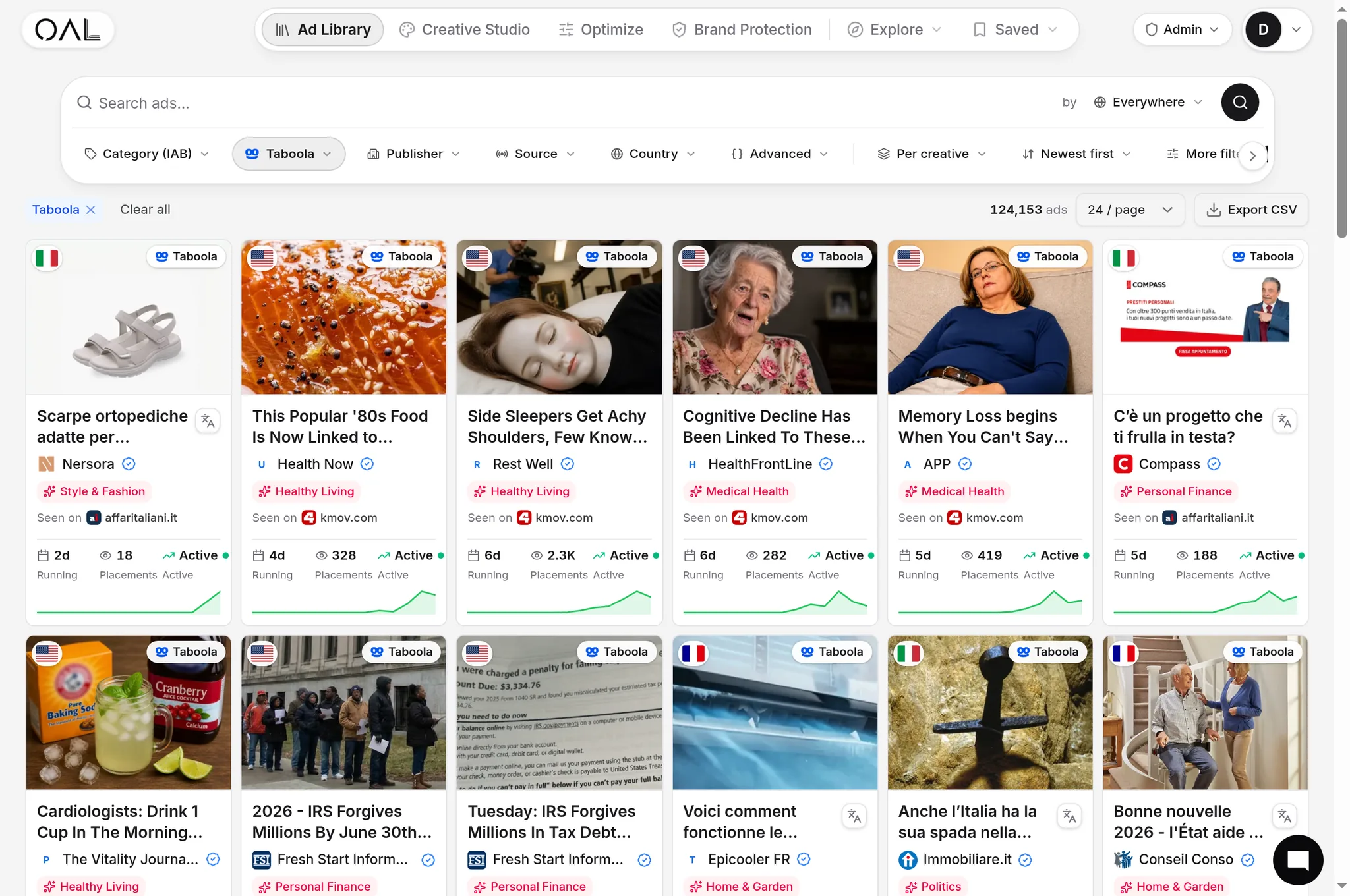
The spread is visible in what actually runs. OpenAdLibrary's index — 725,000+ creatives across 49 networks as of June 2026 — captures German-language ecommerce-software ads and Brazilian retail placements on Microsoft's feed, Greek cost-curiosity creatives on MGID, and New Zealand home-services campaigns on MediaGo. Same slot designs, entirely different clearing prices.
Season stacks on top of all four forces. Q4 retail pressure lifts CPCs in every ecommerce-adjacent geo, and heavy news cycles change supply on premium placements. A geo you priced in March will quote differently in November; treat any band, including ours, as a snapshot.
Country notes practitioners actually trade on#
Within the tiers, a few country-level patterns come up consistently in buyer reports — all qualitative, all worth verifying against your own data:
- United States — the deepest auctions and the highest ceilings in native. Insurance, legal and finance clicks clear at prices that would be irrational anywhere else, because the payouts behind them are equally outsized.
- UK, Canada, Australia, New Zealand — commonly reported somewhat below US pricing with far less volume. Australia and New Zealand auctions are thin enough that a single aggressive advertiser can move a vertical's clearing price for weeks.
- DACH (Germany, Austria, Switzerland) — among the priciest non-English markets. German-language localization is non-negotiable, and audiences punish sloppy translation harder than most; the reward is high purchasing power and less angle saturation than the US.
- France, Southern Europe — France sits at the soft end of Tier 1; Spain, Italy, Portugal and Greece behave as classic Tier 2 with solid volume and forgiving prices, which is why they are standard first stops for geo expansion.
- Japan — expensive clicks, distinct creative conventions, and a market where imported Western creative routinely fails without genuine localization, not just translation.
- Brazil and Mexico — the LATAM volume leaders. Cheap clicks by Tier-1 standards, real ecommerce demand (the index captures Amazon storefront placements in both), and payment-method localization as the make-or-break detail.
- Poland, Czechia, Romania — Eastern Europe's strongest performance markets; buyers commonly treat them as the best CPC-to-quality ratio in Tier 2.
- India and Southeast Asia — enormous volume at Tier-3 prices with wide placement-quality variance; whitelist discipline matters more here than anywhere.
Which networks are strongest in which geos#
Network footprints differ enough that the geo should influence the network choice:
- Taboola (206,145 creatives in the index, June 2026) — the broadest global premium supply; the default starting point for Tier-1 English and Western Europe.
- Outbrain (108,573) — premium news supply concentrated in Tier-1 US and Europe.
- Microsoft Audience Network / MSN (281,839) — portal feed spanning dozens of countries; the index shows live campaigns from Brazil, Mexico, Chile and Germany, making it a serious multi-geo channel. See the MSN native ads guide.
- MGID (62,765) — the classic Tier-2 workhorse across Eastern and Southern Europe, Asia and LATAM, covered in how MGID works.
- Revcontent (15,789) — US-heavy mid-tier supply; useful as a cheaper Tier-1 English complement once your angles are proven, less useful as the place to prove them.
- MediaGo (6,571) — growing APAC and ANZ footprint; the index captures sustained New Zealand campaigns running three weeks and counting, in markets the bigger widgets serve thinly.
Device pricing inside a country#
Within any geo, device splits the price again. Mobile clicks commonly run one-third to one-half cheaper than desktop in the same auction — supply is more plentiful and conversion rates are usually lower. Desktop carries a premium in finance, B2B and high-ticket verticals where buyers research on larger screens. iOS traffic typically clears above Android in the same country because monetization per user runs higher, and the gap widens in geos where iOS share concentrates among high-income users.
The tier interacts with the device split too: in Tier-3 markets, mobile is not a segment but effectively the whole market, and Android dominates it. If your geo tests blend devices, you are not testing a geo — you are testing a blend; split campaigns by device from day one and read each line separately.
The Tier-2/Tier-3 playbook — and the traps#
Cheap geos are the standard escape when Tier-1 auction pressure eats your margin, and they are also where careless buyers donate money. The honest version of both sides:
Why they work:
- Creative competition is thinner — angles that saturated in the US months ago still perform, which is the core of scaling into new geos.
- Testing is cheap: at $0.03 a click you can evaluate an angle for the price of a Tier-1 coffee budget.
- Arbitrage economics are gentler — low CPC against localized payouts can sustain margins Tier-1 no longer offers.
Where they bite:
- Payouts localize down too. The offer that pays $40 in the US may pay $8 in Brazil. Cheap clicks against a small payout is the same math with smaller numbers.
- Machine translation kills funnels quietly. A translated headline over an English landing page torches conversion; audiences click once and learn.
- Placement quality varies more. Long-tail supply carries more incentivized and accidental clicks — worth reading up on ad fraud in native advertising before scaling a Tier-3 whitelist.
- Volume ceilings arrive fast. A winning campaign in a small Tier-2 geo can exhaust its audience in weeks.
Set a breakeven CPC per geo before you bid#
The pricing table only matters relative to your own economics. Breakeven CPC is simple arithmetic: payout × conversion rate. As a purely illustrative example, an offer paying $40 with a funnel converting 1% of clicks breaks even at $0.40 per click; localize the same offer to a Tier-2 market where it pays $12 at the same conversion rate and breakeven falls to $0.12. Many buyers open bidding at roughly 60–70% of breakeven to leave testing headroom, then bid placement-by-placement from the data.
The same arithmetic works for lead generation. A purely illustrative lead-gen case: a finance offer paying $15 per lead with a 3% click-to-lead rate breaks even at $0.45 — comfortably inside Tier-1 bands — while the identical offer structure paying $4 in a Tier-2 market breaks even at $0.12, which still clears that tier's band. The tier did not change whether the campaign can work; the payout-to-CPC ratio did. That ratio is the number to compute before every geo entry, and the reason "cheap clicks" is never a strategy by itself.
The decision rule per geo: if the commonly reported band floor for your target tier sits above your breakeven CPC, do not enter — fix the funnel or find a better payout first. The full bid-and-budget workflow is in our media buying guide for native ads.
Research a geo before you spend a dollar#
The cheapest geo test is the one you never had to run. Before committing budget:
- Check advertiser density. Filter live native ads by country in an ad intelligence platform and count distinct advertisers sustaining spend. A geo with healthy competition validates demand; a ghost town is a warning, not an opportunity.
- Read longevity. Sort by days running. Creatives persisting for weeks in that geo mark offers and angles whose economics work there.
- Audit localization depth. Are the persistent ads professionally localized or lazily translated? The bar you must clear is whatever the survivors do.
- Note which networks carry the geo. If every long-running ad in your target country sits on MGID rather than Taboola, that is your supply answer.
- Trace the funnels. Follow the persistent ads to their landing pages and note payment methods, currency handling and offer localization — the full workflow is in how to spy on competitor native ads.
- Check the device split. Note whether the geo's persistent creatives were captured on desktop, Android or iOS. A market where survivors run overwhelmingly on Android tells you where the affordable conversions are before you spend anything on the others.
An afternoon of this replaces a month of paid discovery — and it is the difference between entering a geo with a map and entering with a coin flip.
Finally, the geo mistakes that recur in every post-mortem: averaging CPCs across countries in one campaign (one line item per country, always — a blended "Europe" campaign is unreadable); entering a geo because clicks are cheap rather than because the payout-to-CPC ratio clears; treating a translated headline as localization; and judging a geo on a hundred clicks. Small markets are noisy — give each country enough volume to read before you write it off, and enough structure that what you read means something.