
 Español
 Português (Brasil)
 Français
 Deutsch
 Italiano
 Nederlands
 Polski
 Svenska
 Türkçe
 Русский
 日本語
 한국어
 简体中文
 Tiếng Việt
 Bahasa Indonesia
 繁體中文
 Čeština
 Dansk
 Norsk (bokmål)
 Suomi
 Ελληνικά
 Română
 Magyar
 Українська
 ไทย
 हिन्दी
 العربية
 עברית
Last-Click Attribution: Definition & Limitations
Last-click attribution gives 100% of the credit for a conversion to the final ad or link a customer clicked before converting.


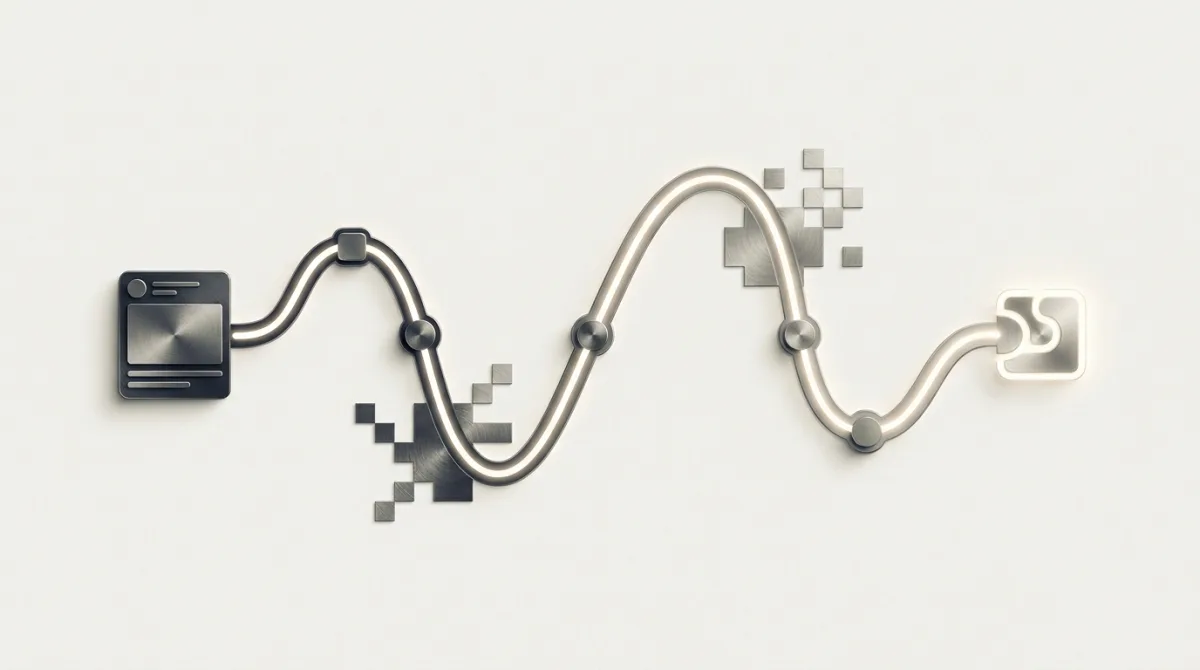
Last-click attribution is a measurement model that gives all the credit for a conversion to the final ad, link or channel a customer interacted with before converting, ignoring every touchpoint that came earlier in the journey. If someone saw a native ad, then a week later clicked a branded search ad and bought, last-click attribution credits the entire sale to that final search click.
Why it's still the default#
Most ad platforms and analytics tools ship with last-click as the out-of-the-box model because it's simple to compute and requires only a single click ID or tracking pixel fire at the moment of conversion, not a full history of every touchpoint. It also matches how a basic conversion tracking setup naturally works: one pixel fires, one channel gets logged.
The systematic bias it creates#
Last-click structurally favors channels that sit close to the purchase decision, like branded search or retargeting, and undervalues channels that introduce a product earlier in the funnel, like native discovery placements. A media buyer relying only on last-click numbers will often conclude an upper-funnel native campaign isn't working and cut its budget, when in fact it generated the demand that branded search later captured and got credit for.
How it compares to other models#
A model that splits credit across every touchpoint a customer interacted with, rather than just the last one, usually surfaces more value in upper-funnel channels. View-through attribution takes a different angle again, crediting a conversion to an ad the user merely saw within a defined attribution window, not one they clicked. A live holdout experiment skips modeled credit entirely and measures what happens when a channel is turned off, which is the closest thing to ground truth any of these methods get to.
When last-click is actually fine#
Last-click isn't wrong for every use case. For a short, single-channel funnel, someone clicks one ad and buys within minutes, common in direct-response native offers, there often isn't much of a multi-touch journey to misattribute in the first place. It also stays useful as a fast, consistent day-to-day optimization signal inside a single platform's ad manager, where you're comparing one ad set against another rather than one channel against a completely different one.
Where the risk shows up#
The real danger is comparing last-click numbers across networks with different attribution windows and calling it a fair fight. A 7-day click window on one network and a 30-day window on another will produce very different last-click conversion counts for reasons that have nothing to do with which network actually performs better. Before reallocating ad spend off a last-click comparison, check what each network is actually running and how long their winning creatives tend to last, see ad longevity, using a tool like OpenAdLibrary's ad intelligence platform, since a channel showing weak last-click numbers might just be operating earlier in the funnel than your tracking gives it credit for.