English
 Español
 Português (Brasil)
 Deutsch
 Italiano
 Nederlands
 Polski
 Svenska
 Türkçe
 Русский
 日本語
日本語 한국어
한국어 简体中文
简体中文 Tiếng Việt
 Bahasa Indonesia
 繁體中文
繁體中文 Čeština
 Dansk
Dansk Norsk (bokmål)
 Suomi
Suomi Ελληνικά
 Română
 Magyar
 Українська
 ไทย
ไทย हिन्दी
 العربية
 עברית
עבריתComment Diversifier au-delà des Publicités Meta (Guide des Canaux Natifs)
Si Meta représente 90 % de vos dépenses, vous n'avez pas un canal marketing, vous avez un point de défaillance unique ; voici comment ajouter le natif comme second moteur et utiliser la reconnaissance concurrentielle pour réduire les risques à chaque étape.


Si Meta représente 90 % de vos dépenses, vous n'avez pas un canal marketing. Vous avez un point de défaillance unique. Toute entreprise construite sur une seule plateforme publicitaire est à un compte désactivé, un pic de CPM, ou une mise à jour des politiques d'une falaise de revenus. Les annonceurs qui survivent à ces événements n'ont pas eu plus de chance. Ils ont construit un second moteur avant d'en avoir besoin.
Ceci est un guide pour ajouter la publicité native comme ce second moteur. Ce n'est pas un discours pour "quitter Meta" (Meta est trop bon dans ce qu'il fait). C'est une séquence concrète pour réduire les risques de la transition vers le natif, avec la reconnaissance concurrentielle comme l'étape qui transforme une expérience coûteuse en une démarche calculée.
Pourquoi la dépendance à un seul canal est le vrai risque#
S'appuyer sur une seule plateforme publicitaire empile trois risques que vous ne contrôlez pas. Il y a le risque de compte : un bannissement, un compte publicitaire désactivé, ou un blocage de paiement peut réduire les revenus à zéro du jour au lendemain. Il y a le risque d'enchère : la hausse des CPM et les nouveaux concurrents grignotent silencieusement votre marge. Et il y a le risque politique : une répression sur un secteur vertical ou un angle créatif peut tuer un angle qui fonctionnait sans possibilité de recours. La diversification ne fait pas disparaître ces risques. Elle empêche qu'un seul d'entre eux soit fatal.
Le schéma se répète dans toutes les cohortes d'acheteurs média. Un canal fonctionne, l'entreprise s'y engage, le canal change les règles, et l'acheteur sans second moteur recommence à zéro. Ceux qui s'en sortent avaient déjà un second canal rentable pour absorber le choc.
Le natif est le second moteur le plus naturel pour les acheteurs habitués à Meta car les compétences sont transférables mais les risques ne sont pas corrélés. Vous savez déjà comment écrire des accroches, construire des pré-landings, et analyser le CPA. Le natif récompense tout cela. Mais le natif s'exécute sur des inventaires séparés, des enchères séparées, et un régime politique séparé. Un bannissement de compte Meta ne touche pas vos dépenses Taboola. Et il y a beaucoup de demande native à étudier : parmi les plus de 589 000 créatives de l'index OpenAdLibrary (juin 2026), Taboola représente à lui seul 157 727 créatives capturées et Outbrain 84 252 autres.
Un second canal n'est pas une assurance que vous achetez et oubliez. C'est un muscle que vous gardez en activité. Le moment d'apprendre le natif, c'est pendant que Meta paie encore les factures, pas la semaine après la désactivation de votre compte.
Natif vs Meta : ce qui change réellement#
Avant de déplacer un dollar, comprenez ce qui est vraiment différent. La publicité native place des annonces dans le flux éditorial des sites d'éditeurs : les widgets "recommandés pour vous" sous les articles, les unités de contenu dans le fil, les modules d'articles sponsorisés. L'utilisateur lit, il ne socialise pas, et cette seule différence refaçonne tout ce qui suit.
| Dimension | Meta | Natif (Taboola / Outbrain / MGID / Revcontent) |
|---|---|---|
| État d'esprit de l'utilisateur | Social, navigation dans le fil | Lecture de contenu, vigilance publicitaire plus faible |
| Ciblage | Riches données d'intérêts/comportement + algorithme | Contextuel + côté offre, plus large |
| Moteur créatif | Visuelle accrocheuse + courte accroche | Titre de curiosité + image ; le pré-landing fait le travail |
| Destination du clic | Souvent directement vers l'offre | Presque toujours un article de conseil / pré-landing d'abord |
| Enchère | Programmatique, forte optimisation par ML | Enchère native programmatique, plus de contrôle sur les enchères |
| Levier de scale | Expansion d'audience, ASC | Expansion de sites/widgets, expansion géographique |
| Fragilité du compte | Élevée (bannissements instantanés courants) | Plus faible, mais approbations plus lentes |
Le plus grand changement opérationnel est le pré-landing. Sur Meta, vous pouvez parfois envoyer du trafic froid directement vers une offre. Sur le natif, le clic atterrit presque toujours sur un article de conseil, un quiz ou un article-liste qui réchauffe d'abord le lecteur. Observez comment les titres sont écrits. Voici une publicité finance en direct sur Taboola, capturée dans notre index :

Ce titre ("2026 - IRS Forgives Millions By June 30th Tax Deadline") ne vend pas un produit dans l'image. Il vend le clic vers un article. Les acheteurs qui sautent le pré-landing et exécutent des entonnoirs style Meta direct-vers-offre sur le natif concluent généralement que "le natif ne convertit pas", alors que le vrai problème est l'architecture de l'entonnoir. Notre guide approfondi sur la publicité native décompose la mécanique de bout en bout.
Le second changement est ce que vous optimisez. L'algorithme de Meta fait un travail colossal. Le natif vous donne un contrôle granulaire sur les enchères au niveau du widget et du site, ce qui signifie plus de gestion manuelle mais une transparence bien plus grande sur l'endroit exact où va votre argent.
Réduisez d'abord les risques : lisez le marché avant de dépenser#
Voici la partie que la plupart des conseils "diversifiez vos canaux" ignorent. Le coût dominant de l'entrée sur un nouveau canal n'est pas le budget test. Ce sont les tests ratés que vous payez en apprenant ce que le canal savait déjà. Tout vétéran du natif a brûlé des sommes à quatre chiffres pour découvrir quels angles, créatives et pré-landings fonctionnent dans un secteur vertical. Vous pouvez acheter la majeure partie de cette connaissance au prix d'un simple regard.
La reconnaissance concurrentielle anticipe la courbe d'apprentissage. Au lieu de partir d'une campagne vierge, vous partez de modèles validés : quels annonceurs mènent réellement des campagnes natives soutenues dans votre secteur vertical, quelles créatives ils maintiennent en ligne depuis des semaines (un bon indicateur de rentabilité), et où mènent leurs clics.
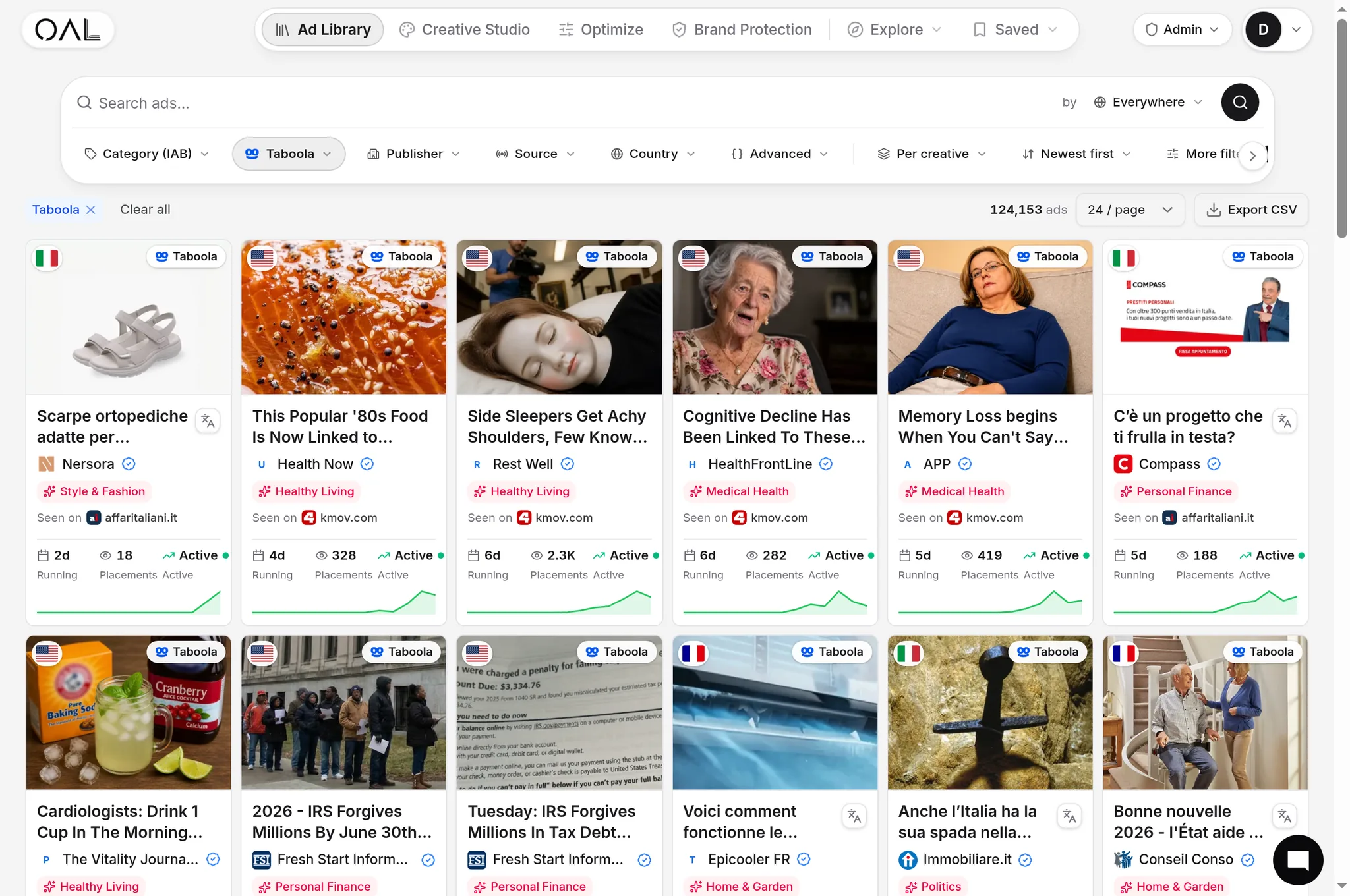
C'est le fossé que OpenAdLibrary est conçu pour combler. Il capture des publicités natives publiques en direct sur Taboola, Outbrain, MGID, Revcontent, Teads, MSN et Yahoo (42 réseaux et 25 933 annonceurs indexés à ce jour), préserve l'image créative réelle en pleine qualité, identifie l'annonceur réel derrière chaque placement plutôt que juste le réseau, et suit le clic jusqu'à la page de destination ou le pré-landing, sans jamais cliquer sur une annonce en direct. Nous avons enregistré plus de 5,4 millions d'observations publicitaires et plus de 926 000 captures de pages de destination, ce qui vous permet de répondre à des questions qui prendraient autrement un mois et un budget test à découvrir.
La longévité est le signal le plus utile ici. Les créatives les plus anciennes de notre index ont été observées en direct et en continu pendant 28 jours d'affilée (la durée actuelle de notre fenêtre de capture). Quand un annonceur maintient la même annonce en vie aussi longtemps, c'est généralement qu'elle est rentable. SmartAsset a exécuté cet angle finance sur Outbrain pendant toute notre fenêtre d'observation :

Une note sur les "gagnants" : le folklore du secteur adore la règle empirique du "gagnant de 90 jours". C'est du folklore général, pas quelque chose que nous pouvons confirmer. Ce que nous pouvons vous dire, c'est ce que nous observons directement, et actuellement ce plafond est de 28 jours de capture continue. Interprétez la longévité comme un signal relatif (28 jours battent trois jours), pas comme un signal absolu.
Avant de lancer, les données concurrentielles répondent clairement à trois choses :
- Qui est engagé ici ? Un annonceur qui exécute la même offre pendant des semaines sur des dizaines de sites a trouvé quelque chose qui fonctionne. Une campagne d'un jour ne l'a pas fait. (Comparez la publicité IRS de 13 jours ci-dessus avec une créative dating que nous avons capturée au jour zéro.)
- À quoi ressemble un entonnoir gagnant ? Voir la créative capturée et le pré-landing vers lequel elle pointe vous donne un entonnoir de référence complet pour votre secteur vertical.
- Où la demande est-elle concentrée ? Dans notre index, la finance (17 232 créatives), l'assurance (15 629) et la santé (14 895) sont les trois secteurs verticaux natifs les plus capturés, avec le e-commerce (13 872) juste derrière. C'est là que l'offre, et la concurrence, sont les plus denses.
Vous ne copiez pas des annonces. Vous lisez le marché. La même discipline qui fait un bon acheteur Meta (étudier le dossier d'inspiration, modéliser les gagnants, puis se différencier) s'applique, sauf que les publicités natives sont publiques et traçables d'une manière que celles de Meta ne le sont pas.
Un plan de migration par étapes#
La diversification échoue quand les acheteurs la traitent comme une réallocation de budget. Retirer des dépenses d'un compte Meta rentable pour financer un test natif non éprouvé, c'est ainsi que vous vous retrouvez avec deux canaux sous-performants. Le bon cadre est l'addition, puis la graduation : ajoutez un petit budget d'apprentissage au natif pendant que Meta tourne à plein régime, et ne transférez des dépenses vers le natif que lorsqu'il atteint le seuil de rentabilité à un volume stable.
- Reconnaissance (semaine 0). Utilisez les données concurrentielles pour choisir un secteur vertical, un réseau de départ, et deux ou trois entonnoirs de référence à modéliser. Déterminez votre CPA seuil de rentabilité avant de lancer quoi que ce soit.
- Choisissez un réseau d'abord. Ne dispersez pas un budget mince sur quatre réseaux. Pour la plupart des annonceurs en réponse directe anglophones, Taboola est le premier mouvement naturel. Il alimente l'inventaire natif de Yahoo dans le cadre d'un accord exclusif de longue durée, donc une seule plateforme atteint une vaste empreinte d'éditeurs premium. Notre guide de configuration Taboola étape par étape détaille la création de compte.
- Construisez l'entonnoir attendu par le natif. Créative (titre de curiosité + image), puis pré-landing, puis offre. Réutilisez vos angles Meta comme matière première, mais reconstruisez l'entonnoir pour un public qui lit.
- Testez avec de l'argent que vous pouvez vous permettre de perdre en apprenant. Quelques centaines de dollars par réseau sur deux à trois semaines, avec un budget quotidien suffisant pour recueillir des données réelles. C'est des frais de formation, pas une quête de profit.
- Analysez les données au niveau widget/site. L'avantage du natif est la granularité. Coupez les sites qui perdent de l'argent, misez sur ceux qui convertissent, et laissez la campagne trouver son inventaire rentable. La mécanique de cette montée en puissance disciplinée est dans notre guide du débutant en achat média natif.
- Graduation, puis scale. Une fois qu'une campagne atteint le seuil de rentabilité à un volume stable, maintenant vous passez à l'échelle. Et ce n'est qu'à ce moment-là qu'il est logique d'ajuster votre mix de canaux.
La géographie est l'un des avantages les plus discrets du natif par rapport à Meta. Les marchés de niveaux 2 et 3 offrent un inventaire moins cher et moins contesté, et un entonnoir qui fonctionne peut être cloné à travers les zones géographiques pour une fraction des CPM des marchés de niveau 1. Cette publicité sur les batteries solaires est en ligne depuis 27 jours, le type d'angle régional durable qui se transpose bien :

Le guide pour cloner un gagnant à travers les régions est dans le passage à l'échelle vers de nouvelles zones géographiques. Et il y a un vrai choix entre pousser un gagnant éprouvé plus fort sur le même inventaire ou s'étendre vers de nouveaux placements, que nous détaillons dans le scale horizontal vs vertical.
Choisir vos réseaux natifs#
Le paysage natif s'est fortement consolidé, ce qui simplifie en réalité le choix. Taboola alimente désormais l'offre native de Yahoo, et Outbrain a acquis Teads début 2025 (la société combinée opère sous le nom Teads). Cela laisse une hiérarchie claire pour un acheteur en diversification :
- Taboola (+ Yahoo) est la plus grande empreinte d'éditeurs premium et la source unique la plus importante de notre index (157 727 créatives). C'est le test par défaut pour la plupart des secteurs verticaux.
- Outbrain / Teads apporte une forte portée premium avec une orientation vidéo et branding post-fusion (84 252 créatives capturées). Un second réseau naturel.
- MGID et Revcontent proposent un trafic moins cher et à plus grand volume qui tend à performer dans les zones géographiques de niveaux 2/3 et les secteurs verticaux en réponse directe agressive. Utile pour le volume une fois que vous avez prouvé un entonnoir.
Choisissez sur des preuves, pas sur la réputation. Sur Taboola, les secteurs verticaux les plus denses dans nos données sont la santé (6 048 créatives), la finance (5 558) et l'assurance (4 303). Sur Outbrain, la finance (2 640) et l'assurance (2 615) sont en tête. Si les annonceurs durables de votre secteur vertical se concentrent sur un réseau publicitaire natif, c'est là que votre entonnoir a les meilleures chances, et les données concurrentielles vous le montrent plus vite qu'aucun guide. Chaque réseau exécute sa propre enchère native programmatique avec ses propres particularités, prévoyez donc d'en apprendre un bien avant d'ajouter le suivant.
Même en dehors des deux grands, le signal tient. Les offres santé sont partout dans le natif, et les angles sont remarquablement cohérents. Voici une publicité pour appareil auditif en ligne depuis 26 jours :

L'état d'esprit de la diversification#
La diversification des canaux n'est pas un projet que vous terminez. C'est une posture que vous maintenez. Les acheteurs qui résistent aux chocs de plateforme traitent chaque canal comme temporaire et chaque gagnant comme quelque chose à comprendre, modéliser et transposer ailleurs. Le natif est le second moteur à levier le plus élevé pour une entreprise dépendante de Meta car les compétences sont transférables tandis que les risques ne sont pas corrélés. La même logique vous oriente éventuellement vers un troisième canal, et un quatrième.
Le fil conducteur est l'intelligence. Que vous entriez sur le natif, que vous vous étendiez à une nouvelle zone géographique, ou que vous testiez la résistance de l'entonnoir d'un concurrent, les annonceurs qui avancent le plus vite sont ceux qui lisent le marché avant de dépenser. OpenAdLibrary rend cette reconnaissance abordable et ouverte : capture d'annonces natives en direct, l'annonceur réel derrière chaque annonce, et le parcours de clic complet vers la page de destination, pour une fraction du prix des outils d'espionnage traditionnels. Commencez gratuitement et parcourez 200 annonces sans carte pour voir ce que vos concurrents diffusent avant d'engager un dollar.
Construisez le second moteur pendant que le premier tourne encore. C'est toute la stratégie.