Español
 Português (Brasil)
 Français
 Deutsch
 Italiano
 Nederlands
 Polski
 Svenska
 Türkçe
 Русский
 日本語
日本語 한국어
한국어 简体中文
简体中文 Tiếng Việt
 Bahasa Indonesia
 繁體中文
繁體中文 Čeština
 Dansk
Dansk Suomi
Suomi Ελληνικά
 Română
 Magyar
 Українська
 ไทย
ไทย हिन्दी
 العربية
 עברית
עבריתYahoo DSP Minimum Spend and Native Access Explained
Yahoo doesn't publish one universal DSP minimum spend figure. Here's what actually determines it and how to get a real answer before you budget.


Yahoo DSP doesn't publish a single official minimum spend figure that applies to every advertiser. Self-serve access through Yahoo's advertising platform generally has a much lower entry point than the managed or enterprise DSP tier, where minimum monthly commitments are common. If a specific number matters for your budgeting, treat any figure you hear from a rep or a forum post as a starting reference point, not a fixed rule, and confirm current terms directly with Yahoo before you plan around it.
Why There's No Single Answer#
Yahoo's advertising stack has gone through several rebrands (Yahoo Gemini folded into what's now marketed under Yahoo/Verizon-affiliated native and search inventory), and access tiers differ by whether you're buying self-serve, through a managed service team, or through a reseller or agency trading desk. Each of those paths carries different account minimums, different onboarding requirements, and different levels of dedicated support. For background on how the platform got here, see what happened to Yahoo Gemini and our glossary entry on Yahoo Gemini and Yahoo Native.
Media buyers and industry commentary commonly describe managed or enterprise DSP access as carrying meaningfully higher minimum monthly commitments, often in the low five figures or more, while self-serve or smaller programmatic access points tend to have lower or no strict minimum. These figures move, vary by market, and are not something OpenAdLibrary can confirm as official policy, so check Yahoo's current advertiser documentation or talk to a rep before you build a budget plan around any specific number you've heard.
What Actually Drives the Minimum#
- Access tier. Self-serve platforms are built to be accessible at modest budgets. Managed and enterprise DSP relationships come with dedicated account support, which is typically why the commitment is higher, you're paying in part for the service layer, not just the media.
- Market and region. Minimum spend commitments (where they exist) commonly differ by country, reflecting local market size and Yahoo's own account management priorities in that region.
- Reseller vs direct. Buying through a certified reseller or agency trading desk can carry a different minimum than going direct, sometimes lower, sometimes bundled into a broader platform fee.
- Inventory type. Native placements inside Yahoo's content properties, search inventory, and display or video each sit on different pricing and access structures. Confirm which inventory type your quoted minimum actually covers.
How This Compares to Other Native Networks#
Taboola and Outbrain's self-serve platforms are built to be accessible without a large upfront commitment, which is part of why they carry so much more live creative volume in the OpenAdLibrary index (206,145 and 108,573 respectively) than Yahoo's native inventory, at 5,926 creatives as of June 2026. That gap partly reflects genuine differences in advertiser access: a lower entry barrier on Taboola and Outbrain means more advertisers, of more varying sizes, actively running campaigns and rotating creative. Yahoo's smaller live creative count is consistent with a narrower, more gated advertiser base, some of it coming through managed relationships rather than open self-serve.
For a full walkthrough of how Yahoo's native ecosystem functions post-Gemini, see how Yahoo native ads work.
Budgeting Realistically#
If you're a smaller advertiser or an affiliate marketer testing new geos or verticals, start by asking directly whether self-serve access is available in your market and what its actual entry threshold is, rather than assuming the enterprise DSP figure applies to you. If you're a brand or agency planning a larger managed campaign, budget with the expectation that Yahoo's managed tier likely carries a higher minimum commitment than a comparable Taboola or Outbrain self-serve test, and confirm the number before committing to a media plan or timeline.
It's also worth sequencing your testing. If your budget doesn't clear Yahoo's minimum threshold yet, running a smaller validation campaign on a lower-barrier network first, then reallocating proven angles to Yahoo once budget allows, is a common and reasonable approach. For general budget planning across native networks, our native ad cost guide and media buying for native ads guide cover how to size a test budget before you scale.
What to Ask Before You Commit#
- What is the current minimum monthly spend for self-serve access in my specific market?
- Does that minimum differ for managed service versus self-serve?
- What inventory does that minimum actually cover, native, search, display, video, or a mix?
- Are there setup fees or account management fees on top of media spend?
- What happens if I don't hit the minimum in a given month, is it a hard requirement or a target?
Getting clear answers to these questions before committing budget avoids the common mistake of assuming a figure quoted for one access tier or region applies universally. Yahoo's own current documentation and account team are the only reliable source here, treat any secondhand number, including the general ranges discussed above, as a starting point for that conversation rather than a final answer.
Checking Demand Before You Commit#
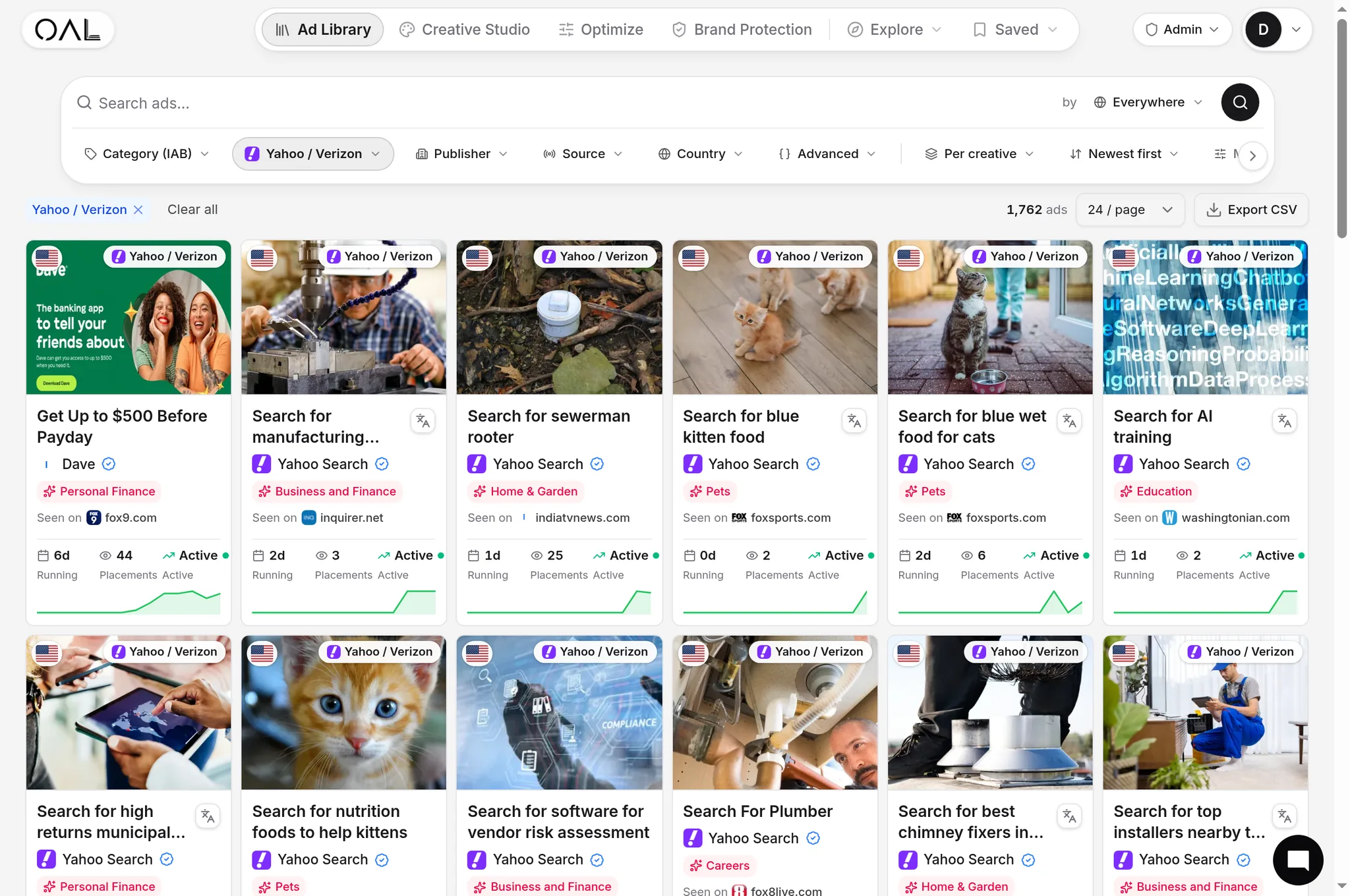
Regardless of minimum spend, it's worth checking whether your vertical actually has active advertiser demand on Yahoo's native inventory before committing budget. OpenAdLibrary's Yahoo ad spy tool shows live creatives and resolved advertisers currently running, which gives you a real signal of whether the network is worth clearing that minimum threshold for in your specific category.
What the Live Advertiser Mix Tells You#
OpenAdLibrary's index carries 5,926 live Yahoo creatives as of June 2026. The vertical spread leans toward software (466 creatives), finance (261), pets (203), health (201), insurance (189) and auto (183). That's a meaningfully different mix than Taboola's health-and-finance-heavy top line, and it's worth reading as a signal of where advertisers are currently finding the access and economics to work, whichever tier they're buying through. If your category isn't well represented in that live mix, it's a reasonable prompt to ask your account contact directly whether current access terms actually support your vertical at the volume you're planning, before you commit to clearing a minimum spend threshold.
A thinner live creative count than Taboola or Outbrain isn't automatically a red flag. It can also reflect a genuinely smaller but more qualified advertiser base that's cleared a higher access bar and is seeing acceptable returns, which is consistent with how a managed-tier minimum spend structure tends to filter who shows up. The honest reading requires knowing which access tier the advertisers you're seeing are actually buying through, information you generally only get by asking Yahoo directly or by piecing it together from account size and campaign polish.
Negotiating the Minimum#
If you're a mid-sized advertiser sitting between self-serve and full enterprise scale, minimums are often more negotiable than the first number you're quoted, especially if you can show a clear ramp plan or an existing track record on comparable inventory elsewhere. Come to that conversation with a specific vertical, geo and monthly budget range rather than an open-ended "what's your minimum," since account teams generally size commitments around what you're actually trying to buy rather than a flat policy. It also helps to ask whether a shorter initial commitment (a one-quarter pilot, for instance) is available before agreeing to a longer-term minimum, so you have an exit point if the channel doesn't perform.
Common Misreadings of "Minimum Spend"#
A few things advertisers frequently get wrong when budgeting for Yahoo DSP access. The first is treating a quoted minimum as a hard floor below which nothing is possible, when in many cases it's closer to a target commitment tied to a specific service level, and the real conversation is about which service level you actually need. The second is comparing a managed-tier Yahoo quote directly against a Taboola self-serve entry point and concluding Yahoo is simply "more expensive," when the two numbers reflect entirely different access models rather than the same product at a different price. The third is assuming the minimum is a one-time setup cost rather than a recurring monthly commitment, which changes the math considerably over a full campaign flight. Get precise language on all three points in writing before you sign anything.