Español
 Português (Brasil)
 Français
 Deutsch
 Italiano
 Nederlands
 Polski
 Svenska
 Türkçe
 Русский
 日本語
日本語 한국어
한국어 简体中文
简体中文 Tiếng Việt
 Bahasa Indonesia
 繁體中文
繁體中文 Čeština
 Dansk
Dansk Norsk (bokmål)
 Suomi
Suomi Ελληνικά
 Română
 Magyar
 Українська
 ไทย
ไทย हिन्दी
 العربية
 עברית
עבריתIs Outbrain Legit? What the Platform Is (And Isn't) Responsible For
Outbrain is a legitimate, publicly traded ad platform running on major publisher sites. The confusion almost always comes from a specific advertiser's ad, not the platform itself. Here's how to tell the two apart.


Outbrain is a legitimate, publicly traded advertising company (it merged with Teads in 2026 to form one of the largest independent open-web advertising platforms) and it is not responsible for the content of the individual ads or advertorials that run through it, in the same way Google isn't responsible for every website a search ad links to. Confusion about whether "Outbrain is legit" almost always traces back to a specific bad experience with an individual advertiser's landing page, not with Outbrain the company or platform itself.
Where the "is Outbrain legit" question actually comes from#
Most people asking this have clicked a sensational headline (a celebrity health claim, a shocking-sounding story, a too-good financial offer) below an article on a news site, followed it to an advertorial or product page, and come away feeling misled by that specific ad. The reasonable follow-up question is whether the platform serving the ad is trustworthy.
The honest answer has two parts. Outbrain the company is a real, established ad tech business with public financial reporting since its Teads merger, running on major publisher sites you already trust for content. But Outbrain is an advertising marketplace, not a publisher of the ads themselves. It doesn't write, fact-check, or vouch for individual advertiser claims any more than a magazine vouches for the truthfulness of every ad printed next to its articles. That distinction, platform versus advertiser, is where almost all the "is this legit" confusion lives.
What Outbrain is actually responsible for#
Outbrain sets and enforces its own advertiser content policies, which prohibit certain categories and claim types outright and require others to carry disclosures. It reviews creative before approving campaigns and can pull ads that violate policy after the fact if flagged. It's also subject to general advertising law like any other ad platform, including FTC rules around clear and conspicuous disclosure for advertorial content.
What it doesn't do: independently verify every factual claim in every ad before it runs, or guarantee that every landing page an ad points to matches what the ad itself implies. At the scale native networks operate, with tens of thousands of active advertisers across dozens of networks industry-wide, pre-screening every claim with the rigor a single reader would want is not how any ad marketplace, native or otherwise, actually functions.
Publisher-side legitimacy vs advertiser-side legitimacy#
It helps to separate two different trust questions that get collapsed into one. The publisher-side question is whether Outbrain's widget technology and the sites it partners with are legitimate: yes, Outbrain's client list includes major news and media publishers, and the widget technology itself is standard content-recommendation infrastructure used across the native advertising industry.
The advertiser-side question is whether any specific ad you clicked is trustworthy, and that has nothing to do with which network served it. A misleading or low-quality advertiser can run on Outbrain, Taboola, MGID, or any other network; the network is the delivery mechanism, not the guarantor of the individual pitch. If you got burned by a specific advertiser's claim, the complaint belongs with that advertiser (and potentially the FTC), not with "is Outbrain legit" as a category question.
How to evaluate a specific ad you're suspicious of#
Check how long the creative has actually been running. A pre-lander or advertorial that's been live for weeks has, at minimum, survived enough scrutiny (from the network's own compliance review and from not generating enough complaints to get pulled) to keep running. That's a rough signal, not proof of legitimacy, but a brand-new creative making an extreme claim is worth more skepticism than one that's been running for a month.
Look at the landing page separately from the ad. A native ad's headline is designed to earn a click; the landing page is where the actual offer, terms, and business identity should be clear. If the landing page has no identifiable business name, no way to verify who's behind it, or terms that only appear in tiny fine print, that's a legitimacy problem with the advertiser, independent of the network.
If you suspect outright fraud (a fake celebrity endorsement, a copycat brand, a scam offer), it's worth documenting and reporting it rather than just writing off the whole platform. Our guide on how to report a scam ad walks through what evidence to capture and where to send it.
What "legit" means differently for readers vs advertisers#
If you arrived here as someone who clicked an ad and felt uneasy, the practical takeaway is simple: evaluate the specific claim and the specific landing page, not the network's brand name. Outbrain being a real company doesn't make any individual pitch true, and it not being a scam operation itself doesn't mean every advertiser on it deserves your trust by default. Treat every native ad, on Outbrain or anywhere else, the way you'd treat any unsolicited pitch: check the specifics before you act on it.
If you arrived here as a marketer evaluating whether to spend money with Outbrain, the calculus is different again. The question isn't whether individual advertisers occasionally push boundary-testing creative (they do, on every ad network, including the biggest ones), it's whether the platform delivers real traffic from real publisher inventory and enforces its policies well enough that your own brand isn't damaged by association. Those are answerable questions with a track record behind them, not a matter of trusting a headline.
What this means if you're considering advertising on Outbrain#
From the advertiser side, "is Outbrain legit" usually really means "will spending money here actually get me real traffic and won't get my brand tangled up with sketchy neighbors." Outbrain runs on real publisher inventory with verifiable traffic, and its own brand safety and content review policies exist specifically because the platform has commercial reasons to keep obviously fraudulent advertisers off it: publisher relationships depend on it. That said, like any open marketplace, enforcement isn't perfect everywhere, all the time, which is a separate operational question from whether the platform itself is a real business worth spending with.
Why native ad marketplaces attract more scrutiny than search or social#
Part of why "is Outbrain legit" gets searched so often, more than an equivalent question about, say, a specific Google search ad, is the format itself. Native widgets are designed to blend visually with the surrounding editorial content, which is the entire point of the native advertising format. That design choice is also exactly what makes a low-quality ad feel more jarring when it doesn't match reader expectations: people trust the publisher's editorial judgment, and a sensational ad sitting one click below a serious news story can feel like it's borrowing that trust without earning it.
This is a real, ongoing tension in the native advertising industry generally, not something unique to Outbrain. Every major native network, and every publisher that runs native widgets, balances ad revenue against reader trust, and enforcement quality varies. It's a legitimate reason to stay skeptical of individual ads by default, which is a healthy instinct, separate from concluding the platform itself is a scam.
Signals that a specific advertiser is worth more scrutiny, not less#
A few patterns are worth watching for on any native platform, Outbrain included. Claims that promise an unusually specific and dramatic result (a precise dollar figure, a named celebrity endorsement that seems implausible, a medical claim that sounds too strong) deserve more skepticism than vaguer, more modest claims. Landing pages with no clear business name or contact information, or that use urgency language stacked on urgency language, are worth a second look before you trust the offer, let alone act on it.
None of these signals are unique to Outbrain. They're general advertorial literacy, useful across every native network and honestly across a lot of web advertising generally. Our ad transparency glossary entry and ad fraud in native advertising guide go deeper on both the mechanics and the warning signs if you want the fuller picture.
How OpenAdLibrary helps#
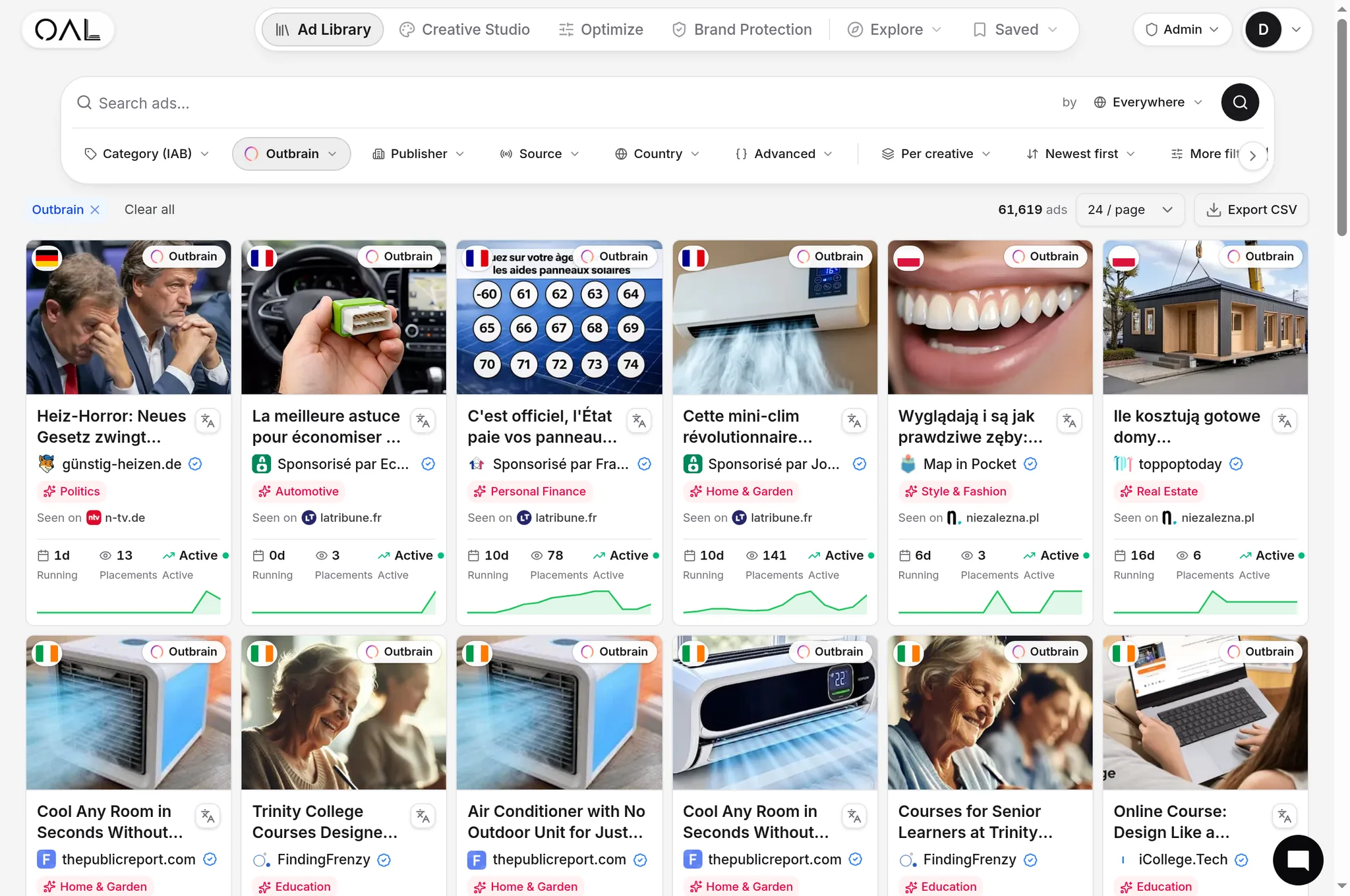
If you want to see what's actually running on Outbrain rather than taking anyone's word for it, including this article's, OpenAdLibrary's /spy/outbrain tool indexes live creatives from the network directly, so you can browse real advertisers, real claims, and real landing pages rather than relying on secondhand accounts. It's also a useful due-diligence step before you advertise yourself: seeing what's already running in your vertical tells you what kind of company you'll be keeping on the platform, and whether the marketplace looks like a fit for your brand.