
 Español
 Português (Brasil)
 Français
 Deutsch
 Italiano
 Nederlands
 Polski
 Svenska
 Türkçe
 Русский
 日本語
日本語 한국어
한국어 简体中文
简体中文 Tiếng Việt
 Bahasa Indonesia
 繁體中文
繁體中文 Čeština
 Dansk
Dansk Norsk (bokmål)
 Suomi
Suomi Ελληνικά
 Română
 Magyar
 Українська
 ไทย
ไทย हिन्दी
 العربية
 עברית
עבריתYahoo DSP Native Ads: Campaign Setup and Best Practices
Yahoo's native inventory now transacts through the Yahoo DSP, not the old Gemini console. Here is how access, campaign structure, creative, and tracking actually work — and what the live feed says about the competition.


Native ads on Yahoo are bought through the Yahoo DSP — the demand-side platform that absorbed Yahoo's native inventory when the old Gemini self-serve platform was retired. To run them you need a DSP seat (self-serve with a spend commitment, or managed service), a native line inside a campaign, image-plus-headline creative built to native specs, and conversion tracking wired up before launch. The trade Gemini-era buyers have to accept: higher minimums and more setup than the old platform, in exchange for programmatic controls, Yahoo's logged-in audience data, and native placements across Yahoo Mail, Yahoo Finance, Yahoo News, Yahoo Sports, and syndication partners.
From Gemini to the DSP: what actually changed#
Yahoo Gemini — later "Yahoo Native" — was a low-barrier, self-serve native platform in the AdWords mold: small budgets welcome, simple campaign editor, native and search inventory in one place. Yahoo folded that buying path into the Yahoo DSP, and the native supply now transacts programmatically alongside display, video, and CTV. The full history is in What happened to Yahoo Gemini; the short version is that the inventory never disappeared — the doorway moved.
Three consequences matter for buyers:
- The barrier went up. Gemini would take almost any advertiser. The DSP is an enterprise product: expect a sales conversation, contract terms, and a spend commitment rather than a credit-card signup. Minimums are negotiated and change, so get current numbers from Yahoo directly rather than from forum posts.
- The controls got real. Programmatic line-level control over supply, frequency, audiences, and brand safety — things Gemini never offered.
- The audience stayed. Yahoo Mail and Yahoo's content properties still deliver one of the larger logged-in native audiences outside social. That deterministic ID base is the platform's genuine edge; see how Yahoo native ads work for the mechanics.
If your budget is below DSP territory, the honest answer is to start on the self-serve native networks instead — our ranking of the best native ad networks covers where smaller budgets go furthest — and graduate to the Yahoo DSP once the spend justifies it.
Getting access: seats, minimums, managed service#
There are three practical routes in. A managed-service arrangement, where Yahoo's team runs campaigns against your budget, is the lowest-effort entry and how many mid-size advertisers start. A self-serve seat gives your team the console directly and usually carries a monthly or quarterly spend commitment. Agency and reseller seats are the third path: several agencies hold DSP seats and will run your native campaigns inside them for a percentage — often the most realistic option between "too big for Taboola-only" and "big enough for our own seat." Whichever route you take, confirm current commitments and terms on Yahoo's advertising site — the packaging changes more often than the platform does.
Campaign structure and setup in the Yahoo DSP#
The DSP follows a conventional programmatic hierarchy — seat → campaign → line → ads — and it's the demand-side platform pattern: budget and flight dates at the campaign, targeting and bidding at the line, creatives attached beneath. A practical native setup looks like this:
- Create the campaign with total budget, flight dates, and a goal type aligned to conversions if you're buying performance.
- Create a native line per major split. Separate lines for desktop and mobile, and for each geo group you actually intend to manage differently. Lumping everything into one line makes later optimization guesswork.
- Target the line. Geo, device, OS, and audience. Audience targeting is where the DSP earns its keep — Yahoo's own segments built on logged-in mail users, your CRM lists, retargeting pools, and lookalikes. Layer contextual or site-list targeting on top if you need placement control.
- Set bids and pacing. Native supply transacts in an auction; watch your effective cost per click (eCPC) rather than fixating on the nominal bid, and use even pacing until you know your winning hours.
- Attach native creative and tracking, then launch small before scaling — the same discipline as any native media buying launch.
Exact menu names shift with platform releases, so treat the current DSP documentation as the source of truth for UI specifics.
Native creative specs and what actually runs#
Yahoo native units assemble from components — image, headline, description, brand name, logo — rendered to fit each placement, per the standard native ad spec model. Build landscape images around 1200×627 with minimal overlay text, write headlines that make a specific promise, and supply the logo; the network composes the rest.
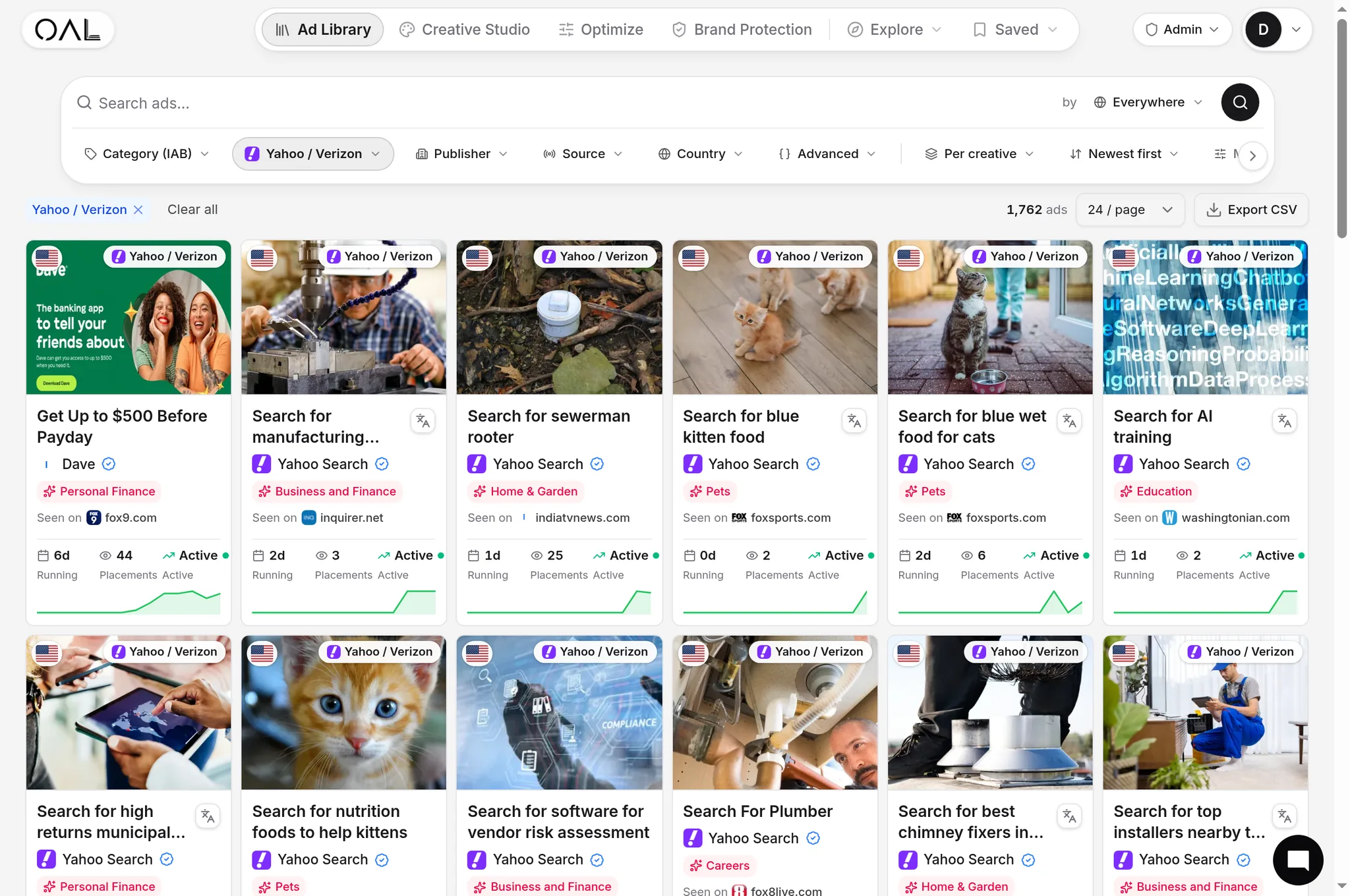
What's actually live on the network is instructive. OpenAdLibrary's index tracks 5,900+ live Yahoo native creatives (July 2026), with software, finance, pets, health, and insurance the most represented verticals. A striking share of observed units are Yahoo's own "Search for…" arbitrage-style ads — generic keyword prompts routing to search results. That tells you two things as an advertiser: there is winnable real estate (much of the feed is low-effort generic creative), and the bar for beating it is a real editorial-style native ad with a concrete hook. Browse the live corpus in the Yahoo ad library before you brief creative — ten minutes of scrolling what's running will sharpen your headlines more than any spec sheet. Our native creative best practices guide covers the image and hook patterns that consistently work across networks.
Tracking and measurement#
Wire conversion tracking before the first dollar spends. The DSP supports on-site tag ("pixel") based conversion rules for standard web funnels, and click-level macro passthrough if you run a third-party tracker — pass the click identifier into your landing URL and postback conversions server-side — the same conversion-tracking architecture you'd use on any native network. Two Yahoo-specific notes: give the platform's optimization a single, clearly-defined conversion event to learn against rather than five competing ones, and keep attribution windows consistent with your other channels so cross-network comparisons mean something.
Best practices for the first 90 days#
- Start with one geo and one clean split. Prove the funnel on your strongest market with desktop and mobile in separate lines before adding countries.
- Launch five or more creatives per line. Native optimization is creative rotation; two ads is not a test.
- Expect a learning window. Programmatic native needs conversion volume to optimize toward; judge lines on a couple of weeks of data, not 48 hours.
- Cost expectations: media buyers commonly report Yahoo native clicks landing in the same broad band as other Tier-1 native networks — often cheaper than social for comparable audiences — but vertical and geo move this a lot, and none of it is official. Budget planning math is in how much native ads cost.
- Mine the mail placement. Yahoo Mail inventory behaves differently from content-feed inventory — audiences checking email convert differently than audiences reading news. Split them in reporting before deciding either "works."
- Watch the whole competitive field, not just Yahoo. Most advertisers who succeed on Yahoo native are running the same funnels on Taboola or Outbrain; seeing their cross-network footprint tells you which offers have economics strong enough to copy-study.
Gemini-era habits to unlearn#
Buyers who ran the old platform tend to carry three habits into the DSP that no longer serve them. First, treating it as a discovery channel: Gemini's low floor made it cheap to test raw offers, but DSP minimums mean every test carries real budget — validate offers on lower-barrier networks and bring only proven funnels here. Second, ignoring audience targeting: Gemini buying was mostly placement-and-bid, whereas the DSP's edge is its logged-in ID graph, and running native lines without audience layering wastes the platform's main advantage. Third, set-and-forget lines: programmatic native drifts, and a line left untouched for a month will quietly migrate toward whatever inventory clears cheapest. Review supply reports weekly, prune underperforming placements, and keep the creative rotation moving — the same operational cadence that wins on every other native network applies here, just with bigger numbers at stake.
The Yahoo DSP rewards advertisers who arrive with a proven native funnel and treat the platform as a scaling channel with unique audience data — and punishes those who treat it as a place to discover whether their offer works. Prove the offer cheaply elsewhere; bring it to Yahoo when the unit economics already stand up.