Español
 Português (Brasil)
 Français
 Deutsch
 Italiano
 Nederlands
 Polski
 Svenska
 Türkçe
 Русский
 日本語
日本語 한국어
한국어 简体中文
简体中文 Tiếng Việt
 Bahasa Indonesia
 繁體中文
繁體中文 Čeština
 Dansk
Dansk Norsk (bokmål)
 Suomi
Suomi Ελληνικά
 Română
 Magyar
 Українська
 ไทย
ไทย हिन्दी
 العربية
 עברית
עבריתNewsBreak Advertising Cost: CPCs, $10/Day Minimum & Budget Guide
NewsBreak runs a CPC auction with a $10/day minimum. Here is what buyers report paying, the budget a real test requires, and how costs compare with Taboola and Meta.


NewsBreak advertising runs on a cost-per-click auction with a $10-per-day minimum budget on the self-serve platform (at the time of writing — confirm in the current ad manager), and media buyers commonly report CPCs from roughly $0.10 to $0.50 for broad US targeting, with competitive verticals and tightly local targeting pushing higher. Those figures are unofficial and your creative will move them — but they mean a decision-grade test costs hundreds of dollars rather than thousands, which is exactly why the channel keeps showing up in native buyers' test rotations.
How NewsBreak pricing works#
There is no rate card. The self-serve ad manager at business.newsbreak.com works the way most native platforms do:
- You bid a max CPC and set a daily budget of at least $10 per ad; you pay per click, not per impression.
- The auction rewards engagement. Like every native feed auction, delivery effectively ranks on bid times expected click-through rate, so a creative that earns clicks buys the same traffic cheaper. Creative quality is a pricing lever, not just a conversion lever.
- Managed service exists for bigger commitments — expect meaningfully higher practical minimums there; self-serve is where testing starts.
- Install conversion tracking before your first dollar. NewsBreak provides a pixel; without it you will buy clicks and learn nothing.
Platform specifics — bid types, optimization options, minimums — change often enough that NewsBreak's current documentation should be your source of truth for anything you are about to build a plan around.
The CPC ranges buyers report#
None of the following is official. Ranges are what practitioners commonly report, and your niche, creative and season will move them a lot:
- Broad US targeting, mainstream verticals: roughly $0.10–$0.50 per click.
- Competitive money verticals — insurance, finance, legal: the top of that range and beyond. This mirrors the whole native ecosystem: across OpenAdLibrary's 725,000-creative index, finance (24,068 live creatives) and insurance (22,427) are two of the three biggest verticals (July 2026), and crowded categories price accordingly everywhere.
- Tight local targeting: higher CPCs than broad national — narrowing to specific cities or regions shrinks available supply, and thinner auctions cost more per click. The premium is often worth it for local-intent offers; just do not expect broad-targeting prices.
For calibration against other channels, our native ads CPC benchmarks map what buyers pay across the major networks, and how much native ads cost covers the full budgeting picture for the channel class.
Budget math: the $10/day minimum vs a real test#
The $10-per-day minimum is the floor to be live, not a budget that produces decisions. Illustrative arithmetic, using a $0.25 CPC purely as an example: $10 buys about 40 clicks a day, so judging one creative on a 300-click sample takes over a week — and judging four creatives sequentially takes a month. That is too slow to be useful.
A more realistic structure for a first test:
- Three or four creatives, each targeting roughly 300 clicks — about 1,000 to 1,200 clicks total, or roughly $250–$300 at the illustrative CPC above.
- $30–$40 per day for one to two weeks, split across the creatives, rather than the bare minimum dripped out over a month.
- A CPA ceiling computed before launch. The controlling equation is CPC divided by conversion rate: at a $0.25 CPC and a 2% conversion rate, you are paying $12.50 per conversion — decide whether that number works for your offer before the traffic starts, not after.
Kill creatives that are clearly losing after 150–200 clicks; give anything ambiguous its full sample. The discipline matters more than the exact thresholds.
What moves your CPC up or down#
- Creative CTR, more than anything. The auction charges weak creative a premium. Testing new hooks is usually a cheaper path to lower CPCs than cutting bids.
- Targeting breadth. Every restriction — geography, age, interest — shrinks supply and raises the clearing price. Start broader than feels natural, then narrow toward what converts.
- Vertical competition. Insurance, finance and legal auctions are crowded on every native channel; budget for the premium or find a less contested angle.
- Seasonality. Q4 retail pressure and enrollment-season insurance demand push auctions up; January and summer typically soften. Plan tests for calm periods when you can.
- Creative age. A single-app audience sees your ad repeatedly, so creative fatigue sets in faster than on syndicated networks — CTR decays, and your effective CPC climbs. Refresh angles on a cadence rather than waiting for the decay to show up in costs.
A week-by-week testing plan#
A concrete sequence that keeps the spend honest:
- Week 1 — calibration. Launch three or four creative concepts at $30–$40 per day total, broad US or state-level targeting, pixel verified before the first impression. Goal: a real CPC baseline and an early CTR read. Kill only the obvious losers.
- Week 2 — decision. Let survivors reach their full click sample. Compare cost per conversion against the ceiling you computed pre-launch. If nothing is within striking distance of your allowable CPA, the verdict is on the offer-audience fit, not the bid — iterate the funnel or angle before spending more.
- Week 3 and beyond — compounding. Scale the winner stepwise, clone it into new geographies, and start the next creative concept in parallel. A channel with one winning ad is a channel one fatigue-curve away from zero; the pipeline is the asset.
Write the kill criteria down before launch. Every number is easier to rationalize after it has already spent your money.
Scaling without CPC blowups#
Once something works, resist the urge to multiply budget overnight. Buyers consistently report smoother delivery from stepwise raises — increase daily budget in increments, watch CPC and conversion rate for a day or two, then step again. Horizontal expansion — cloning the winning creative into adjacent geographies or new audience segments — usually scales further than bidding up in the same auction, a pattern covered in depth in how to scale affiliate campaigns. And keep feeding the creative pipeline: on a channel this demographically concentrated, the next hook is the real scaling budget.
How NewsBreak costs compare with other native channels#
| NewsBreak | Taboola / Outbrain | Microsoft Audience Network | Meta | |
|---|---|---|---|---|
| Entry minimum | $10/day | Higher practical minimums | No meaningful floor | Low minimum |
| Reported CPC posture | Commonly sub-$1 | Commonly sub-$1, contested verticals higher | Commonly sub-$1 | Higher for 45+ US segments |
| Geo reach | US only | Global | Global, Tier-1 strongest | Global |
| Audience | 45+, local | Broad, older on news | 45+, desktop-heavy | Everyone |
The honest read: NewsBreak's costs are in the same family as the rest of native, and its advantage is not the CPC itself — it is the combination of a low entry price, thin competition and a concentrated older-US audience. If the demographic fits your offer, the channel deserves a structured test; if it does not, no CPC is cheap enough.
Spend after you have seen what works#
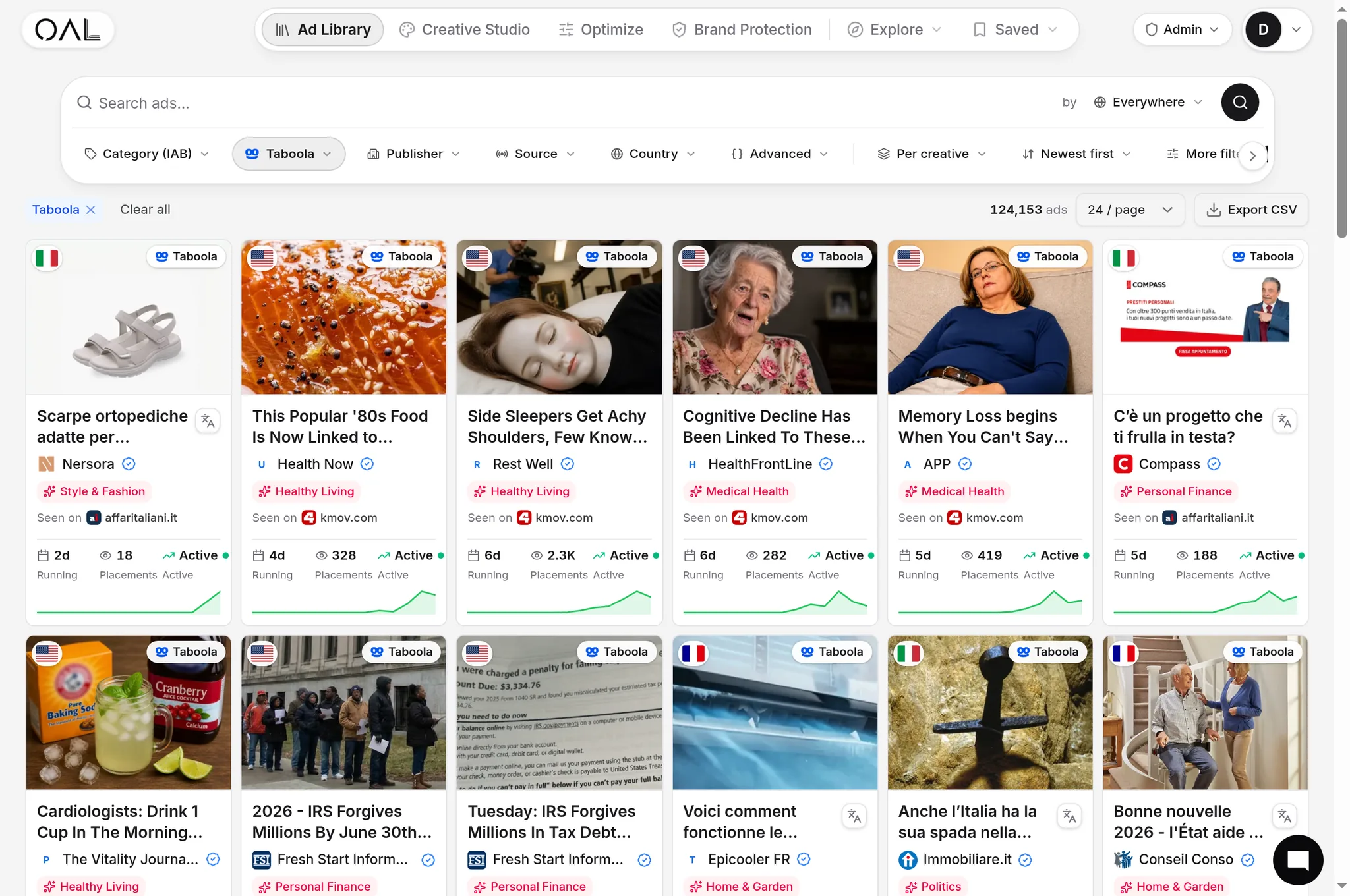
NewsBreak has no public ad library, so the evidence base for what converts with its exact demographic lives on the observable networks next door. OpenAdLibrary's native ad spy tool indexes 725,000+ live creatives across 49 native networks — filter to your vertical, sort by days running, and study the angles and landing funnels that older-US-audience advertisers sustain for weeks before you write your first NewsBreak headline. The free tier is enough to start, and full access is $29.99/month. The fundamentals of turning cold feed traffic into buyers — pre-sell pages, funnel math, kill criteria — are in our media buying guide for native ads.