Español
 Português (Brasil)
 Français
 Deutsch
 Italiano
 Nederlands
 Polski
 Svenska
 Türkçe
 Русский
 日本語
日本語 한국어
한국어 简体中文
简体中文 Tiếng Việt
 Bahasa Indonesia
 繁體中文
繁體中文 Čeština
 Dansk
Dansk Suomi
Suomi Română
 Magyar
 Українська
 ไทย
ไทย हिन्दी
 العربية
 עברית
עבריתHealth Advertising Benchmarks 2026: Native CPCs, CTR Patterns & Networks
Health is native advertising's #1 vertical. This study benchmarks 24,472 live health creatives by network, cost band, headline formula and longevity — and finds compliant angles outlasting aggressive ones.


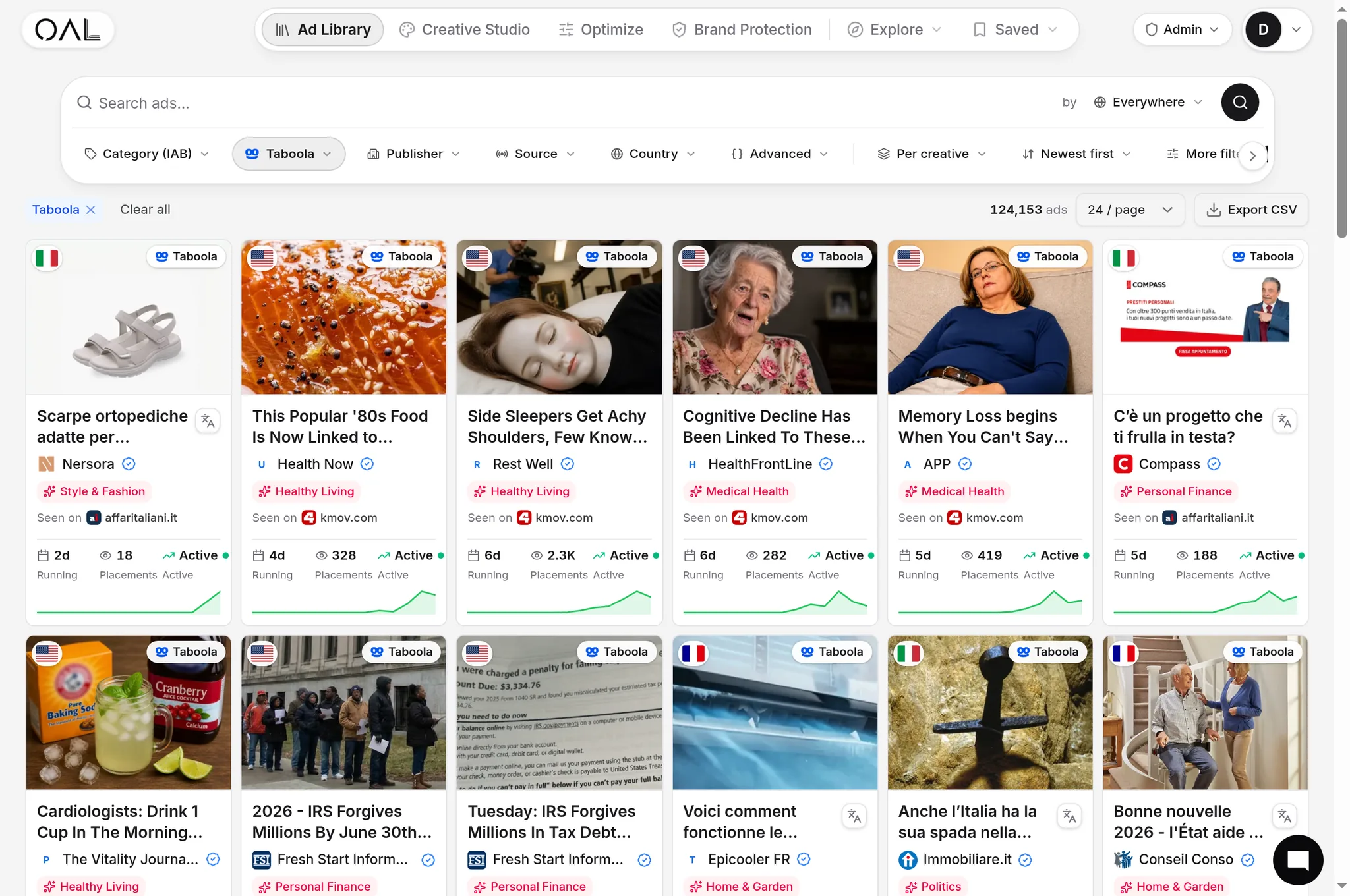
Health is the largest vertical in native advertising: 24,472 live health creatives in OpenAdLibrary's index of 725,000+ native ads across 49 networks (July 2026) — ahead of finance (24,068) and insurance (22,427). Nearly half of all classified health creatives run on Taboola (11,982), while Revcontent is the most health-dependent network in the index, with health making up roughly 16% of everything it serves. On cost, health clicks commonly land mid-band within the published $0.20–$0.90 native CPC range on premium networks, and from a few cents on mid-tier feeds in cheaper geos. This study covers the volumes, the network mix, cost and CTR patterns, and the longevity data — which delivers a verdict most health buyers don't expect: the compliant brand angles outlast the aggressive ones.
Where these numbers come from#
Every platform figure in this study comes from live captured ads. OpenAdLibrary observes native placements continuously across publisher feeds, storing each creative with its advertiser, network, traced landing page and first-seen/last-seen dates — the pair that yields "days running," the longevity metric used throughout this study. The corpus behind the numbers: 725,882 creatives, 29,257 advertisers, 49 networks, 6.9 million observations and 1.3 million landing captures as of July 2026. Creatives are deduplicated perceptually, so a headline-image pair observed across dozens of publishers counts once, and each is classified by industry vertical; health counts below are that classified subset.
Standard caveats: counts are live creatives (a supply-side activity proxy), not spend estimates; classification of a moving corpus is never total, so read counts as floors; and all CPC discussion is practitioner-reported ranges — no network publishes vertical rate cards. Note also that our classifier separates health from nutra (supplements sold on aggressive direct-response funnels), so the true "health-and-wellness" footprint is larger than the health line alone — the supplement economy has its own dedicated breakdown in our nutra on native ads guide.
Health tops the vertical league table#
Top five classified verticals in the index, July 2026:
| Rank | Vertical | Live creatives |
|---|---|---|
| 1 | Health | 24,472 |
| 2 | Finance | 24,068 |
| 3 | Insurance | 22,427 |
| 4 | Ecommerce | 19,368 |
| 5 | Entertainment | 18,179 |
Health's lead over finance is slim — 404 creatives — but its composition is unlike any other vertical. Finance concentrates among comparison sites, asset managers and lead-gen shops; health spans hearing-care retail chains, posture devices, skin-care DTC, pain-relief offers, and a long tail of affiliate advertisers running advertorial funnels. That breadth is why health has topped native vertical rankings for years: when one sub-niche gets saturated or policy-squeezed, three others absorb the demand. The cross-vertical context is in the top native ad verticals breakdown, and the affiliate-side view in best affiliate verticals for native ads.
The sub-niche map#
Reading the live health creatives, six recurring sub-niches structure the vertical:
- Hearing care. The longevity champions — retail chains and device brands (Audika, Boots Hearingcare in our capture set) running symptom-question hooks for weeks at a time to a senior, desktop-heavy audience.
- Pain and mobility. Sciatica, knee, joint and back offers, usually mechanism-story advertorials. A live example of scale behavior: SmoothSpine's sciatica angle was captured running simultaneously on Outbrain ("Why Your Sciatic Nerve Won't Heal — What Most Doctors Miss," 10 days) and MediaGo ("Sciatica Is Not from a Slipped Disc," 21 days). Same advertiser, same mechanism, two networks — the signature of an angle being scaled horizontally after validation.
- Posture and wearables. Device offers like the posture-support bra ("A bra that not only lifts but also improves your posture," Femillie, Taboola) — DTC ecommerce wearing health framing.
- Oral and dental adjacent. Red-light gum therapy, dental alternatives ("Dentists Said Gums Can't Grow Back. Red Light Proves Them Wrong," RejuvaCare, MGID, 16 days) — a reliably aggressive corner of the vertical.
- The nutra border. Supplements on direct-response funnels, classified separately in our index — Revcontent alone carries 440 classified nutra creatives on top of its health line.
- Beauty-wellness crossover. Skin, hair-regrowth and anti-aging angles that our classifier files under beauty but that share health's funnel anatomy and compliance exposure.
The sub-niche you're in sets your realistic CPC, your network options and your compliance ceiling — which is why the useful competitive question is never "how is health performing" but "who are the ten advertisers in my sub-niche and what are they running." The workflow for answering that is in how to spy on competitor native ads.
Network mix: where health creatives run#
| Network | Live health creatives | Share of network's index | Health rank on network |
|---|---|---|---|
| Taboola | 11,982 | 5.8% | #1 vertical |
| Outbrain (Teads) | 3,102 | 2.9% | #3 (behind insurance, finance) |
| Revcontent | 2,566 | 16.3% | #1 vertical |
| MGID | 1,220 | 1.9% | #2 (behind entertainment) |
| Yahoo | 201 | 3.4% | #4 |
| MediaGo | 155 | 2.4% | #6 |
Four findings worth acting on:
- Taboola is the health network in absolute terms. Its 11,982 live health creatives are 49% of all classified health creatives in the index — health is Taboola's #1 vertical and Taboola is health's #1 network, a mutual dependence with consequences: deepest competition, highest CPCs, most sophisticated funnels, and the strictest large-network review posture. Calibrate against what's live via the Taboola spy tool.
- Revcontent is health-dependent in relative terms. At 16.3% of its entire index — plus a further 440 creatives classified as nutra, its #5 vertical — Revcontent is proportionally the most health-saturated feed we track. Direct-response health buyers use it as a lower-cost volume source; you can inspect its live inventory in the Revcontent spy tool.
- Outbrain ranks health only #3 behind insurance and finance — its premium-publisher DNA tilts the feed toward money verticals, and its health inventory skews more branded than Revcontent's.
- MSN's absence from this table is the surprise. The Microsoft Audience Network is the largest single network in the index, yet health does not crack its top six verticals (ecommerce, finance, travel, insurance, software, education do). Health demand concentrates where direct-response advertorial culture is strongest — the Taboola/Revcontent axis — not simply where the most inventory exists.
The Yahoo and MediaGo tails carry a lesson of their own: health charts on both (201 and 155 creatives respectively) but well behind their lead verticals, so treat them as expansion inventory for angles already proven elsewhere rather than discovery networks. The cheapest place to learn what works in health is where the most health advertisers are already paying tuition.
What health clicks cost in 2026#
The defensible statement is a range with drivers, flagged as practitioner-reported rather than official:
- Premium networks: health commonly prices mid-band within the published $0.20–$0.90 native CPC range. Competitive Tier-1 sub-niches — hearing aids, joint pain, senior mobility — push toward the top of the band, because the advertisers behind them monetize like lead-gen.
- Mid-tier networks: buyers commonly report health clicks from a few cents in Tier-2/Tier-3 geos to roughly the lower third of the band in Tier-1 — the reason high-volume supplement funnels live on MGID and Revcontent.
- Device split matters unusually much. Senior-targeted health offers (hearing, mobility, pain) perform desktop-heavy; beauty-adjacent health skews mobile. Bidding one rate across both wastes money in either direction.
- Auction density is visible before you spend. Count distinct advertisers running your sub-niche in your geo in the live index; a dozen long-running competitors means bid inflation, zero means either open space or a dead audience.
Network-by-network cost detail is in the native CPC benchmarks, and realistic test-budget arithmetic in the native advertising cost guide.
Why does the biggest vertical not command the biggest CPCs? Because health's depth comes from its long tail. Finance auctions are driven by a compact set of well-funded lead buyers bidding on the same senior, Tier-1, desktop audience; health auctions include those advertisers (hearing, mobility) but also thousands of DTC and affiliate offers whose unit economics cap bids far lower. The result is a wide intra-vertical spread: hearing-aid clicks can price like finance while a generic wellness advertorial click prices like entertainment. Averages across that spread mislead — position your expectations by sub-niche, not by the vertical line.
CTR patterns: the authority-figure formula#
Health headlines in the live index cluster around one dominant structure: authority figure + contradiction of standard advice + urgency. Real captured examples:
- "Cardiologist: 2 Veggies Will Kill Your Belly Fat Overnight! (Try It)" — Outbrain
- "Endocrinologist: If You Have Diabetes, Read This Before It's Removed!" — Revcontent
- "Surgeons: This Simple Trick Will End Knee Pain & Arthritis Quickly (Try It)" — Revcontent
- "Dentists Said Gums Can't Grow Back. Red Light Proves Them Wrong" — MGID
The formula works on a curiosity gap: a credentialed source apparently overturning what the reader believes creates an information debt only the click repays. It is also, not coincidentally, the highest-compliance-risk structure in native — implied medical claims, implied endorsement, manufactured urgency — which is why these creatives churn on the more permissive networks.
The contrasting pattern is the compliant discovery hook: "Struggling to Hear Clearly? Discover a Device Transforming Lives" (Audika, Taboola). Symptom-level question, no outcome promise, no fake authority — and 37 consecutive days live at capture.

Image patterns track the same split. The aggressive cohort leans on close-up body parts, food macros and lo-fi "one weird trick" visuals engineered to look non-commercial; the compliant cohort uses product-in-context photography and recognizable brand styling. Networks increasingly police imagery as strictly as claims — graphic or distress-inducing visuals are a rejection trigger on premium feeds even when the headline is clean.
As with every vertical, treat CTR as a within-campaign ranking metric only — native CTR is placement-relative, and the aggressive formula's higher click rate frequently buys lower-intent traffic that dies at the offer page.
Longevity: compliant angles outlast aggressive claims#
Longevity is the study's most decision-relevant metric because it approximates the one number no ad platform will ever show you: whether a campaign is profitable. Advertisers switch off losers within days; a creative funding itself for a month has passed the only test that matters. Sorting the health vertical by days running produces the clearest signal in the dataset:
- The 30+ day cohort is dominated by compliant, brand-anchored advertisers. Audika's hearing hook at 37 days; a Boots Hearingcare creative ("Discover comfortable and discreet hearing solutions") at 38 days — the longest health-adjacent runs in the index sit with advertisers who would survive any policy review.
- The authority-claim creatives skew young. The claim-heavy examples above were captured at 0–3 days old on Revcontent and 16–22 days at best elsewhere — consistent with the churn-and-replace economics of aggressive health advertising, where creative death by rejection, fatigue or takedown is priced in.
The pattern has a practical translation: aggressive claims can win a week; durable health businesses are built on angles that can legally run forever. Longevity is the metric that separates the two, and our ad longevity analysis covers how to read it. When you research competitors, sort by days running first — a 37-day hearing-aid angle teaches you more about what actually converts than fifty three-day wonder headlines.
One caveat on reading longevity honestly: days running measures a creative's observed lifetime so far, within the capture window — a two-day-old creative might be a fresh test or a future 40-day runner. Longevity separates proven from unproven; it can't grade the unproven. Judge new competitor creatives by their advertiser's track record, not their age.
How to use these benchmarks#
- Choose your axis. Brand-safe or claim-adjacent? The first points to Taboola and Outbrain economics; the second lives on Revcontent and MGID with churn budgeted in.
- Validate sub-niche density before spending. Pull the live creatives in your exact niche and geo; count advertisers and note the longest runner.
- Budget for the band, split by device. Mid-band premium CPCs for Tier-1 health, desktop-weighted for senior offers.
- Copy longevity, not CTR. Model your angle on what has run 30+ days, and use the aggressive formula ads only as a map of what the permissive networks currently tolerate.
A worked example. Say you're bringing a posture-support device to native. The sub-niche map says posture wearables live on Taboola as DTC-with-health-framing; a live search for posture and back-support creatives shows the active advertisers, their hooks (lift-plus-posture benefit stacking, in the Femillie example) and whether any creative has crossed the 30-day line. If the long-runners are all symptom-question hooks and the claim-heavy variants are churning at under a week, the market has already run your compliance experiment for you — enter with the durable structure, budget mid-band Tier-1 CPCs, and split desktop/mobile bids from day one. The research takes an evening and de-risks the first month of spend.
Health is native's biggest vertical because its funnels convert cold feed traffic better than almost anything else. The benchmark data says the durable version of that business looks more like Audika than like "Cardiologist: 2 Veggies" — and the index lets you verify that claim ad by ad rather than taking anyone's word for it.