Español
 Português (Brasil)
 Français
 Deutsch
 Italiano
 Nederlands
 Polski
 Svenska
 Türkçe
 Русский
 日本語
日本語 한국어
한국어 简体中文
简体中文 Tiếng Việt
 Bahasa Indonesia
 繁體中文
繁體中文 Čeština
 Dansk
Dansk Suomi
Suomi Ελληνικά
 Română
 Magyar
 Українська
 ไทย
ไทย हिन्दी
 العربية
 עברית
עבריתAd Fatigue in Native Ads: How Long Creatives Last and When to Refresh
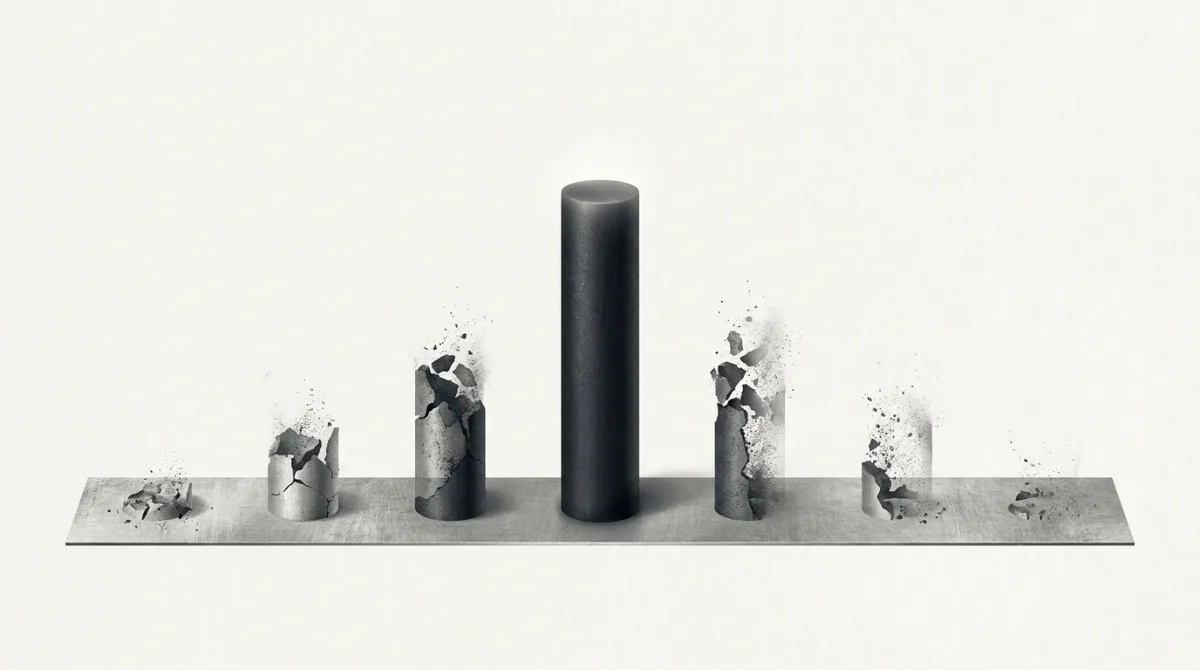
Most native creatives die within days; a thin band survives five weeks. How to tell fatigue from a losing creative, and the refresh cadence that keeps winners alive.

Ad fatigue in native advertising is the measurable decay in a creative's click-through rate that sets in once the audience on your placements has seen it too many times to respond. On native networks it arrives faster than most buyers expect, and it is visible in the data: across OpenAdLibrary's index of 725,000+ live native creatives on 49 networks (June 2026), the overwhelming majority of creatives stop appearing within days of first capture, while only a small minority persist for weeks. The fix is not a fixed rotation calendar. It is a refresh cadence driven by each creative's own decay curve, backed by a bench of image and angle variants built before the drop starts.
Why native creatives fatigue faster than social ads#
Three structural facts about native placements compress creative lifespans.
The audience pool is smaller than it looks. A content-recommendation widget shows a handful of paid slots beneath an article, and publisher audiences are loyal — the same readers return to the same sites daily. Your creative is not rotating through an effectively infinite social feed; it is greeting the same commuters at the same bus stop every morning. Frequency management on native networks is also coarser than on Meta or TikTok, so repeat exposure stacks up quickly on the placements that spend the most.
CTR decides your delivery. On auction-driven networks like Taboola and Outbrain, the effective rank of your ad is a function of bid multiplied by expected CTR. As fatigue erodes clicks, the network quietly serves you fewer impressions at the same bid. Fatigue on native therefore shows up first as shrinking volume and creeping effective cost per click — not as a dramatic CTR cliff on a dashboard. Buyers who watch only spend and conversions usually diagnose it weeks late. (For the auction mechanics, see how Taboola ads work.)
Winners get cloned. The moment a creative works, competitors adapt the same image style and hook. The audience is not just fatiguing on your ad; it is fatiguing on the pattern. This is why a proven angle can die across an entire vertical at once — and why tracking what competitors launch matters as much as tracking your own metrics.
How long native creatives actually live#
Because OpenAdLibrary continuously observes live placements and records first-seen and last-seen dates for every creative, lifespan is measurable rather than folklore. Three patterns stand out in the index.
Most creatives are tests, and most tests die. The bulk of the corpus disappears within days of first capture. That is not waste — it is the machinery of native buying working as designed. Disciplined buyers launch broad, kill fast, and feed budget to the survivors.
The long tail is where the money is. The most persistent creatives in the index currently cap out at 38 days of continuous observation — the edge of the current observation window, meaning they were still live when the window closed. As of June 2026 that list includes a finance creative ("Retirees Are Dropping These 12 Costs" on Microsoft Audience Network) and an Outbrain story advertorial about a retiree trapping cyclists cutting through his yard, both observed for 38 straight days. No advertiser pays for a losing ad for five consecutive weeks; longevity is the strongest public profitability signal native advertising offers. The survivors are worth studying as a class — see the longest-running native ads.
Evergreen problem–solution angles age slowest. Health (24,472 classified creatives), finance (24,068) and insurance (22,427) are the three largest verticals in the index, and their evergreen angles — hearing loss, joint pain, retirement costs, premium rebates — are heavily represented among the longest-observed creatives. A hearing-device creative from Audika, for example, was observed for 37 days on Taboola; a butterfly-garden gadget ad ran 37 days on the same network. News-adjacent and entertainment hooks sit at the other extreme: their relevance expires by design, so they churn in days no matter how well they are made. Where your vertical sits on that spectrum should set your baseline expectation for creative lifespan.
Fatigue or a loser? Read the curve, not the calendar#
The most expensive mistake in refresh management is misdiagnosis: killing a fatigued winner that needed an image swap, or lovingly refreshing a creative that never worked in the first place.
| What you observe | What it usually means | What to do |
|---|---|---|
| CTR never materialized in the first few thousand impressions | The hook never worked | Kill it and launch a different hook, not a variant |
| Strong opening CTR, steady decay over one to three weeks | Classic creative fatigue | Refresh the image first, then the headline |
| CTR healthy, conversion rate slipping | Landing page or offer fatigue, or a competitor undercutting you | Audit the funnel, not the creative |
| A whole ad group decays together after weeks of stability | Placement audience exhausted | Expand publishers or geos; re-skinning won't help |
Only the second row is true creative fatigue. The others are creative failure, funnel drift and audience exhaustion — different problems with different fixes, and none of them solved by uploading a new image on a schedule.
A refresh cadence that holds up in practice#
- Trigger on decay, not dates. Baseline each creative's CTR over its first stable week, then act when performance falls materially below that baseline. Many buyers use a sustained 20–30% drop from the creative's own baseline as the trigger — a heuristic, not an official benchmark, and your vertical will move it. The exact threshold matters less than measuring each creative against its own history instead of an account average.
- Refresh in order of cost. An image swap preserves the headline's proven promise and is the cheapest reset — in native, the image is half the hook. If the swap doesn't restore delivery, rotate headline variants against the same image. Only after both fail should you conclude the hook itself is spent.
- Keep a bench. Hold three to five unlaunched variants per winning angle before fatigue hits. A refresh that takes a week to brief and produce costs you a week of decayed delivery on your best placements.
- Rotate angles, not just skins. Variants that differ only cosmetically fatigue together, because the audience is burning out on the underlying pattern, not the pixels. Maintain two or three genuinely distinct angles per offer and cycle among them. The taxonomy in the most common native ad angles is a practical rotation grid, and hook vs angle vs claim clarifies which layer you are actually rotating.
- Rest, then revive. Retired winners often perform again after weeks off, especially on new placements or geos where the exposure history is clean. Archive proven creatives with their stats instead of deleting them; a revived winner is cheaper than a new test.
Calibrate against competitors' refresh cycles#
Your own account tells you when a creative decays; it cannot tell you whether that lifespan is normal for your vertical. Competitor longevity data can. Add rivals to a watchlist — here is the workflow — and their first-seen/last-seen dates become a refresh benchmark: if their creatives routinely persist 30+ days while yours die in five, your problem is creative quality, not market saturation. A long-running competitor creative that suddenly vanishes is a fatigue or compliance signal; a burst of new variants from one advertiser is a test wave you can learn from before spending a dollar of your own. A native ad spy tool built on longevity data — or the network-specific view in the Taboola spy tool — turns competitor rotation into a free early-warning system for your own refresh cadence.
The bottom line#
Native creatives die fast by default. The index shows a corpus dominated by short-lived tests, with a thin band of five-week survivors carrying the profitable angles — and the distance between those two groups is mostly refresh discipline. Treat fatigue as a measurable curve, not a feeling: trigger refreshes off each creative's own baseline, refresh image-first, keep a variant bench, rotate real angles rather than re-skins, and calibrate your expectations against the competitors whose ads outlive yours.