English
 Español
 Français
 Deutsch
 Italiano
 Nederlands
 Polski
 Svenska
 Türkçe
 Русский
 日本語
日本語 한국어
한국어 简体中文
简体中文 Tiếng Việt
 Bahasa Indonesia
 繁體中文
繁體中文 Čeština
 Dansk
Dansk Norsk (bokmål)
 Suomi
Suomi Ελληνικά
 Română
 Magyar
 Українська
 ไทย
ไทย हिन्दी
 العربية
 עברית
עבריתQuem Anuncia no Outbrain? A Mistura de Anunciantes ao Vivo, Camada por Camada
Marcas, anunciantes de performance e players de arbitragem: as três camadas da base de anunciantes do Outbrain, mapeadas com dados de índice ao vivo e criativos reais em execução.


A base de anunciantes do Outbrain é uma mistura de três camadas: anunciantes de conteúdo de marca e corporativo comprando alcance em publishers premium, marketers de performance e afiliados executando funis publicitários em saúde, finanças e seguros, e players de arbitragem de mídia comprando cliques para conteúdo monetizado por anúncios. Em julho de 2026, o índice do OpenAdLibrary contém mais de 108.000 criativos do Outbrain ao vivo — seguros, finanças e saúde lideram as verticais classificadas — e cada anunciante por trás deles é identificável e pesquisável. Este artigo mapeia quem está realmente na rede, camada por camada, com exemplos ao vivo.
A mistura de anunciantes, em números#
O Outbrain — que se fundiu com o Teads em 2025 e agora opera sob o nome Teads (a fusão, explicada) — não publica um diretório de anunciantes nem uma biblioteca de anúncios. O que segue vem de observação independente: captura contínua de posicionamentos do Outbrain ao vivo em um índice de mais de 725.000 criativos nativos em 49 redes. A fatia do Outbrain, classificada por vertical:
| Vertical | Criativos ao vivo (julho de 2026) |
|---|---|
| Insurance | 4,345 |
| Finance | 3,990 |
| Health | 3,102 |
| Ecommerce | 2,277 |
| Software | 1,932 |
| Home & garden | 1,545 |
Duas observações para ler a tabela com honestidade. As contagens cobrem criativos que nosso classificador atribuiu a uma vertical — uma parte do corpus sempre fica não classificada ou em meio a classificação, então trate estes como um piso e um ranking, não um censo total. E a contagem de criativos não é gasto: uma campanha de marca pode executar três criativos com orçamentos que superam em muito a grade de teste de trinta variantes de um afiliado.
Ranking à parte, seguros e finanças no topo é o padrão característico do Outbrain — categorias reguladas e de alto LTV cujos anunciantes valorizam o contexto editorial premium no qual a rede construiu seus relacionamentos com publishers (como o Outbrain funciona cobre esse inventário em detalhes). A saúde fica logo atrás, sustentada principalmente pela camada de performance descrita abaixo.
Camada 1: marcas e conteúdo corporativo#
A fatia mais distintiva da demanda do Outbrain mal se parece com publicidade de resposta direta. Programas de conteúdo corporativo usam a rede para distribuir material de nível editorial em posicionamentos de notícias premium. Um exemplo ao vivo do índice: SPECTRA by MHI — o hub de conteúdo de marca da Mitsubishi Heavy Industries — executando peças de conteúdo como "Methane: Tackling a rising climate priority" (34 dias) e "From trash to treasure: Waste to energy explained" (9 dias). Sem oferta, sem urgência; o KPI é atenção qualificada, e a execução de um mês sinaliza que o programa está obtendo isso.
Para compradores, essa camada importa como contexto: no Outbrain você compartilha feeds com conteúdo de marca, e criativos que combinam com o registro editorial mais calmo tendem a viajar mais longe do que enquadramentos de resposta direta gritantes transplantados de outros canais.
Camada 2: anunciantes de performance e afiliados#
O motor de volume da rede. Funis publicitários em beleza, saúde e finanças dominam a contagem de criativos, e o índice ao vivo mostra o ofício:
- The Skin Mag — "Moisturizer Won't Tighten Skin! Use This Household Item Instead" — uma isca publicitária de beleza com 30 dias de execução.
- Health Weekly — "Cardiologist: 2 Veggies Will Kill Your Belly Fat Overnight!" — o ângulo de saúde com figura de autoridade, 22 dias.
- SmoothSpine — "Why Your Sciatic Nerve Won't Heal (What Most Doctors Miss)" — agitação de problema em um funil de dispositivo.
- Tech-tips lead gen — "One Setting, Turn Off Ads (Android Users)" — iscas de utilidade alimentando ofertas de software e segurança, 26 dias.
Esses anunciantes são os que valem a pena estudar se você compra tráfego de performance: seus sobreviventes são combinações comprovadas de isca, pré-página de destino e oferta. O método de pesquisa — filtrar por vertical e duração de execução, então rastrear páginas de destino — está descrito no guia de espionagem de anúncios do Outbrain, e a mesma lógica de longevidade se aplica aqui como em todo lugar: um anúncio ainda em execução após 30 dias quase certamente é lucrativo.
Camada 3: arbitragem de conteúdo#
A terceira camada compra cliques para conteúdo monetizado por mais anúncios — arbitragem de tráfego. O índice mostra isso claramente: o criativo em formato de história da Novelodge "[Story] Man Helps Hitchhiking Girl To Get Home…" está em execução há 35 dias, comprando cliques de curiosidade para páginas de conteúdo serializado cuja economia depende do leitor ver mais anúncios do que o custo do clique para adquirir.
A demanda de arbitragem é uma característica permanente das redes nativas, e seu sobrevivente de 35 dias acima é um lembrete de que o modelo funciona quando executado com disciplina. Para compradores, a principal relevância da camada é o contexto de leilão: arbitradores são licitantes implacáveis e sensíveis ao preço cujas margens os forçam a sair de qualquer posicionamento no momento em que ele para de pagar, o que torna sua presença sustentada em um posicionamento um sinal de qualidade fraco, mas real. Para publishers, essa camada molda como é o "preenchimento" em posicionamentos de baixo nível.
O que a mistura significa se você está comprando#
- Espere competição real em seguros, finanças e saúde. A tabela de verticais acima é seu censo competitivo. Entrar nessas categorias significa superar em lances — ou em criatividade — anunciantes que já sobreviveram ao leilão por semanas.
- O registro importa. As três camadas compartilham espaço no feed. Criativos calibrados para o contexto editorial (curiosidade, autoridade, especificidade) recorrem entre os de longa duração em todas as três camadas; vendas duras importadas raramente o fazem.
- A mistura de anunciantes difere da do Taboola. As duas redes se sobrepõem, mas inclinam-se de forma diferente — a comparação é mapeada em Taboola vs Outbrain, e o censo do lado do Taboola em quem anuncia no Taboola. Anunciantes entre redes — marcas executando o mesmo ângulo em ambas — são geralmente o sinal mais forte de uma oferta que funciona, um padrão visível entre os principais anunciantes nativos por rede.
- Se você vende inventário, a mistura é sua previsão de receita. Publishers avaliando a rede podem ler a mesma tabela: demanda pesada por seguros e finanças significa que o feed em um site de negócios ou notícias será monetizado com anúncios relevantes e toleráveis, enquanto uma inclinação mais leve para entretenimento do que nas redes de médio nível significa menos dos criativos estilo isca que corroem a confiança do leitor.
Lendo a estratégia de um único anunciante de fora#
Uma vez que você pode extrair todo o portfólio ao vivo de qualquer anunciante, os metadados contam uma história que os criativos sozinhos não contam:
- A contagem de criativos sinaliza fase. Dois ou três criativos que estão em execução há semanas é um programa maduro em modo de manutenção; trinta variantes com poucos dias é um anunciante em meio a testes, queimando orçamento para encontrar um ângulo. Ambos são informativos — o primeiro diz o que venceu, o segundo o que alguém acredita que vale testar.
- A distribuição de longevidade separa vencedores de desejos. Um portfólio onde um punhado de criativos carrega execuções de 30+ dias enquanto o resto gira semanalmente mostra exatamente quais ângulos pagam. Ordene por duração de execução e leia o topo; ignore a rotatividade.
- A dispersão de ângulos revela convicção. Dez execuções de uma mesma afirmação significa que o anunciante encontrou algo e está escalando. Cinco ângulos não relacionados significa que eles não encontraram — ou estão defendendo várias ofertas ao mesmo tempo.
- A diversidade de páginas de destino mapeia o teste de funil. Múltiplos criativos resolvendo para diferentes pré-páginas de destino é um experimento de funil em andamento; tudo canalizando para uma página é um pipeline estabelecido.
Dez minutos disso por concorrente, mensalmente, é mais informação estratégica do que a maioria das assinaturas de inteligência paga entregava alguns anos atrás — e os dados de observação subjacentes são comportamento público.
Como pesquisar qualquer anunciante do Outbrain#
Como nenhum diretório oficial existe, a pesquisa ocorre através de observação independente:
- Pesquise a marca ou domínio na ferramenta de espionagem do Outbrain do OpenAdLibrary — cada criativo capturado é resolvido para um anunciante, com datas de execução, dados de geo e dispositivo anexados.
- Leia o portfólio ao vivo deles. Todos os criativos atuais para aquele anunciante, ordenados por longevidade, mostram quais ângulos eles confiam com orçamento.
- Rastreie os funis. Cada criativo tem um link para sua página de destino ou pré-página de destino capturada, então o caminho completo do clique é inspecionável sem gerar um clique faturado.
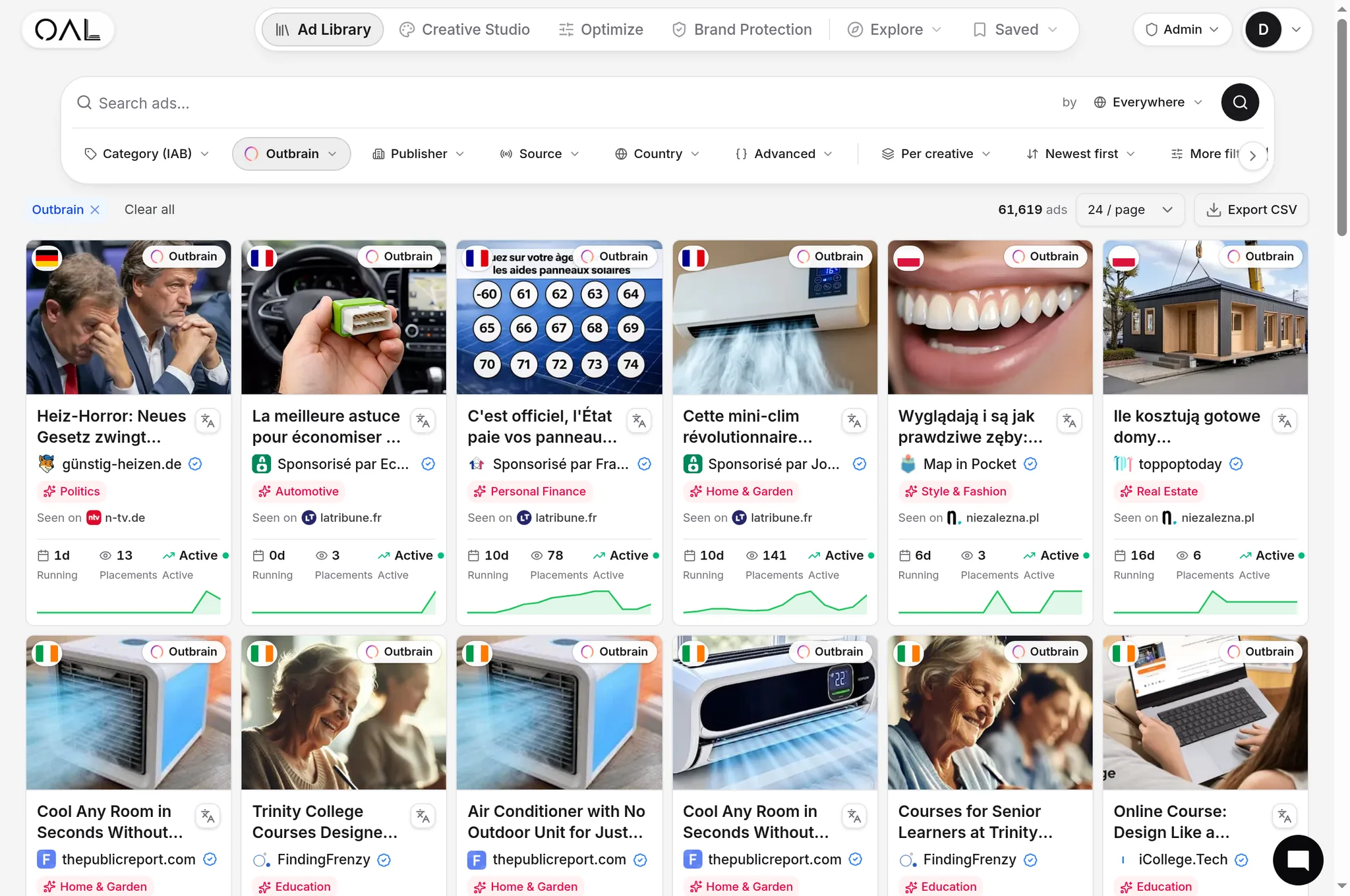
- Navegue no corpus lateralmente. A biblioteca de anúncios do Outbrain suporta filtros de vertical, geo e palavra-chave quando você quer a visão de censo em vez de um único anunciante.
A coluna de anunciantes de uma rede nativa é informação pública tornada pesquisável — a rede mostra esses anúncios para milhões de leitores diariamente. A única coisa que faltava até recentemente era o índice.