English
 Español
 Português (Brasil)
 Deutsch
 Italiano
 Nederlands
 Polski
 Svenska
 Türkçe
 Русский
 日本語
日本語 한국어
한국어 简体中文
简体中文 Tiếng Việt
 Bahasa Indonesia
 繁體中文
繁體中文 Čeština
 Dansk
Dansk Norsk (bokmål)
 Suomi
Suomi Ελληνικά
 Română
 Magyar
 Українська
 ไทย
ไทย हिन्दी
 العربية
 עברית
עבריתLe trafic Taboola est-il de bonne qualité ? Réalité des conversions, des bots et de la qualité
Taboola envoie de vrais clics humains depuis des sites d'éditeurs grand public — un trafic froid, avec une énorme variance entre les emplacements. Ce que la qualité signifie réellement sur le réseau, et comment les acheteurs qui restent rentables la gèrent.


Le trafic Taboola est un trafic humain réel provenant des widgets de recommandation de contenu sur les sites d'éditeurs grand public — ce n'est pas une ferme à bots, et ce n'est pas non plus une intention de recherche. Ses deux traits caractéristiques : les lecteurs arrivent dans un état d'esprit froid, de découverte, et la qualité varie énormément d'un éditeur à l'autre. Les acheteurs qui le traitent comme un trafic de recherche ou Meta concluent généralement que « ça ne convertit pas » ; les acheteurs qui gèrent la qualité au niveau de l'emplacement et construisent des entonnoirs pour des audiences froides le font tourner de manière rentable pendant des années. Cet article couvre d'où viennent les clics, les trois problèmes de qualité que vous rencontrerez réellement, la réponse honnête sur les bots, et ce que révèle le mix d'annonceurs du réseau.
D'où viennent réellement les clics Taboola#
Taboola place des widgets de recommandation de contenu — les grilles « vous aimerez peut-être » — en dessous et à côté des articles sur des milliers de sites d'éditeurs, des grandes marques d'information aux sites de contenu de longue traîne. Un lecteur termine un article, parcourt le widget et clique sur quelque chose qui attire son œil. C'est tout le contexte d'acquisition, et il explique la plupart de ce que les gens appellent un problème de qualité :
- Le visiteur n'a pas fait de recherche pour vous — il n'y a pas d'intention de requête à exploiter.
- Le visiteur n'a pas été ciblé sur son identité comme le ferait une plateforme sociale avec le matching de profils — le ciblage est d'abord contextuel et géographique.
- Le visiteur lisait autre chose trente secondes plus tôt. Votre entonnoir doit construire l'intention à partir de zéro.
Comment fonctionnent les annonces Taboola couvre la mécanique en profondeur ; ce sont les implications sur la qualité qui comptent ici. Un trafic froid n'est pas un mauvais trafic — c'est un trafic à un stade plus précoce, et son prix s'ajuste en conséquence.
Les trois problèmes de qualité que les acheteurs rencontrent réellement#
Intention froide#
Attendez-vous à des taux de rebond plus élevés et des sessions plus courtes que la recherche. C'est structurel, pas un défaut. La solution est architecturale : un pré-lander de style éditorial qui prolonge l'expérience de lecture et pose le problème avant de présenter le produit. Les annonceurs qui envoient les clics Taboola directement sur une page produit ou un formulaire de lead sont les voix les plus fortes dans les discussions « Taboola ne convertit pas ». Il est aussi payant de définir des conversions intermédiaires — une capture d'email, la fin d'un quiz, une lecture engagée — pour que les clics froids qui n'achèteront pas aujourd'hui laissent tout de même un actif derrière eux au lieu d'un simple rebond.
Variance des éditeurs#
Le réseau couvre des milliers de sites, et ils ne sont pas du tout égaux. Certains emplacements envoient des lecteurs engagés qui convertissent ; d'autres envoient du volume qui clique et disparaît. Toute campagne accumule les deux. Les acheteurs rentables gèrent cela au niveau du site : rapports par emplacement, seuils de dépense et élagage constant vers une liste blanche de sites éprouvés. La gestion des emplacements n'est pas une optimisation accessoire en natif — c'est le cœur du travail.
Clics accidentels sur mobile#
Sur les petits écrans, les widgets sont proches du contenu et de la navigation, ce qui produit des clics accidentels — visibles dans l'analytics sous forme de sessions inférieures à une seconde. Le volume mobile est important et bon marché, donc il peut encore être rentable, mais jugez-le séparément du desktop : un reporting mixé laisse les emplacements mobiles riches en clics accidentels se cacher dans les chiffres de conversion desktop. Un indicateur rapide : comparez les taux de sessions engagées entre les deux appareils pour le même emplacement — un site dont les clics desktop lisent et dont les clics mobiles disparaissent en moins d'une seconde vous vend des glissements de pouce, pas des lecteurs.
Quelle part est constituée de bots ?#
La réponse honnête : une certaine — comme sur tout canal publicitaire web ouvert — mais pour la plupart des annonceurs, le trafic invalide est une taxe gérable, pas l'histoire principale. Taboola exécute un filtrage du trafic invalide et crédite les clics invalides détectés selon ses politiques (consultez sa documentation actuelle pour les détails). Le point plus profond est que vous ne devriez jamais vous fier uniquement au filtrage d'un réseau comme seule défense :
- Mesurez en aval de l'entonnoir, pas les clics. Les bots gonflent les clics ; ils n'achètent pas de produits ni ne remplissent de vrais numéros de téléphone. Jugez les emplacements sur les conversions et les sessions engagées.
- Surveillez l'engagement par emplacement. Un site qui envoie des centaines de clics avec un temps sur page proche de zéro est bloqué — que la cause soit des bots, des clics accidentels ou simplement un mauvais fit d'audience ne change pas la décision.
- Vérifiez avec votre propre analytics. La durée de session, le comportement de défilement et la conversion par emplacement exposent les déchets plus vite que n'importe quel tableau de bord anti-fraude.
Pour le paysage plus large — les types de fraude, les incitations, les signaux de détection — consultez la fraude publicitaire en natif.
Comment auditer vous-même la qualité en une semaine#
Vous n'avez pas besoin d'un fournisseur anti-fraude pour vous faire une opinion défendable de ce que Taboola vous envoie. Une semaine de trafic instrumenté répond à la plupart des questions :
- Transmettez l'ID d'emplacement dans votre analytics sur chaque clic, pour que chaque session porte le site d'origine. Sans cela, tout ce qui suit est de la spéculation.
- Segmentez les sessions en engagées et non engagées — choisissez un seuil simple comme dix secondes ou plus ou un événement de défilement — et calculez le taux d'engagement par emplacement. L'écart entre vos meilleurs et pires sites est généralement le chiffre le plus instructif de la semaine.
- Vérifiez la cohérence géographique. Des sessions provenant de pays non ciblés en volume sont un drapeau à remonter.
- Comparez le délai de conversion. Les vrais utilisateurs convertissent selon des délais humains — de quelques minutes à quelques jours. Les emplacements produisant des « conversions » instantanées et uniformes méritent la suspicion, pas la célébration.
- Établissez une référence par rapport à un canal de confiance. Envoyez un petit lot parallèle de trafic de recherche ou social sur le même lander ; l'écart d'engagement entre les canaux calibre ce à quoi ressemble « froid mais réel » par rapport à « cassé ».
À la fin de la semaine, vous aurez une liste de blocage, une liste restreinte et un coût par clic engagé réaliste — ce qui est plus que ce que la plupart des annonceurs retirent jamais du débat sur la « qualité » du trafic natif.
Ce que le mix d'annonceurs vous dit sur la qualité#
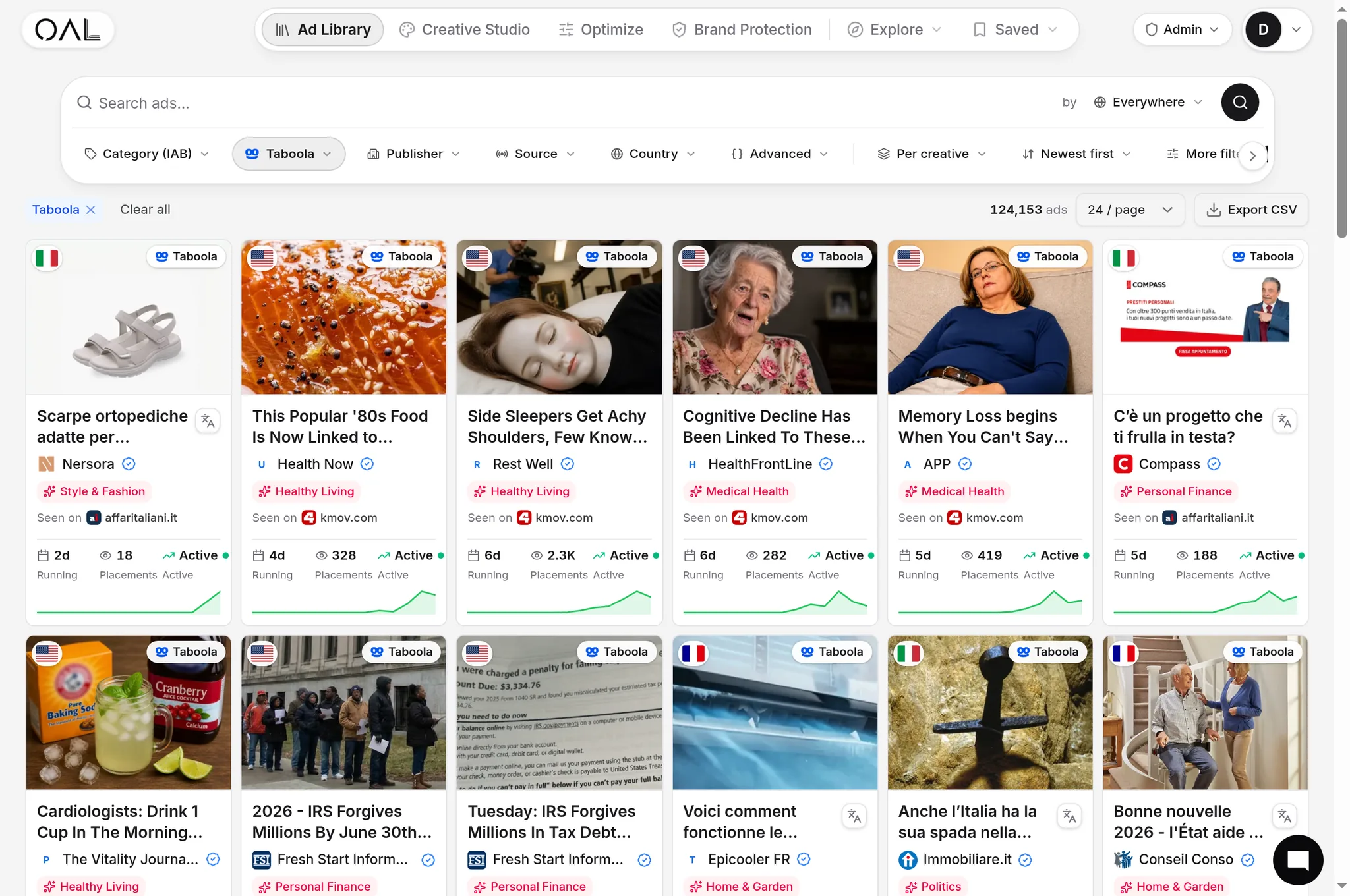
Si le trafic Taboola ne convertissait pas, ses plus gros utilisateurs seraient des annonceurs de marque achetant de la portée bon marché. Ce n'est pas le cas. Sur les plus de 206 000 créatifs Taboola en direct dans l'index d'OpenAdLibrary (juillet 2026), les verticales les plus encombrées sont la santé (environ 12 000 créatifs en direct classés), la finance (environ 8 200) et l'assurance (environ 7 400) — des catégories performance où les acheteurs mesurent le coût par acquisition quotidiennement et arrêtent tout ce qui ne fonctionne pas.
La longévité fait le même point de manière plus forte : l'index montre des créatifs d'annonceurs pilotés par CPA — une marque d'aides auditives, un gadget maison-jardin — observés en fonctionnement pendant 37 jours consécutifs. Personne ne paie pour cinq semaines consécutives de clics Tier-1 qui ne convertissent pas. La longévité des annonces est ce qui se rapproche le plus d'un signal public de rentabilité en publicité native, et sur Taboola, elle pointe massivement vers des annonceurs qui comptent les conversions. Vous pouvez inspecter qui annonce sur Taboola par verticale, ou parcourir vous-même le corpus en direct via l'outil de recherche Taboola — le mix d'acheteurs en réponse directe impitoyables est son propre verdict sur la qualité.
Faire tourner Taboola pour que les problèmes de qualité ne vous dévorent pas#
- Instrumentez avant le lancement. Le suivi des conversions plus un postback côté serveur rend le CPA par emplacement visible dès le premier clic. Sans cela, vous optimisez sur le CTR, ce qui récompense exactement les emplacements que vous devriez couper.
- Séparez les campagnes desktop et mobile. Des prix différents, des comportements différents, des verdicts différents.
- Revoyez les rapports par site à un rythme fixe. Fixez une règle mécanique — dépense dépassant un multiple du CPA cible avec zéro conversion signifie blocage — et appliquez-la sans état d'âme, au moins hebdomadaire pendant le premier mois.
- Optimisez vers les événements en aval de l'entonnoir. Des leads et des ventes, pas des clics. Les emplacements poubelles à CTR élevé sont le piège signature du canal.
- Budgétisez la phase d'élagage. Les premières semaines de toute campagne Taboola sont en partie dépensées à acheter les données d'emplacement qui rendront les semaines suivantes rentables. Ce n'est pas du gaspillage ; c'est les frais de scolarité.
Verdict : un bon trafic pour le bon opérateur#
Le trafic Taboola est réel, abondant et froid. Il récompense les annonceurs qui apportent des entonnoirs conçus pour un trafic de découverte, une marge suffisante pour survivre aux tests, et la discipline de gérer les emplacements chaque semaine — et il punit tous les autres avec des taux de rebond élevés et des CPAs ambigus. Si vous évaluez le réseau dans son ensemble, Taboola en vaut-il la peine présente l'argument basé sur les données, et Taboola vs Outbrain le compare à son pair premium le plus proche. La qualité du canal n'est pas une propriété du réseau — c'est une propriété de la façon dont vous le gérez.