English
 Español
 Português (Brasil)
 Deutsch
 Italiano
 Nederlands
 Polski
 Svenska
 Türkçe
 Русский
 日本語
日本語 한국어
한국어 简体中文
简体中文 Tiếng Việt
 Bahasa Indonesia
 繁體中文
繁體中文 Čeština
 Dansk
Dansk Norsk (bokmål)
 Suomi
Suomi Ελληνικά
 Română
 Magyar
 Українська
 ไทย
ไทย हिन्दी
 العربية
 עברית
עבריתOutbrain vaut-il le coup en 2026 ? Ce que montrent les données publicitaires en temps réel
Plus de 108 000 créations Outbrain en temps réel indiquent que les annonceurs continuent de payer — mais seul un type précis d’annonceur en profite. Les données, l’économie et un verdict exploitable.


Outbrain vaut le coup en 2026 pour les annonceurs disposant de tunnels axés sur le contenu, d’audiences Tier‑1 et d’économies unitaires qui soutiennent des CPC native premium — et constitue un mauvais choix pour les budgets très limités, les tunnels uniquement pages produit et quiconque s’attend à des CPC de type fil d’actualité social. Ce n’est pas une hypothèse ; c’est ce que montrent les données en temps réel. L’index OpenAdLibrary recense plus de 108 000 créations Outbrain en direct (juillet 2026), et les annonceurs qui les utilisent — comparateurs d’assurances, marques financières, tunnels santé, programmes de contenu d’entreprise — continuent de payer mois après mois. Une dépense soutenue à cette échelle constitue la réponse du marché : Outbrain fonctionne, mais pour un type précis d’annonceur. La question est de savoir si vous êtes cet annonceur.
What Outbrain is in 2026#
First, the corporate reality: Outbrain acquired Teads in early 2025 and the combined company now operates under the Teads name, positioning itself around premium editorial inventory and full-funnel "outcomes" — the details are in Did Outbrain become Teads? and the Teads platform explainer. For a media buyer, the practical takeaway is that the classic Outbrain proposition survived the merger: sponsored-content placements in and under articles on a network skewing toward established, brand-safe publishers, bought mainly on CPC. The mechanics — formats, targeting, bidding — are covered in how Outbrain works.
That publisher skew is Outbrain's identity. Its historic differentiation from Taboola was a tighter, more editorial supply pool — which tends to mean somewhat higher CPCs, an audience that reads, and stricter creative review. Everything below follows from that.
What the live ad data actually shows#
Opinions about ad networks are cheap; observed spend is not. Three findings from the Outbrain corpus:
1. The vertical mix is a money mix. The top classified verticals among live Outbrain creatives (July 2026): insurance (4,300), finance (4,000), health (3,100), ecommerce (2,300), software (1,900), home & garden (1,500). Insurance and finance at the top — categories with high customer values and industrialized lead-gen funnels — tells you the network's traffic converts on considered purchases, not impulse buys.
2. Campaigns run long. The index records first-seen and last-seen dates for every creative, and Outbrain's long-runners are striking: a House and Garden story creative and a pet-content advertiser (Cleverst) were both observed at 38 days and counting, a Novelodge fiction-style ad at 35 days, and health funnels like SmoothSpine cycling continuously. Performance buyers do not run losing ads for five weeks — longevity is the tell.
3. Brand money runs alongside performance money. Corporate content programs — for example SPECTRA by MHI's sustainability series, observed running 30+ days — share the feed with affiliate funnels. A network holding both demand types has liquidity at both ends: reach pricing for brands, conversion pricing for performance buyers.
The pattern across all three findings is the same: this is a network where committed advertisers iterate and stay, not one where money touches down, loses and leaves. That does not guarantee your campaign works — it guarantees the channel can work, which is the question "is it worth it" actually asks.
Who Outbrain is worth it for#
- Insurance, finance and health lead-gen. The dominant verticals for a reason: older, Tier-1, desktop-heavy news audiences with real purchasing power, and payouts that absorb the CPCs. If your competitors are already sustaining spend here, that is validation, not deterrence.
- Affiliates and lead-gen buyers running advertorial funnels. Outbrain rewards the ad → advertorial → offer structure; story-driven creatives running for weeks are the network's signature winners. If you have never built one, start with the pre-lander funnel playbook.
- DTC brands with a story. Products that need 60 seconds of explanation — the "why" products — do well; catalog products do not.
- Content and B2B brand programs. Editorial adjacency and brand-safe supply make it a defensible awareness buy, as the corporate content in the index demonstrates.
- Meta-heavy accounts that need a second channel. Native is the standard diversification play when social CPMs spike or accounts wobble — the diversification playbook covers the transition.
Who should skip it#
- Budgets that cannot fund a real test. Plan on spending 5–10× your target CPA before you have a verdict; if that number is out of reach, the platform will happily take a smaller amount and teach you nothing.
- Product-page-only funnels. Sending interruption traffic straight to a checkout page is the most reliable way to conclude, wrongly, that native "doesn't work."
- Low-value impulse products. If a conversion is worth a few dollars, premium editorial CPCs will not pencil.
- Strict last-click, same-day ROAS expectations. Content-led funnels convert on longer paths; if your measurement can only see same-session conversions, the channel will look worse than it is.
- Anyone unwilling to iterate creatives. Native headlines fatigue and get outbid; winners in the index are the survivors of large testing programs, not first drafts.
The math that decides it#
Ignore adjectives — run your own numbers. Media buyers commonly report Tier-1 desktop Outbrain CPCs in the rough range of $0.20–$0.90 (unofficial, niche- and geo-dependent). The funnel arithmetic is three multiplications: CPC ÷ (pre-lander clickthrough × offer conversion rate) = your CPA. At a $0.50 CPC, a 30% pre-lander clickthrough and a 3% offer conversion, you are paying about $55 per sale — fine for an insurance lead-gen payout or a $150-AOV product, fatal for a $25 gadget. Full cost context lives in how much native ads cost and the network CPC benchmarks.
Three levers move that CPA more than bidding ever will: a better hook (CPC down), a better advertorial (clickthrough up), a better offer match (conversion up). Worth-it-ness on Outbrain is mostly a creative and funnel question wearing a media-buying costume.
One measurement caveat before you run the math on your own results: content-led funnels convert on longer, messier paths than search or retargeting. Readers click a story on Tuesday, search your brand on Thursday and buy on Saturday — and a strict last-click report books that sale to "organic" or "brand search." Before declaring an Outbrain test dead, check branded-search volume, direct traffic and total new-customer counts over the test window against baseline. Plenty of "failed" native tests were measurement failures; the reverse — a bad funnel rescued by attribution generosity — is much rarer.
Outbrain vs the alternatives#
| If you want… | Consider |
|---|---|
| Premium editorial supply, considered-purchase audiences | Outbrain (Teads) |
| Maximum native scale and placement variety | Taboola — see the head-to-head comparison |
| Cheaper clicks and looser creative policy for aggressive testing | MGID / Revcontent tier |
| Social-style impulse buying | Meta, TikTok — different channel entirely |
The honest framing: Outbrain vs Taboola is a coin with two premium faces, while the mid-tier networks trade quality for cost. Many mature native operations run Outbrain and Taboola simultaneously and let the numbers allocate budget.
How to decide without burning a budget#
The cheapest due diligence is checking whether advertisers like you already sustain spend on the network:
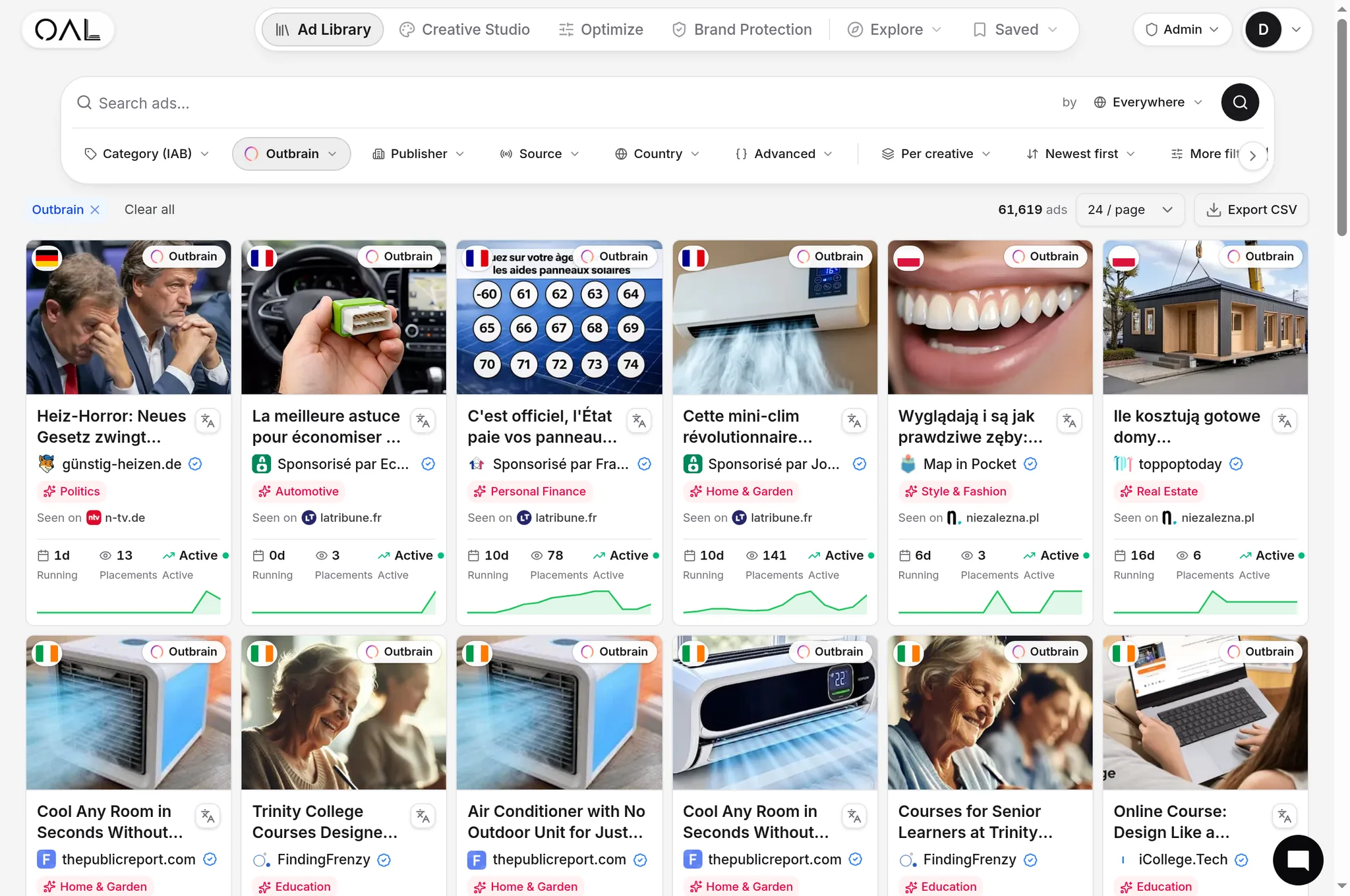
- Search your vertical and your competitors in the live Outbrain index at /spy/outbrain — the Outbrain ad spy guide is the full walkthrough.
- Filter for creatives running 3+ weeks and reverse-engineer those funnels: hook, advertorial structure, offer.
- If your category shows sustained campaigns, model your test on the survivors and fund a proper test. If your category is a ghost town, treat that as data too — either an opportunity nobody has cracked or a fit problem others already paid to discover.
Verdict: worth it — conditionally. Outbrain in 2026 is a proven channel for considered-purchase verticals and content-led funnels, with 108,000+ live creatives of advertiser spend as evidence. It is not a cheap-clicks slot machine, and it punishes underfunded tests and lazy funnels. Decide with the data, size the test off your CPA, and let your own numbers cast the final vote.